

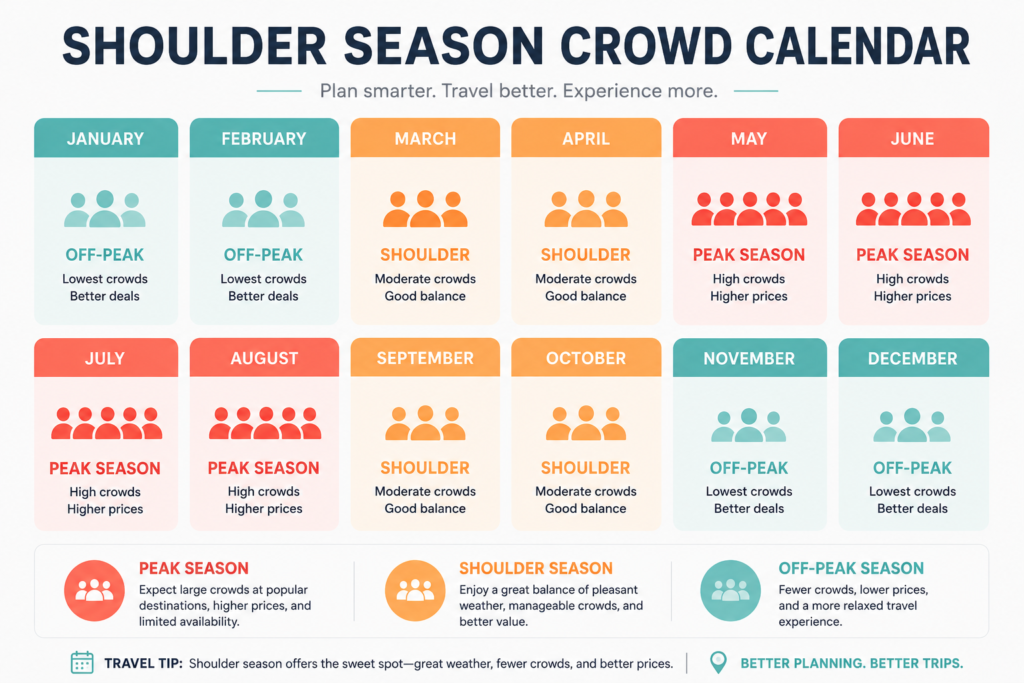
The best time to visit popular destinations is almost never peak season, and it’s not necessarily the cheapest off-season month either. A shoulder-season window can be worth comparing, but it does not guarantee a discount, fewer crowds, open attractions or favourable weather. Check quotes for your dates, local events, seasonal timetables and the activities that matter to your trip.
| Travel Window | Crowds & Infrastructure | Pricing |
|---|---|---|
| Shoulder season | Check local events, crowds and seasonal opening dates | Compare actual quotes; savings vary |
| Peak season | Overcrowded; long queues, strain on services | Premium rack rates |
| Off-season | Closed tour operators, harsher weather | Lowest cost, real trade-offs |
Three reliable shoulder windows to start with: Southern Europe runs September-October, Southeast Asia runs April-May, and Central America runs November.
Why Most “Best Time to Visit” Advice Falls Short
The typical seasonal guide draws one simple line: high season means good weather and crowds, low season means cheap prices and closed restaurants. That framework misses everything in between — the specific weeks where weather holds, crowds thin, and prices haven’t caught up to demand yet.
Pricing Moves in Spikes, Not a Smooth Curve
Tourist pricing doesn’t drift smoothly from expensive to cheap across a season. It spikes. A destination technically in its off-season can surge in price for one specific week because of a local festival, a school half-term, or a holiday cluster that booking aggregators never flag. The peak/shoulder/off-season model is the right starting framework, but only if you apply it at the week level, not the month level.
What You’re Actually Paying for in Peak Season
Peak season delivers the most predictable weather and the worst value-to-experience ratio. You pay a premium for flights and rooms, plus the privilege of queuing with everyone else who read the same “best months to visit” list. Booking platforms compound this with “great value” badges that just reflect high demand — a hotel flagged “great value” in July may simply be the least overpriced option in an overpriced week.
What Off-Season Actually Costs You
Off-season has real upside: lower base prices, shorter lines, a more local feel. The catches are just as real — reduced operating hours, closed attractions, and weather that can actively work against you. “Off-season” is a label, not a guarantee — some resort destinations keep nightly fees flat even as rack rates drop, quietly eating into the apparent savings.
Shoulder Season Windows by Region
Europe: Late April-May and September-Early October
For most of Western and Southern Europe, these two windows are the clearest shoulder seasons. Barcelona, Rome, and Amsterdam in May offer daytime temperatures within a few degrees of July highs, with accommodation rates running noticeably lower. September keeps the weather advantage while adding post-summer crowd thinning.
The micro-spike to watch for: UK half-terms in late May and late October, and German regional school breaks that stagger across states throughout the year — both inject localized demand into otherwise quiet weeks.
Southeast Asia: Coast-Dependent Timing
Southeast Asia’s shoulder timing varies by coast, which is why blanket advice fails here. On Thailand’s Gulf Coast (Koh Samui, Koh Phangan), mid-October through early November — the tail end of monsoon — is a genuine shoulder window, with hotels dropping rates sharply as occupancy lags while weather stays largely usable. The Andaman Coast (Phuket, Krabi) runs on the opposite monsoon calendar, making April-May its equivalent window. Vietnam splits further still — north and south follow different rainfall patterns entirely, so no single date applies to the whole country.
The Americas and Caribbean: Avoiding the Double-Peak Trap
The Caribbean’s off-season coincides with hurricane season, June through November. The trap: U.S. summer school holidays push domestic demand into early July regardless of hurricane risk, so the first two weeks of July see price spikes even though the calendar suggests low-cost travel. The genuine shoulder windows are May and November — hurricane risk is low or declining, school is in session, and prices reflect the actual lull.
How to Build Your Own Crowd Calendar
A crowd calendar maps demand spikes before they hit prices — the signals exist, they’re just not assembled in one place.
Start With School Holiday Schedules
UK half-terms (late May, late October), German state school breaks (staggered by region), French school zones (three zones with overlapping windows), and Japanese Golden Week (late April to early May) are the most predictable demand drivers in global tourism. Golden Week is particularly instructive: booking Tokyo for the week immediately after — arriving around May 7 or 8 — gets you nearly identical experiences at materially lower prices, just by waiting five days. The same logic applies to Silver Week in mid-September.
Layer In Local Events
Music festivals, national holidays, and religious observances create week-level demand spikes that standard seasonal guides never mention. A quick check of a destination’s public holiday calendar against its school break schedule gives you a rough crowd map for any month.
Use Flexible Departure Dates
A ±3-day departure window, visible on most flight search tools as a price calendar, is one of the most powerful tools available. A Wednesday departure versus a Friday departure in the same shoulder week can represent a 20-30% fare difference on popular routes.
Destination Dupes: Timing Arbitrage, Not Settling
Choosing a dupe destination isn’t about accepting less — it’s about timing.
- Porto instead of Lisbon in August. Lisbon’s Alfama district hits peak footfall in August; Porto’s riverside crowds thin out meaningfully over the same period, with comparable boutique hotels running noticeably cheaper. Same country, same culture, far less friction.
- Sri Lanka instead of Bali in peak summer. Bali in July is gridlocked. Sri Lanka’s southwest coast offers comparable beaches and a richer cultural itinerary, with the bonus that most summer travelers haven’t recalibrated their mental map to include it yet.
- Colombia’s Coffee Region instead of Cartagena in December. Cartagena spikes hard in December as North American travelers chase warmth. The Eje Cafetero stays relatively quiet, offers cooler mountain temperatures, and delivers an experience that’s hard to replicate anywhere else in the Americas.
Why Shoulder Season Beats True Off-Season
The cheapest time to visit isn’t always the best value. Shoulder season usually wins on the value-to-experience ratio, because the experience quality stays close to peak while the price drops well below it. True off-season often means degraded experience — closed museums, monsoon rains, skeleton-crew service — that undercuts the nominal savings on paper.
Booking Strategy: Locking In Shoulder Season Rates
Shoulder season prices don’t stay low once enough travelers catch on to the window — timing your search matters as much as picking the right season.
- Short-haul flights: book 6-8 weeks out. Far enough ahead to beat last-minute demand spikes, close enough that airlines haven’t adjusted base pricing on popularity signals.
- Long-haul flights: book 3-4 months out, and set fare alerts on at least two search tools simultaneously, since price-drop triggers vary by platform.
- Accommodation: book directly with hotels rather than through OTAs when possible — hotels have more pricing flexibility outside peak demand and would rather fill a room at a slight discount than pay OTA commission on a lower rate. Ask directly about a rate match or a complimentary upgrade; shoulder season gives the front desk genuine room to negotiate.
- Ground logistics: factor in airport transfers and local transport from the start — tourist-season taxi surcharges in some destinations apply year-round regardless of when you actually fly in.
Essential Internal Resources
These guides on Parandjah Travels cover the related planning layers:
- For sustainable, slow-travel timing: Sustainable Travel Practices
- For timing your flights around any season: Finding Flights Off Peak Season
- For destination dupes specifically: 6 Europe Travel Dupes Under $50/Day
- For choosing where to stay in any destination: Where to Stay in Major Cities on a Budget
- For event and festival-specific timing: How to Save on Festival Travel
[H2] Master Your Destination: City Budget Guides
These city guides cover exactly where to stay for less in 24 major hubs — useful for planning around any shoulder season window above:
European Budget Hubs
Madrid · Paris · Rome · Dublin · Lisbon · Budapest · Prague · Vienna · Istanbul · Amsterdam · Milan · Barcelona · Berlin
Asia-Pacific and Americas Budget Hubs
Bangkok · Tokyo · Sydney · Toronto · Singapore · Mexico City · Seoul · Buenos Aires · Cape Town · Chicago · New York
Frequently Asked Questions
Is shoulder season always cheaper than peak season?
No. Compare final accommodation quotes for the same room conditions and your actual dates; there is no universal seasonal discount. Watch for micro-spikes within shoulder season caused by school holidays or local festivals, which can temporarily push prices back toward peak-season levels.
What’s the difference between shoulder season and off-season?
Shoulder season keeps attractions open and weather largely favorable while pricing sits well below peak. True off-season often means closed museums, reduced operating hours, and harsher weather — the lower price can come with a meaningfully worse experience.
How far in advance should I book a shoulder season trip?
6-8 weeks out for short-haul flights, 3-4 months out for long-haul. This window beats last-minute demand spikes while staying early enough that airlines haven’t yet adjusted base pricing upward based on route popularity.
Which destinations have the best shoulder season value?
Southern Europe (September-October), Southeast Asia (April-May, though it varies by coast), and Central America (November) are consistently reliable. Pairing a shoulder season window with a destination dupe — like Porto instead of Lisbon, or Sri Lanka instead of Bali — compounds the savings further.
Want More Free Travel Resources?
Grab the free 2026 Travel Dupes Cheat Sheet for budget-friendly destination ideas to pair with your shoulder season timing. Subscribe at the top of parandjahtravels.com to download it instantly.
Conclusion
The best time to visit popular destinations is almost always a shoulder window — close enough to peak conditions to barely notice the difference, far enough from peak pricing to genuinely matter. Build a rough crowd calendar before you book, watch for school-holiday micro-spikes inside your target window, and lock in flights within the right lead time. The travelers who find these windows first are the ones who did the work before everyone else caught on.

Marsha Rowe is the Founder and Travel Strategist at Parandjah Travels. She uncovers high-intent travel intelligence, specializing in slow travel frameworks and sports event logistics.