

Barcelona on a budget starts with comparing a complete room quote and the journeys you will actually make. Gràcia and Eixample can both work; neither is always cheaper, quieter or more convenient. This guide adds Poble-sec and nearby alternatives to the comparison, corrects airport-ticket coverage and shows a transparent budget example.
| Base | Useful for | Check before booking |
|---|---|---|
| Gràcia | Square and neighborhood walks | Gradients, station and room noise |
| Eixample | Many central itinerary options | Which part suits your actual sights |
| Poble-sec | Montjuïc-area plans | Street gradients and evening noise |
| L’Hospitalet | Selected transport or event itineraries | Exact station and door-to-door journeys |
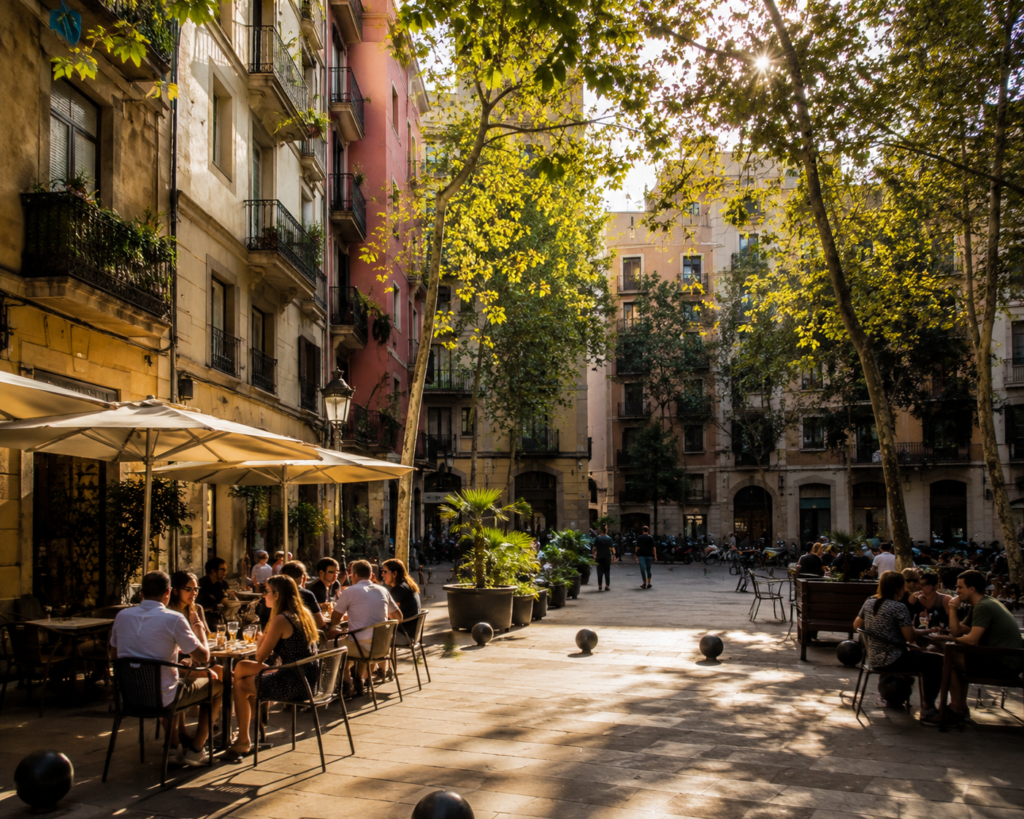
Gràcia vs. Eixample: Compare Specific Rooms
Gràcia’s squares, including Plaça del Sol and Plaça de la Vila de Gràcia, can suit a trip with time for neighborhood walks. Check gradients, stairs and the room’s exact station rather than treating the whole district as equally hilly or equally connected. Eixample is a large area with different station options and distances to sights. Compare the same room type, taxes, bathroom arrangements and cancellation terms. A lower nightly quote is only useful if it fits the places and hours on your itinerary.
Poble-sec and L’Hospitalet Deserve a Fair Comparison
Poble-sec can suit Montjuïc-area plans, but some streets involve gradients and some bars create evening noise. L’Hospitalet de Llobregat is a separate neighboring city with its own neighborhoods and useful transport connections; dismissing it as having no character or worthwhile restaurants is not a practical assessment. A room there may work for a particular rail, airport or event itinerary. Map door-to-door journeys and compare the total room saving with added fares and time before deciding.
T-casual vs. T-usual: Correct Airport Coverage
The 2026 TMB fare table lists a one-zone T-casual at €13 for ten integrated journeys and a one-zone T-usual at €22.80. T-casual does not cover entry or exit at the L9 Sud Aeroport T1 and T2 stations. In contrast, T-usual explicitly includes those airport metro stations and allows unlimited journeys for 30 consecutive days from first validation, subject to its personal identification and zone rules. You do not have to stay 30 days for the product to be worth comparing.
Compare the Full Ticket Cost, Not a Marketing Label
For ten eligible city journeys, the €13 T-casual allocates €1.30 per journey if all ten are used. With two separate €5.90 airport Metro tickets, the outlay becomes €24.80 before any support-card costs. The current one-zone T-usual at €22.80 may therefore be worth considering for that itinerary, subject to eligibility and identity requirements. Check the route and current terms for your dates; compare Hola Barcelona as well if its coverage and duration suit your plans. These products do not automatically include every airport express service.
Food, Admissions and Practical Precautions
Compare menú del día inclusions, service hours and the price of drinks or extras rather than assuming every lunch costs €12–18. Add the specific paid architecture and museum tickets you want, and check timed-entry rules before committing the rest of the day. Keep belongings secure around crowded streets, stations and attraction queues, and consult current official travel advice. A quieter-looking district is not a safety guarantee. Plan the evening route home and allow for transport changes.
Worked Barcelona Day Budget
An illustrative solo day is €90 room + €7 breakfast + €15 lunch + €22 dinner + €13 for a newly purchased one-zone T-casual + €20 admissions = €167. This counts the full ten-journey ticket on the purchase day, with some journeys potentially used later. Room, food and admission amounts are planning allowances, not live quotes. Use a complete tax-inclusive room total and add airport travel and any support-card cost. Replacing the T-casual with the cited €22.80 T-usual makes this example €176.80 before those extras.
Essential Internal Resources
Before you finalize your Barcelona trip, these guides cover the planning layers around it:
- For timing flights around seasonal pricing: Finding Flights Off Peak Season
- For protecting your trip financially: Travel Insurance Comparison for Budget Trips
- For eating well without overspending: How to Save Money on Food While Traveling
- For the full trip-planning framework: How to Plan a Trip on a Budget
More European Budget Guides
Combining Barcelona with a longer European trip? These guides cover costs and planning for other cities in the region:
Paris · Madrid · Rome · Prague · Berlin · Amsterdam · Lisbon · Vienna · Budapest · Milan · Dublin · Istanbul
Frequently Asked Questions
Is Gràcia or Eixample better for a budget trip to Barcelona?
Compare actual room quotes and routes. Gràcia suits neighborhood walks; Eixample offers many different bases. Neither guarantees the cheaper or more convenient stay.
What transit card should I buy in Barcelona?
Compare ride counts, airport route and support costs. T-casual excludes the L9 Sud airport stations; T-usual includes them and is personal, with identification requirements.
Is it worth staying outside Barcelona to save money?
It can be. Compare a specific connected property with your room saving, extra fares and time. L’Hospitalet should not be dismissed as unsuitable for every itinerary.
What’s the best budget food option in Barcelona?
Compare the complete menú del día with the dishes you would otherwise order, including drinks, extras and service hours. Check current menus rather than relying on a fixed price range.
Want More Free Travel Resources?
Explore more accommodation, transport and meal-planning guides at Par & Jah Travels.
Conclusion
Choose Barcelona accommodation by its complete price and your actual routes. Compare T-casual, T-usual and visitor products with airport coverage included, then add the paid sights and meals you want. That gives you a concrete decision without assuming one district or card always wins.

Marsha Rowe is the Founder and Travel Strategist at Parandjah Travels. She uncovers high-intent travel intelligence, specializing in slow travel frameworks and sports event logistics.