

The best value travel insurance for budget trips is a standalone policy from a digital-first provider like SafetyWing or Heymondo, running roughly $1 to $4 a day. Your rewards credit card covers a short domestic weekend trip fine, but it fails on multi-destination international runs — it excludes emergency medical evacuation and adventure activity liability entirely. Skip the expensive add-ons and look for a plan with at least $100,000 in emergency medical coverage and a separately listed evacuation limit.
Here’s how I break down pricing by trip length, what each coverage tier actually includes, and the claim traps that catch budget travelers most often.
Why Going Uninsured Doesn’t Actually Save You Money
If you’re running a tight $30-40 daily budget with no financial cushion, a single $15,000 emergency medical evacuation bill ends the trip instantly. A standalone policy at $1-4 a day is structurally cheaper than absorbing any one bad medical or transit outcome out of pocket — the math only works in insurance’s favor once you actually need it, but by then it’s too late to buy.
Gear Theft and Flight Delays Add Up Fast
A stolen laptop or camera mid-trip is a real financial hit, especially on a 6-week run where replacing it isn’t a quick fix. Budget carriers also rarely offer automatic rebooking when they cancel a flight, which means unplanned accommodation costs on top of the missed connection. These risks scale fast the closer you run your finances to the margin.
Do You Need Standalone Coverage If You Already Travel Cheap?
Yes, in most cases. Standard domestic health insurance typically has zero reach once you leave your home country, or caps international coverage at a level that’s effectively useless. Standalone international plans exist specifically to cover the gap domestic health networks leave open. A quick weekend trip to a destination with a verified reciprocal healthcare agreement might only need a bare-bones medical policy — but an extended multi-country run with electronics and adventure activities genuinely needs a dedicated plan.
Pricing by Trip Length
Trip duration is the single biggest lever in what you’ll actually pay.
Weekend City Hops (1-7 Days)
Short-trip policies offer strong absolute value, often under $15-25 total for basic medical coverage. The daily cost looks high when you divide it out, but the upfront total stays low. If your credit card already covers flight delays, a basic medical-only top-up is usually all you need here.
Two-Week Backpacker Runs (8-21 Days)
This is the core pricing bracket for most standard backpacker plans. An emergency-medical-only policy for a traveler under 35 typically runs $1-4 a day depending on coverage limits. Adding cancellation coverage adds another $2-5 a day. For most independent travelers, this mid-tier is the genuine sweet spot between cost and protection.
Multi-Month Slow Travel (30+ Days)
Single-trip policies get expensive fast past the 60-day mark. Annual multi-trip policies or subscription-style nomad plans deliver noticeably better per-day value for anything over 45 days, and they remove the requirement of locking in a fixed return date before you even leave.
Age matters here too — premiums stay low under 35 but climb meaningfully past 50, and pre-existing conditions can trigger surcharges or exclusions if you don’t read the policy carefully. This makes a careful comparison genuinely worth the time for older slow travelers or anyone managing a chronic condition abroad.
The Three Coverage Tiers
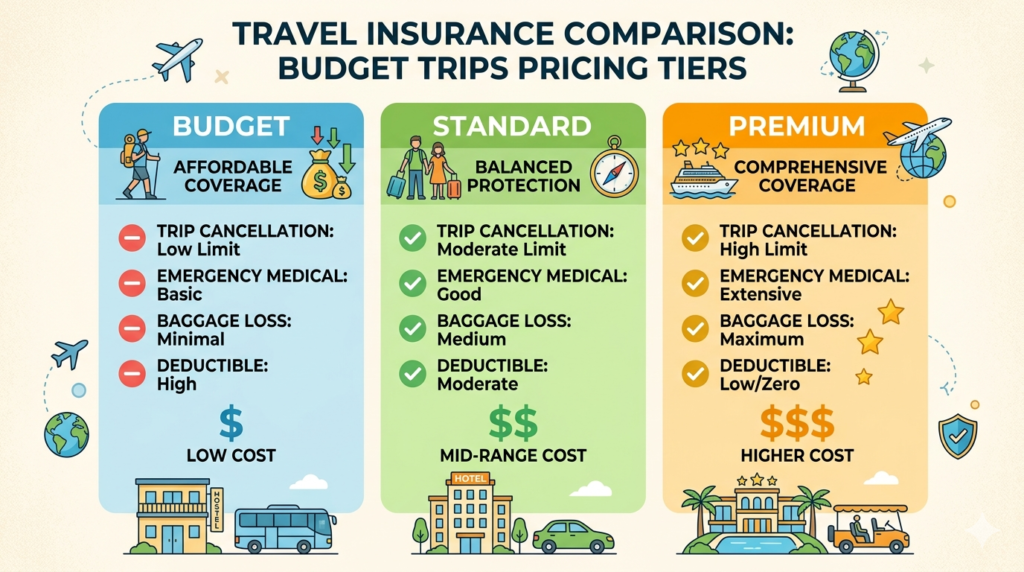
Tier 1 — Bare-Bones: Emergency hospitalization, medical treatment, and evacuation only. No cancellation, gear, or delay protection. This is your safety floor against catastrophic financial exposure, and it’s the lowest-cost option for shoulder-season trips through major urban hubs.
Tier 2 — Mid-Range: Adds trip cancellation, route interruption, and flight delay coverage. The right upgrade if your itinerary involves non-refundable costs, complex connections, or long-haul flights on budget airlines.
Tier 3 — Full Coverage: Bundles everything in Tier 2 with riders for high-value gear theft and adventure sports — motorbike riding, trekking, scuba diving. Worth it if you’re renting a scooter in Vietnam or diving in the Philippines; check that your specific gear value and diving depth are actually covered before assuming they are.
Four Non-Negotiables, Regardless of Tier
Whatever provider or tier you choose, the policy needs to clear these four bars:
- Emergency medical minimum of $100,000, ideally scaling to $250,000+
- Evacuation listed as a separate line item, never folded into the general medical cap
- 24/7 live phone assistance, not just a slow support email
- Zero country exclusions for your actual destinations, especially if you’re planning overland border crossings
The cheapest premium on paper is rarely the safest value in an actual emergency. A slow claims process or an unstaffed support line leaves you exposed exactly when you need help most — cross-reference real user reviews against the policy limits, not just the price.
Five Claims Traps That Catch Budget Travelers

A policy only matters if your claim actually gets approved. Watch for these:
- Missing the police report window — theft claims usually require a formal police report filed within 24-48 hours, or the claim gets denied automatically.
- Booking replacement travel before calling your insurer — call the emergency line first, or the company may reject the expense as unauthorized.
- Pre-existing condition exclusions — adjusters review medical history going back 1-5 years, so check this before you assume you’re covered.
- Weak purchase receipts — keep cloud-backed digital copies of receipts for laptops, phones, and cameras to prove their value if you need to claim.
- Unlisted adventure activities — if motorbike riding, paragliding, or deep scuba diving isn’t explicitly named in the policy text, assume it’s excluded.
Why Your Credit Card Isn’t Enough
Built-in credit card travel insurance works fine for a low-cost domestic weekend with no adventure activities and no high-value gear. It looks solid on paper for a European trip too — until you cross into a non-EU country. Credit card coverage typically excludes long-distance medical evacuation, caps out-of-country limits quickly outside the EU, and denies payouts for higher-risk adventure activities entirely.
A standalone plan starting under $2 a day from a digital-first provider closes that gap without blowing your daily budget. Know exactly where your credit card’s safety net stops — that’s the point where a standalone policy needs to take over.
Matching Your Trip Type to a Coverage Tier
| Trip Type | Minimum Coverage Needed | Recommended Tier |
|---|---|---|
| Weekend city hop | Credit card baseline + emergency medical top-up | Bare-Bones |
| 2-week backpacker run | $250,000 medical + separate evacuation + flight delay | Mid-Range |
| 3+ month slow travel | Annual multi-trip or long-stay plan, high-limit medical + evacuation | Mid-Range to Full |
| Digital nomad, continuous travel | Subscription plan with gear riders, flexible end date | Full, Nomad-Specific |
| Adventure-heavy itinerary | Action-sports rider + full medical + high-limit gear theft | Full Coverage |
Emergency medical and evacuation coverage are non-negotiable on any international trip outside a verified reciprocal-healthcare zone. Everything else scales up or down with your actual risk and budget.
Essential Internal Resources
These guides on Parandjah Travels cover the related planning layers:
- For destination dupes specifically: 6 Europe Travel Dupes Under $50/Day
- For avoiding crowds at major destinations: Day Trip Alternatives to Popular Tourist Sites
- For timing your flights around this trip: Finding Flights Off Peak Season
- For eating well on a budget once you land: Food Tour Alternatives for Local Eating Travel
- For Balkan-specific slow travel: Balkan Budget Rotation Guide
Master Your Destination: City Budget Guides
Pair your insurance plan with a smart, affordable home base. These city guides cover exactly where to stay for less in 24 major hubs:
European Budget Hubs
Madrid · Paris · Rome · Dublin · Lisbon · Budapest · Prague · Vienna · Istanbul · Amsterdam · Milan · Barcelona · Berlin
Asia-Pacific and Americas Budget Hubs
Bangkok · Tokyo · Sydney · Toronto · Singapore · Mexico City · Seoul · Buenos Aires · Cape Town · Chicago · New York
Frequently Asked Questions
Is travel insurance really necessary for a short budget trip?
For domestic or low-risk weekend trips, your credit card’s built-in coverage is often genuinely sufficient. Once you’re traveling internationally for more than a few days, a basic standalone medical policy closes gaps that credit cards typically don’t cover, like evacuation and out-of-network treatment.
How much does budget travel insurance actually cost per day?
Bare-bones emergency-medical-only coverage for a traveler under 35 typically runs $1 to $4 a day. Adding cancellation and delay protection adds another $2 to $5 a day. Multi-month nomad subscription plans usually offer better per-day value than booking repeated short-term policies.
Does my credit card’s travel insurance cover international medical evacuation?
Usually not, or only at very limited caps. Most credit card travel benefits are designed for short domestic or EU-zone trips and exclude long-distance medical evacuation, which is exactly the coverage that matters most on a serious international medical emergency.
What’s the most common reason a travel insurance claim gets denied?
Missing required documentation deadlines is the most frequent cause — particularly theft claims that aren’t backed by a police report filed within 24 to 48 hours of the incident. Booking replacement travel before contacting your insurer’s emergency line is the second most common mistake.
Want More Free Travel Resources?
Grab the free 2026 Travel Dupes Cheat Sheet for budget-friendly destination ideas to plan your next insured trip around. Subscribe at the top of parandjahtravels.com to download it instantly.
Conclusion
The cheapest insurance policy and the right insurance policy are rarely the same thing. Match your coverage tier to your actual trip — bare-bones for a short low-risk hop, mid-range for a multi-leg backpacker run, full coverage if gear or adventure sports are involved — and confirm the four non-negotiables before you buy. A few dollars a day is a small price for not having a single bad week end your entire trip.

Marsha Rowe is the Founder and Travel Strategist at Parandjah Travels. She uncovers high-intent travel intelligence, specializing in slow travel frameworks and sports event logistics.