

Useful flight-saving strategies begin with flexible comparisons and a complete price, not a universal booking day or a guaranteed discount. This guide explains how to track fares, test dates and airports, and compare booking conditions without turning a lower headline price into a more expensive journey.
Compare Complete Fares for the Same Trip
Set a maximum amount you can spend and record the itinerary that amount must cover: passengers, dates, airports, bags and essential timing. Compare the final payable price for the same requirements. A basic fare may exclude an overhead bag, while another fare includes the item you need. Add airport transfers and any overnight accommodation caused by an early departure or late arrival. Keep optional seat and meal choices separate so you can see which extras you actually intend to buy.
Use Date Grids and Alerts Correctly
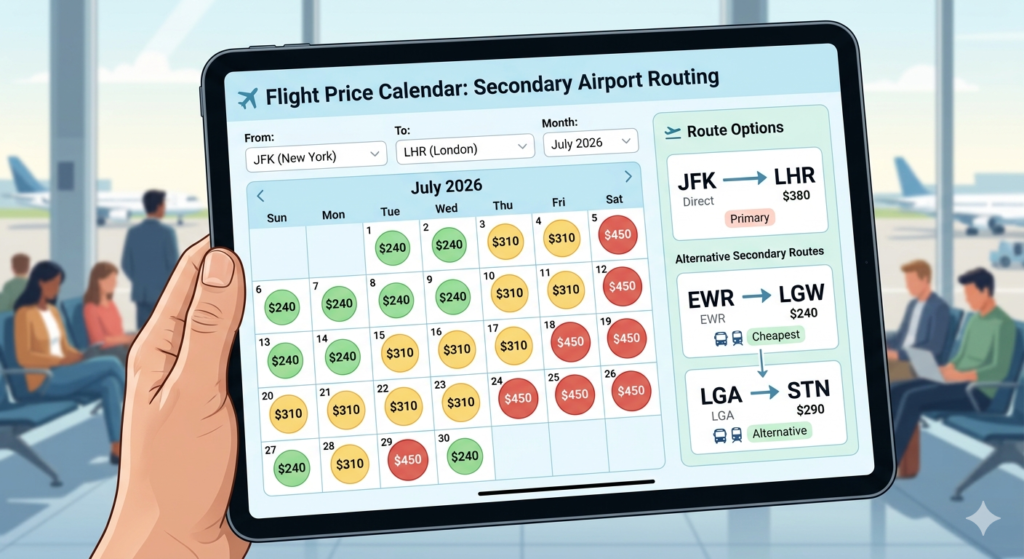
Google Flights date grids and price graphs compare fares for alternative travel dates; the graph is not simply a record of prices you personally watched in past months. Use filters to keep the comparisons practical. Price tracking supports specific dates or Any dates and can email significant changes. Forecasts are estimates, not promises. An alert is a reason to review an option, not an instruction to buy. There is no booking window or weekday that guarantees the lowest price for every route.
Make Nearby Airports Earn Their Place
Compare the exact arrival airport, final destination and transfer available at your arrival time. In a hypothetical comparison, a €160 flight plus €45 transfer totals €205, while a €190 flight plus €10 transfer totals €200. The cheaper flight is €5 more expensive overall. Include the return leg too. A distant airport may still be worthwhile when the full saving is meaningful to you, but an airport name associated with a city does not establish a short journey to your room.
Compare Open-Jaw and Separate-Ticket Options
For a trip visiting two cities, compare returning from the second city with the cost and time of backtracking to the first. Use multi-city search and compare final prices rather than assuming airlines price every leg independently. Separate tickets or self-transfer options require additional checks: baggage collection, terminal or airport changes, entry requirements and what happens after a delay. Search tools can show a low fare without making all connections protected. Confirm the actual booking arrangement with the seller before paying.
Do Not Build a Trip Around Skipping a Flight
Hidden-city ticketing means buying an itinerary while intending to stop at an intermediate airport. It can breach the operating airline’s conditions. American Airlines explicitly prohibits this practice and lists potential consequences for unused tickets and travel. A cabin bag can also be placed in the hold, and operational changes may alter the routing. Carry-on packing or booking one way does not remove these issues. Price an itinerary you intend to complete rather than treating skipped segments as a dependable savings method.
Check Award and Unusually Low Fare Conditions
If you already have usable points, compare the points required, taxes, charges, availability and cancellation terms with the cash ticket. Do not transfer points solely because a general guide promises business-class value; confirm the actual award and transfer conditions first. An unusually low fare may be an error rather than a lasting offer. Do not assume that waiting 24 or 48 hours makes it immune from cancellation, and avoid adding nonrefundable arrangements on that assumption.
Understand the Seller and Any Cancellation Window
Identify whether you are buying from the airline or an agency and who handles changes. For relevant US bookings, DOT guidance explains the airline 24-hour hold-or-refund requirement when purchase is at least seven days before departure. The rule does not require both options and does not apply to third-party agency bookings in the same way. Check your seller’s actual terms. Read restrictions before payment and save the fare conditions, booking reference and confirmation.
Use a Repeatable Decision Rather Than a Browser Trick
Choose dates, check realistic alternatives, compare complete totals and book an option that fits the budget and itinerary. Do not rely on incognito mode, cookie clearing or a country-switching tactic to deliver a fare saving; verify any price difference on identical dates, currency and terms. Search coverage and availability can differ between tools. Recheck the seller’s checkout total, passenger details and baggage allowance before purchase, then verify that the confirmation matches the itinerary you chose.
Essential Internal Resources
These guides on Parandjah Travels cover the related planning layers:
- For the full seasonal timing strategy: Best Time to Visit Popular Destinations
- For destination dupes specifically: 6 Europe Travel Dupes Under $50/Day
- For event and festival-specific flight strategy: How to Save on Festival Travel
- For the complete trip-planning framework: How to Plan a Trip on a Budget
- For finding flights off-peak specifically: Finding Flights Off Peak Season
Master Your Destination: City Budget Guides
Once your flight is locked in, these city guides cover exactly where to stay for less in 24 major hubs:
European Budget Hubs
Madrid · Paris · Rome · Dublin · Lisbon · Budapest · Prague · Vienna · Istanbul · Amsterdam · Milan · Barcelona · Berlin
Asia-Pacific and Americas Budget Hubs
Bangkok · Tokyo · Sydney · Toronto · Singapore · Mexico City · Seoul · Buenos Aires · Cape Town · Chicago · New York
Frequently Asked Questions
Does incognito mode actually lower flight prices?
Do not rely on it for savings. Compare identical itinerary and fare conditions and verify the checkout total; a private browsing window does not guarantee a lower fare.
What’s the best tool for tracking flight prices?
Choose a tracker that covers your route and useful dates. Google Flights offers specific-date and Any dates tracking; forecasts and alerts do not guarantee the cheapest future price.
Is hidden-city ticketing legal?
It can breach airline conditions and create ticket, baggage and rerouting problems. American Airlines explicitly prohibits it. This guide does not treat skipping a segment as a dependable booking strategy.
How far in advance should I book an international flight?
Start in time to compare routes and meet your planning needs. There is no universal cheapest window. Judge an acceptable fare by its complete cost and conditions rather than a fixed number of months.
Want More Free Travel Resources?
Explore more practical accommodation, transport and packing guides at Par & Jah Travels.
Conclusion
Compare the full fare, realistic dates and complete airport journeys. Alerts can reduce repeated searching, but clear booking conditions and an itinerary you can actually use are what make a lower price useful.

Marsha Rowe is the Founder and Travel Strategist at Parandjah Travels. She uncovers high-intent travel intelligence, specializing in slow travel frameworks and sports event logistics.