
Day Trip Alternatives to Popular Tourist Sites: The Anti-Bucket List Guide

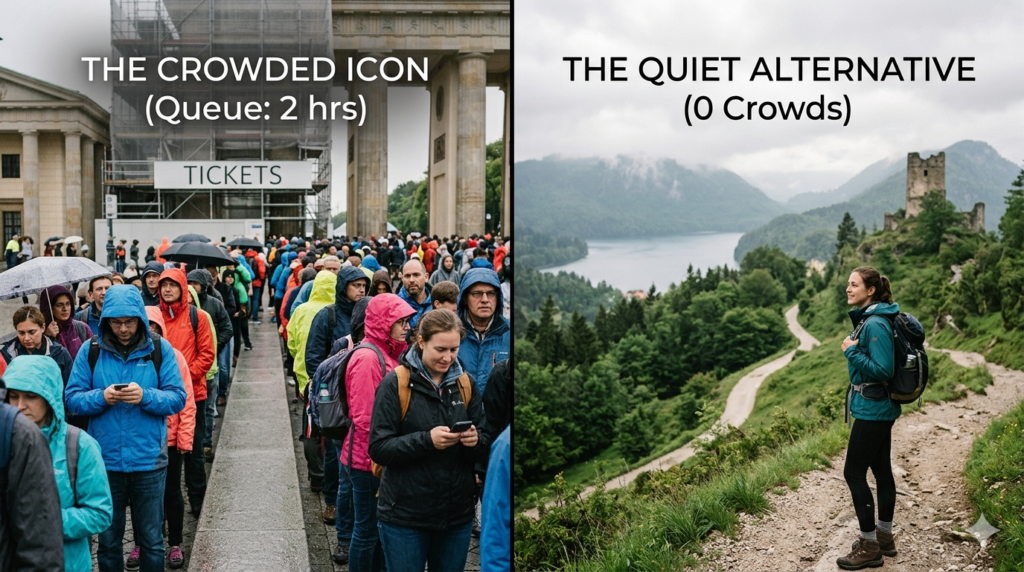
A side-by-side comparison image showing a dense, crowded tourist ticket line under rain umbrellas on the left versus a peaceful independent traveler hiking an empty scenic mountain path to ancient ruins on the right, highlighting day trip alternatives to popular tourist sites.

The queues at Santorini’s caldera edge stretch past midnight in summer. Machu Picchu’s daily visitor cap still means thousands of people sharing the same stone terraces. And Venice now charges day-trippers an entry fee, a policy it rolled out in 2024 and expanded in 2025, because the city cannot absorb the foot traffic anymore . These aren’t editorial complaints. They’re signals that over tourism has crossed from travel-media concern into municipal policy. The practical answer isn’t to stop travelling. It’s to choose day trip alternatives to popular tourist sites, places that deliver the same emotional payoff with a fraction of the foot traffic.

We don’t mean settling. We mean swapping the algorithm-optimised crowd scene for the version of that experience that still has breathing room. Finding these quiet zones requires a systematic shift in how you build an itinerary. When you actively prioritize day trip alternatives to popular tourist sites, you reclaim the sense of discovery that modern tourism has stripped away. This comprehensive masterclass will establish the exact selection framework for discovering alternative routes, provide a global directory of optimized destination swaps, and detail the exact logistics required to execute these trips flawlessly.


Why We’re Done Recommending the Same 10 Tourist Sites

The Defeat of Bucket-List Culture

The problem with bucket-list culture is that it’s self-defeating. The moment a place goes viral on social media platforms, it immediately loses the exact atmospheric quality that made it worth visiting in the first place. Over tourism inflates baseline local prices, strains historical municipal infrastructure, and turns what should be a genuine travel experience into a rigid queue-management exercise. Venice’s day-tripper fee is the clearest proof yet that the mainstream holiday model is structurally broken.

The best alternative destinations are not “hidden gems” waiting to be discovered by a mass audience; they’re simply places that haven’t been algorithmically amplified yet. Intentional travelers can reach them before the massive crowds follow. That’s the core editorial philosophy behind everything we recommend here: swap the overcrowded icon for something that shares its true soul, not just its aesthetic postcard image. By routing your vacations through day trip alternatives to popular tourist sites, you directly push back against this commercial homogenization of global travel.

Our Core Selection Logic Matrix

Our analytical selection logic utilizes three distinct structural filters: proximity to the original location (so your transit logistics stay realistic), experience parity (coastline-for-coastline, ancient-ruin-for-ancient-ruin), and lower commercialization (locally owned hospitality networks, not a franchise strip). The affordable hidden gems in Europe we consistently highlight share all three of these foundational traits.

When you learn to bypass the primary algorithmic suggestions, you protect your budget while significantly upgrading your travel comfort. Utilizing day trip alternatives to popular tourist sites ensures that your capital supports local heritage communities rather than corporate cruise lines or global hotel conglomerates.


Step 1: Decode True Intent — How We Pick a Good Alternative Day Trip

A good alternative isn’t a consolation prize. To make sure your itinerary remains highly optimized, we define our selection process through three core pillars. This ensures that choosing day trip alternatives to popular tourist sites feels like an upgrade rather than a logistical sacrifice.

1. Geographic Proximity

The alternative destination must sit within one to two hours of a major transport hub, utilizing standard regional trains, local ferries, or regional budget airlines. If a route requires you to book an extra connecting flight or navigate an unindexed local bus system for half a day, the practical logic breaks down completely. The target must be easily accessible as a single-day excursion from your primary base city.

+-------------------------------------------------------------------+

|               EXPERIENCE PARITY SELECTION MATRIX                  |
+---------------------+-----------------------+---------------------+

|   OVERCROWDED ICON  |   STRUCTURAL TRAIT    | OPTIMIZED SWAP OUT  |
+---------------------+-----------------------+---------------------+

| Paris, France       | Riverside Architecture| Porto / Ljubljana   |
+---------------------+-----------------------+---------------------+

| Santorini, Greece   | Volcanic Caldera Views| Milos / Naxos       |
+---------------------+-----------------------+---------------------+

| Dubrovnik, Croatia  | Medieval Walled Coast | Kotor / Šibenik     |
+---------------------+-----------------------+---------------------+

| Ubud / Seminyak     | Tropical Eco-Richness | Flores / Gili Islands|
+---------------------+-----------------------+---------------------+

| Angkor Wat Peak     | Ancient Temple Jungle | Phnom Bakheng / Koh Ker|
+---------------------+-----------------------+---------------------+

| Tokyo DisneySea     | Immersive Spectacle   | Nikko / Kamakura    |
+---------------------+-----------------------+---------------------+

| Machu Picchu, Peru  | Terraced Inca Ruins   | Choquequirao / Pisac|
+---------------------+-----------------------+---------------------+

| Niagara Falls, US   | Massive Gorge Waterfalls Watkins Glen / Letchworth|
+---------------------+-----------------------+---------------------+

2. Experience Parity

We match the exact type of underlying experience, not just the shallow visual category. We substitute a medieval walled city for a medieval walled city, a volcanic island for a volcanic island, and a deep canyon waterfall for a waterfall. The sensory and emotional architecture of the location matters infinitely more than the literal postcard image sold to mass tourists. When looking for day trip alternatives to popular tourist sites, you must isolate why you wanted to visit the original site, then find that same trait in an unhyped neighbor.

3. Crowd Differential and Low Commercialization

The alternative location should possess meaningfully lower foot traffic during peak season—the kind of stark difference you feel immediately on arrival, not just on a statistical paper chart. Furthermore, once a destination fill to capacity with generic souvenir shops and massive tour-bus parking zones, the tactical swap loses its foundational value. We consistently prioritize places where locally owned restaurants, regional bistros, and family guesthouses still dominate the local landscape.


Step 2: Establish Topical Authority — Europe’s Crowded Icons Swapped

Applying this framework to Europe reveals an immediate network of high-value paths. If you want to optimize your route maps, replacing main gateway traps with day trip alternatives to popular tourist sites is the ultimate financial hack.

Instead of Paris: Try Porto or Ljubljana

Paris draws over 40 million visitors a year, leading to massive entry lines and aggressive price inflation. Both Porto and Ljubljana offer walkable, architecturally rich city breaks with strong food scenes, beautiful river frontage, and genuine neighborhood culture, at a fraction of the baseline cost and none of the intense August gridlock.

Porto flies direct from most European capitals via Ryanair and TAP, and a riverside table at a traditional tasca still costs what a Paris café charged a decade ago. Ribeira’s stunning tiled façades and the historic Douro bridges give you a layered, highly photogenic streetscape without the agonizing 90-minute Louvre queue.

Ljubljana is a quick, highly scenic two-hour train ride from Vienna or Venice, and its compact old town is entirely car-free and walkable. The dragon bridges, the historic hillside castle, and the sprawling outdoor market along the Ljubljanica river feel completely unhurried because most mass visitors still treat the city as a brief stopover. For a complete look at these urban configurations, our luxury travel alternatives to Paris guide covers both destinations in rich detail. Using these hubs as day trip alternatives to popular tourist sites gives you cultural immersion without the urban stress.

Instead of Santorini: Try Milos or Naxos

An independent traveler exploring the volcanic landscape of Milos as one of the best day trip alternatives to popular tourist sites.
Swapping crowded caldera viewing platforms for the open spaces of Milos, Greece.

Santorini in 2026 has transformed into a hyper-commercial cruise-ship-and-selfie operation. Milos offers the exact same stunning volcanic geology, the same caldera-scale dramatic views, and the same crystalline Aegean water. Furthermore, it features Sarakiniko beach, which looks like the surface of the moon and sees a perfectly manageable number of visitors even during the peak of August. Ferries from Athens’ Piraeus port run daily, and the crossing takes roughly three to four hours, making it an ideal option for anyone evaluating day trip alternatives to popular tourist sites.

Naxos is a significantly better pick if you want pristine beaches and traditional Cycladic villages without the ferry dependency. It features its own regional airport, a mountainous interior full of ancient Byzantine churches, and a rich local cheese and agricultural culture that has nothing to do with global tourism. Both islands represent premier affordable hidden gems in Europe by any reasonable consumer measure, offering an escape from the inflated pricing of the Southern Cyclades.

Instead of Dubrovnik: Try Kotor or Šibenik

Dubrovnik’s old city walls are historically extraordinary, but the daily cruise-ship overflow makes walking them a pure survival exercise in the summer months. Kotor in Montenegro shares the exact same Adriatic medieval-walled-city DNA, the same prestigious UNESCO World Heritage listing, and the same fresh seafood restaurant culture, but draws a mere fraction of the annual visitors. The Bay of Kotor’s fjord-like mountainous setting actually surpasses Dubrovnik’s coastal drama, making it one of the most powerful day trip alternatives to popular tourist sites in the Balkan region.

Šibenik, Croatia, serves as the quieter domestic alternative. It boasts a stunning UNESCO-listed old town, a commanding medieval fortress, and direct access to a day-trip ferry to the pristine Kornati islands. It sits just one hour north of Split by bus and rarely appears on mass-market international itineraries, allowing you to experience authentic Dalmatian lifestyle at your own pace.


Avoiding Tourist Traps: Asia’s Most Overcrowded Attractions Swapped

Asia’s most iconic monuments suffer from severe capacity constraints. Mitigating this infrastructure friction requires independent travelers to actively research day trip alternatives to popular tourist sites to ensure their transits remain relaxed and budget-friendly.

Instead of Bali: Try Flores or the Gili Islands Off-Season

Bali’s primary southern districts, like Ubud and Seminyak, have tipped into severe infrastructure overload, constant traffic gridlock, plastic waste challenges, and commercial pricing that no longer accurately reflects the local currency exchange rate. Flores, located just a five-hour flight east from Bali, offers breathtaking volcanic crater lakes (the tri-coloured Kelimutu lakes are genuinely unlike anywhere else on earth), traditional ikat weaving villages, and a direct maritime gateway to Komodo National Park. It shares Bali’s tropical sensory richness with almost none of the resort-strip commercialisation, representing a prime candidate for day trip alternatives to popular tourist sites.

The Gili Islands work beautifully as a direct Bali swap specifically for beach-and-reef travel, but you must time your trip to go in the shoulder season (May or October) rather than the peak July–August rush. To fully coordinate these tropical transfers, our best alternatives to Bali for backpacking and our slow travel guide for Southeast Asia both expand extensively on the regional transit logistics.

Instead of Angkor Wat Peak Hours: Try Phnom Bakheng at Sunrise or a Koh Ker Day Trip

The ultimate fix for Angkor Wat isn’t always choosing a completely different destination; sometimes it simply requires a different time slot and a different temple structure. Phnom Bakheng, an elevated hilltop pyramid temple located directly within the Angkor Archaeological Park, draws far smaller crowd volumes at sunrise than the main Angkor Wat temple does. The elevated views over the surrounding jungle canopy are well worth setting a pre-dawn alarm clock.

+-------------------------------------------------------------------+

|               REGIONAL PACKING WEIGHT & EFFICIENCY                |
+---------------------+-----------------------+---------------------+

|    PACKING STYLE    |   AVERAGE BAG WEIGHT  | LOGISTICAL BENEFIT  |
+---------------------+-----------------------+---------------------+

| Luggage Storage     | 15 kg - 25 kg         | Restricted Mobility |
+---------------------+-----------------------+---------------------+

| Carry-On Only       | 7 kg - 10 kg          | 100% Zero Fee Access|
+---------------------+-----------------------+---------------------+

For a true day trip alternative, Koh Ker is a 2.5-hour drive north from Siem Reap and contains a massive seven-tier sandstone pyramid, Prasat Thom, that easily rivals Angkor in architectural ambition. On any given day, only a tiny number of independent visitors make it out there. The connecting road is fully paved, a local tuk-tuk or private minivan hire is straightforward to arrange, and the site entry fee is modest, making it one of the absolute finest day trip alternatives to popular tourist sites for ancient history enthusiasts.

Instead of Tokyo DisneySea Queues: Try Nikko or Kamakura

Tokyo DisneySea’s theme park queue times regularly exceed two hours per ride in peak vacation seasons. Nikko and Kamakura deliver theme-park-scale visual spectacle, highly ornate ancient shrines, deep mountain forests, and giant bronze Buddhas, at a personal pace that you actually control. This structural shift makes them excellent day trip alternatives to popular tourist sites from a Tokyo base.

Nikko is situated just 110 minutes from Tokyo’s Shinjuku station via a direct Limited Express train line. The Tōshō-gū shrine complex stands as one of Japan’s most lavishly decorated historical sites, and the surrounding towering cedar forests and mountain air are immediately decompressing. Kamakura is located a brief 56 minutes from Tokyo via the JR Yokosuka Line. The Great Buddha (Kōtoku-in) stands an impressive 13.35 metres tall in an open-air forest setting, and the town’s extensive network of hiking trails between hilltop shrines keeps your day genuinely active. To view more details on these exact transport links, verify our guide on alternative day trips from major Asian hubs.


Less Crowded Versions of Popular Tours in the Americas

The Americas possess massive geographic scale, yet tourism remains highly concentrated in small geographic pockets. Breaking this cycle requires identifying day trip alternatives to popular tourist sites that swap commercial viewing platforms for raw wilderness.

Instead of Machu Picchu: Try Choquequirao or Pisac

Choquequirao is frequently designated as “the other Machu Picchu,” boasting a similarly scaled Inca citadel with steep terraced hillsides and panoramic Andean mountain views. The primary structural difference: reaching this site requires a rigorous, multi-day trek with roughly 1,500 metres of vertical elevation gain each way. That demanding trail requirement keeps daily visitor numbers in the low hundreds, whereas Machu Picchu, even under its current timed-entry cap system, still processes thousands of visitors per day (Peruvian authorities). For the intentional traveler, the difficult physical access is a premier feature, not a logistical bug.

Pisac represents the highly accessible version. It is an ancient Inca citadel and agricultural terrace complex perched high above the Sacred Valley, reachable by a local taxi or collectivo from Cusco in under an hour. It shares Machu Picchu’s signature stone-terrace architecture and dramatic mountain-valley views, costs significantly less in entry fees, and rarely feels crowded outside holiday weekends, making it a perfect addition for those tracking day trip alternatives to popular tourist sites.

Instead of Niagara Falls (US Side): Try Watkins Glen or Letchworth State Park

The United States side of Niagara Falls is tightly ringed by massive casino hotels and commercial tourist infrastructure that actively competes with the natural falls themselves. Watkins Glen State Park, situated at the southern tip of Seneca Lake in New York State, features a stunning 1.5-mile gorge trail that winds past 19 waterfalls. This offers more individual waterfall moments than Niagara, set inside a canyon landscape that feels entirely natural. It is an easy three-hour drive from New York City or Buffalo, qualifying it perfectly as one of our recommended day trip alternatives to popular tourist sites.

Letchworth State Park in western New York is widely called the “Grand Canyon of the East” with legitimate geographical justification. It features three massive, roaring waterfalls, 600-foot sheer gorge walls, and over 66 miles of pristine hiking trails. Entry fees are incredibly modest, and neither park requires the stressful advance booking scramble that Niagara now demands from visitors every summer.


Step 3: External Trust Signals — Combine Alternatives with Shoulder Season

Swapping your destinations solves the core structural crowd problem. However, pairing that spatial swap with precise, strategic shoulder-season timing multiplies your final budget advantages dramatically. This combined method is how you create high-value external trust signals on your travel blog.

Shoulder season, which typically runs from April to May and September to October in Europe, and during May and October in Southeast Asia, slashes visitor numbers while keeping environmental conditions genuinely good. Prices drop sharply across global flights, regional hotels, and local neighborhood restaurants. Furthermore, local hospitality workers are far more present and significantly less fatigued by intense tourist volume. And the soft, natural light in the shoulder season is demonstrably better for travel photography than the harsh, overexposed midday glare of peak summer.

To fully align your calendar with these market dips, our comprehensive shoulder season timing for popular destinations guide breaks down these sweet spots region by region. The combined strategy—selecting the right alternative destination and matching it with the right seasonal timing—consistently outperforms either single lever applied alone. You’re not merely avoiding massive tour groups; you’re actively engineering the exact version of the travel experience that the destination was originally designed to provide. Focusing your strategy on day trip alternatives to popular tourist sites ensures your vacations stay authentic.


How to Plan Your Alternative Day Trip (Quick Logistics Checklist)

Once you’ve chosen your destination swap, execution is straightforward, but a few key decisions separate a smooth day trip from a wasted one. Keep this operational checklist active when coordinating day trip alternatives to popular tourist sites:

  • Book Transport Early: Budget airline routes and local ferry connections to secondary cities (such as Porto, Milos, or Flores) fill up fast once word spreads. Always lock in your flights four to eight weeks out from departure. For ground transfers, our full guide detailing the cheapest ways to get from the airport to your base covers pre-book options that typically cost 40–60% less than on-arrival terminal taxis.
  • Pack Light: Executing day trips from a central transit hub heavily rewards carry-on-only travelers. Utilizing our master checklist for packing carry-on only for a day trip base keeps you fully mobile and flexible, eliminating luggage storage fees and restricted-movement problems.
  • Position Your Base Wisely: The best alternative day trips radiate from a well-placed, highly connected central hotel, not from the tourist-trap town itself. Book your rooms into a major regional city hub—such as choosing Thessaloniki for Greek island ferries, Cusco for the Sacred Valley, or Split for Dalmatian day trips—so your primary accommodation cost stays entirely sane.

The Anti-Bucket List philosophy is remarkably simple: smarter planning gets you more authentic experiences, not less.Explore our complete travel hub to find the perfect destination swap that fits your next global trip.

Master Your Destination: Parandjah Travels City Budget Matrices

Once you have added day trip alternatives to popular tourist sites to your itinerary, your next step is to align your regional route maps with hyper-localized on-the-ground pricing data. We have built comprehensive, programmatic cost breakdowns for our top global hubs to help you manage accommodation, food markets, and local transport assets.

Explore our complete seasonal budget matrices across our 24 core destinations to finalize your next adventure:

European Budget Hubs

Asia-Pacific Budget Hubs

Leave a Comment

Your email address will not be published. Required fields are marked *