
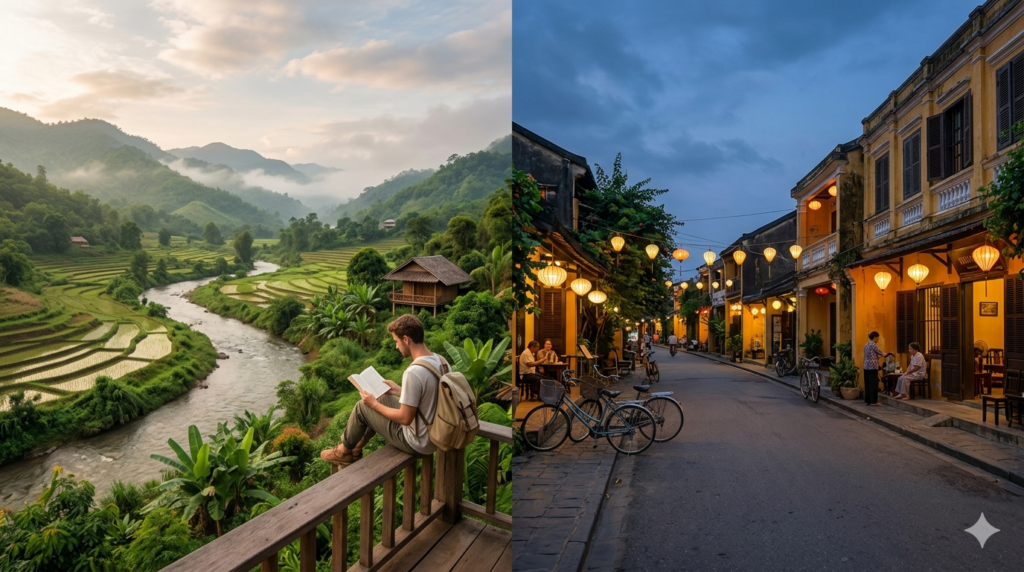
Slow travel in Southeast Asia means giving fewer bases enough time for everyday life, with transfers and entry requirements planned around your passport. It does not require a fixed two-week minimum or guarantee a monthly rental discount. This guide offers a six-week planning structure and the checks needed before turning it into bookings. Entry information was reviewed in October 2026.
Choose Bases by the Routine You Want
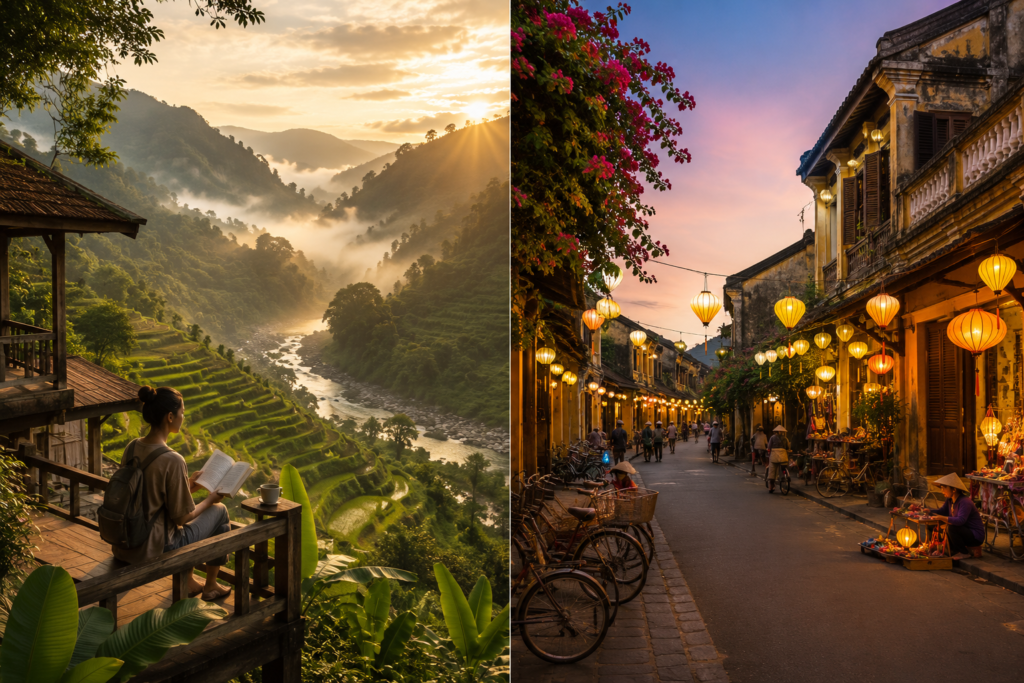
Chiang Mai is a candidate for a city routine; central Vietnam can suit a trip combining Da Nang, Hội An and Huế; Kampot is another base to investigate if Cambodia fits your route. Compare the actual neighbourhood, groceries, laundry, transport and accommodation rather than a destination-wide daily-price promise. Bangkok can also be a long-stay base if its location and routine suit you. Lombok and the Gili Islands require a separate transport and weather assessment; they are not simply an interchangeable final stop in a mainland itinerary.
Compare Weekly and Monthly Quotes Honestly
Ask for the final price for the exact dates, including utilities, air conditioning, cleaning, deposits and internet. A monthly quote divided by 30 is not the price of a 14-night booking. Verify whether a discounted stay has different payment or cancellation terms. In a hypothetical 28-night comparison, $900 accommodation plus $100 utilities totals $1,000, or about $35.71 per night. Compare it with the actual nightly alternative; do not present an unverified $15 studio or a fixed savings percentage as available across the region.
Use a Six-Week Structure With Transfer Days
One possible planning template is roughly two weeks in northern Thailand, two weeks in central Vietnam and the remaining period in Cambodia. This is a structure to test, not a confirmed connected itinerary. Reserve time for arrivals and border formalities within those periods. Check current flights and ground services before choosing the order; do not assume Chiang Mai–Da Nang is a daily nonstop. If you choose an island ending instead, remove another base or allow enough time and money for the additional journey rather than squeezing it into a spare day.
Treat Central Vietnam as Several Connected Places
Hội An, Da Nang and Huế are different places. A trip from a Hội An base to Huế requires a ground connection and a substantial onward journey; it is not a 40-minute train ride from Hội An. Check the rail departure station, service duration and final transfer when comparing options. An overnight side trip can be more comfortable than trying to combine sightseeing with both journeys in one day. Avoid paying for two rooms unintentionally if you keep your base room during a side trip.
Check Thailand’s Current Scheme for Your Passport
Thailand’s government announcement says revised tourism exemption and visa-on-arrival measures took effect on 15 September 2026, revoking the general 60-day exemption scheme. The revised 30-day scheme is for eligible nationalities, not every passport. Visa exemption and visa on arrival are different arrangements. Check your passport’s applicable route, current arrival-card requirements and permitted stay with Thai official sources or the e-Visa system. Do not rely on a border run or assume an extension will be granted.
Check Vietnam and Cambodia Before Fixing Transfers
The Vietnam official e-Visa portal describes visas of up to 90 days for single or multiple entry, with application and designated-border requirements. A visa processed online before travel is not the same as arriving without a prearranged visa. Cambodia’s tourist e-Visa information distinguishes the three-month entry validity from a one-month permitted stay. Check passport eligibility, usable entry points, dates and official requirements for the actual route. Also verify whether your activities require a different permission; tourism entry should not be assumed to authorise remote work.
Budget the Whole Six Weeks
Use current room quotes and a daily allowance based on menus and transport you expect to use. A hypothetical 42-day worksheet with $1,260 rooms, $630 meals, $210 local travel, $240 activities and $300 inter-base travel totals $2,640 before international travel, documents, coverage, connectivity and contingency. That is a calculation, not a regional cost guarantee. Price every border crossing and bag separately where required. An overnight train may replace a hotel night, but comfort, arrival time and local transfers still affect the comparison.
Check Weather and Transport for Each Base
There is no single shoulder-season window that works across Southeast Asia. Thailand travel health guidance notes seasonal smoke haze in Bangkok and Chiang Mai. Vietnam advice describes different regional rain seasons and central-area flooding risks. Check current forecasts, air quality and official travel advice before departure, including border access. Do not treat scooter rental as a default cheap activity; assess licence, experience, safety and coverage requirements. Leave room to change a transfer without losing the entire itinerary.
Essential Internal Resources
These guides on Parandjah Travels cover the related planning layers:
- For the full visa-free travel country framework: Visa-Free Travel Countries for Long-Term Stays
- For the 183-day tax rule while staying long-term: 183-Day Residency Rule Guide
- For finding cheap coworking spaces in the region: Cheap Coworking Spaces for Digital Nomads
- For timing your flights into the region: Finding Flights Off Peak Season
- For sustainable slow travel practices: Sustainable Travel Practices
Master Your Destination: City Budget Guides
These city guides cover exactly where to stay for less in 24 major hubs, including Bangkok, Singapore, and Tokyo as regional reference points:
European Budget Hubs
Madrid · Paris · Rome · Dublin · Lisbon · Budapest · Prague · Vienna · Istanbul · Amsterdam · Milan · Barcelona · Berlin
Asia-Pacific and Americas Budget Hubs
Bangkok · Tokyo · Sydney · Toronto · Singapore · Mexico City · Seoul · Buenos Aires · Cape Town · Chicago · New York
Frequently Asked Questions
How long should I stay in each Southeast Asia destination for slow travel?
Stay long enough to enjoy the routine you want within your available time and entry permission. There is no universal 14-day threshold; compare actual weekly or monthly terms.
Is Southeast Asia affordable for slow travel in 2026?
It depends on dates, accommodation and travel style. Build a full budget from current quotes, including transfers and international travel, rather than treating a regional daily allowance as guaranteed.
Do I need a visa to slow travel through Thailand, Vietnam, and Cambodia?
Check each country for your passport and route. Thailand changed its tourism exemption schemes in September 2026; Vietnam and Cambodia offer e-Visa processes with their own conditions. Do not assume all three allow visa-free arrival.
What’s the best way to travel between countries in Southeast Asia slowly?
Compare the actual available flight, rail, coach and transfer options for your dates. Verify departure points, journey times, baggage and border requirements; there is no universally cheapest or best mode.
Want More Free Travel Resources?
Explore more practical accommodation, transport and packing guides at Par & Jah Travels.
Conclusion
Build the route around usable bases, verified entry permission and complete transfer costs. Fewer moves can make a six-week trip easier to manage, while real quotes and regional weather checks keep the plan grounded.

Marsha Rowe is the Founder and Travel Strategist at Parandjah Travels. She uncovers high-intent travel intelligence, specializing in slow travel frameworks and sports event logistics.