

Carry-on-only packing starts with the allowance on your ticket, the activities and weather you expect, and a realistic laundry plan. Clothing that mixes well can reduce the number of pieces you need, but a fixed list does not fit every airline or traveler. This guide offers an adjustable wardrobe, security checks for toiletries and batteries, and a final packed-bag test.
| Category | What to Pack | Why |
|---|---|---|
| Tops | 5 performance shirts (3 light, 2 dark neutral) | All pair with every bottom |
| Bottoms | 3 versatile trousers or shorts | Neutral palette matches all tops |
| Footwear | 2 pairs max | Heavy pair worn on plane |
| Jacket | 1 technical layer | Worn during transit |
| Toiletries | Solid alternatives where suitable | Reduces ordinary liquids; security rules still apply |
Why Most Packing Lists Fail
Generic packing guides treat your bag like a grocery cart — throw in the right items and go. The problem is that items don’t exist in isolation. A linen shirt might be breathable, but it wrinkles badly and dries slowly. A dark blazer looks sharp but eats a third of your bag and works with exactly two outfits. Without a system connecting fabric choice, outfit compatibility, and laundry frequency, even a “light” packing list bloats by day three.
The Fabric Problem
Heavy denim and hoodies can add bulk and take longer to dry. Compare the weight and care label of the actual garments. Lightweight synthetic or merino items may help, but drying time depends on fabric thickness, humidity and ventilation; neither is guaranteed to dry overnight.
The Color Palette Problem
If your shirts don’t match your trousers, you’re forced to carry extra layers just to make separate outfits function. A locked color palette — one base neutral like navy or black, all supporting pieces within that family — means every top pairs cleanly with every bottom. That multiplies your outfit combinations without adding weight.
An Adjustable Clothing List for a Longer Trip
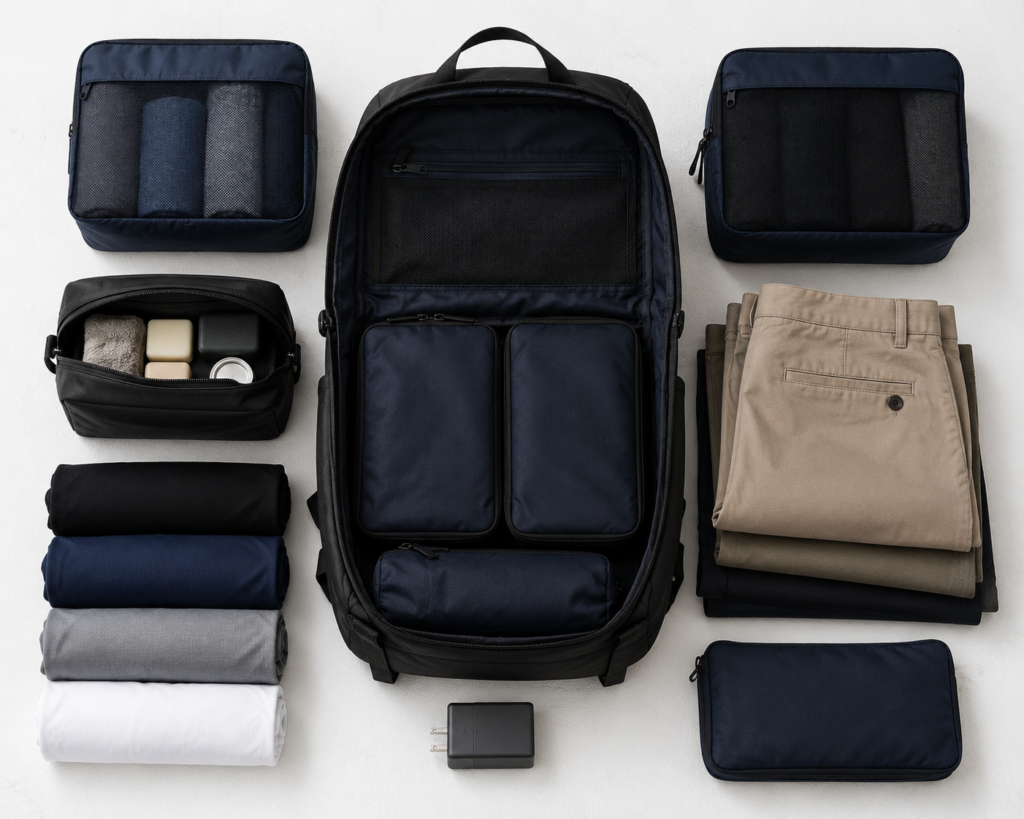
Use this as a starting point for a mild-weather trip with reliable laundry, then adjust for climate, activities, accessibility and personal needs:
- 5 performance tops — 3 in light neutrals, 2 in dark neutrals
- 3 bottoms — every pair matches all 5 tops
- 2 pairs of footwear — heavy walking shoes worn onto the plane, one lightweight pair packed
- 1 technical jacket — worn during transit, doubles as a layer on cold evenings
- 7 days of underwear and socks — laundry by day 4, repeat
Choose laundry timing around your clean-clothing supply and actual facilities. A wash around day four can work for this example, but confirm drying time, property rules and laundry opening hours. Carry a small clean buffer if clothes may not dry before departure.
Packing cubes can organize clothes and compress bulk, but they add weight and do not guarantee faster security screening. Keep items the airport asks you to remove easy to reach.
Footwear: The Two-Pair Rule
Shoes take substantial space. One versatile pair plus a lightweight second pair may suit the trip, but specialist activities, formal occasions or medical needs can require a different plan.
The transit pair: Wear comfortable shoes appropriate for the journey. This can reduce packed volume, but do not compromise comfort or rely on worn items to evade a baggage rule.
The packed pair: If needed, choose a lightweight pair that meets your planned activities. Anything in an exterior pocket still counts toward the packed bag’s dimensions.
Check the actual dress code and footwear requirements. A dark sneaker may suit some casual occasions, but is not a substitute for required formal shoes or protective equipment.
Toiletries: Check Every Security Checkpoint
Solid shampoo or soap can reduce the liquids you carry, but does not bypass security screening. For US checkpoints, TSA guidance limits ordinary liquids, gels, creams and pastes to containers of 100ml/3.4oz or less in one clear quart-sized bag per passenger. Container capacity matters even if a larger bottle is partly empty.
Do not apply the US bag rule globally. UK guidance says limits and bag requirements depend on the airport, with some allowing larger containers. Check your departure, connection and return airports; a permissive first checkpoint does not guarantee acceptance later.
Medically necessary liquids and certain infant supplies can have exemptions and separate screening. Do not assume prescription liquids must fit the ordinary 100ml allowance. Read the applicable security guidance and destination medication rules, and carry any required supporting documents.
Tech: Eliminating Hidden Weight
Electronics are where carry-on bags quietly gain weight without travelers noticing.
- Compatible charger: A multi-port charger can reduce separate adapters if it provides the right power and charging protocols for your devices. Check combined output when using several ports.
- Power bank: Check the Wh rating and airline rules. FAA guidance permits personal-use lithium-ion spares up to 100Wh in the cabin; 101–160Wh requires airline approval with a maximum of two larger spares, and more than 160Wh is not permitted. Airlines can be stricter. Protect terminals and keep power banks out of checked bags, including gate-checked luggage.
- Plug adapter: Check the countries and device input-voltage ratings. A plug adapter is not a voltage converter, and some outlets or high-power appliances need a different solution.
Set the technology allowance after accounting for essential devices. A laptop alone may exceed 500g, so that is not a realistic universal target. Weigh the charger, adapter, cables and power bank as well as the devices.
Airline Carry-On Rules: Dimensions, Weight and Inclusions
There is no universal carry-on or under-seat size. Check the number of bags, dimensions, weight and inclusion on every operating airline and fare. Include handles, wheels and filled exterior pockets when measuring. A 35–40-litre label does not tell you whether the packed bag fits a particular sizer.
As an October 2026 example, Ryanair’s policy lists a 40 × 30 × 20cm personal bag. The purchased Priority option adds a 10kg, 55 × 40 × 20cm cabin bag. Recheck before travel; these are different items, not interchangeable airline standards.
Measure and weigh the packed bag at home, including everything you will carry. Leave a margin for souvenirs and the scale difference. An oversized or overweight item may attract the carrier’s current fee or be refused; there is no universal US$75–150 gate penalty. Prepaying for a bag can cost less on some airlines, but compare the actual quote.
Even a compliant cabin bag may be checked for operational reasons. Keep documents, essential medicines and valuables accessible, and remove power banks and spare lithium batteries if the bag goes into the hold.
Calculate Your Full Trip Budget Before You Fly
Carry-on-only travel can save baggage fees when your selected fare includes the cabin allowance you need. Compare that saving with extra laundry, toiletries and any required bag purchase. Build the full trip budget from current quotes rather than assuming a packing method guarantees a saving.
Essential Internal Resources
These guides on Parandjah Travels cover the related planning layers:
- For the full flight-saving toolkit including baggage fee strategy: Travel Hacks for Saving on Flights
- For budget airline total cost comparisons: Best Budget Airlines for Long Haul Flights
- For the complete trip planning framework: How to Plan a Trip on a Budget
- For sustainable travel practices that align with carry-on philosophy: Sustainable Travel Practices
- For coordinating flights and hotels once you’re packed: Flight and Hotel Coordination Guide
Worked Weight Check: Count the Bag Itself
Illustrative 7kg allowance: 1kg empty bag + 3kg clothing + 1.2kg electronics + 0.5kg toiletries + 0.4kg documents and small items = 6.1kg, leaving 0.9kg. This is not a recommended load for every trip. Check whether the airline combines personal-item and cabin-bag weight; a separate laptop bag may not provide an extra allowance. Weigh the actual packed items.
Frequently Asked Questions
Can carry-on only packing really work for trips longer than a week?
It can, when your clothing, climate, activities and laundry access make it practical. Use the example list as a starting point, and allow for drying time and a clean-clothing buffer.
What’s the best bag for carry-on only travel?
Choose a bag that fits the exact airline dimensions when packed and is comfortable for you to move. Soft bags can flex but are not guaranteed to fit; volume alone is not proof of compliance.
How do I handle the liquids rule when packing carry-on only?
Check every departure, transit and return checkpoint. Solid toiletries can reduce ordinary liquids. US TSA rules use 100ml/3.4oz containers and a quart-sized bag; other airports can differ. Medically necessary liquids may have exemptions and separate screening.
What happens if my carry-on is too big at the gate?
The carrier may charge its current fee, check the bag or refuse it if it cannot be accepted. Measure and weigh at home and check your fare inclusion. If the bag is checked, remove power banks, spare lithium batteries and essential items.
Want More Free Travel Resources?
Grab the free 2026 Travel Dupes Cheat Sheet for budget-friendly destination ideas to plan your next carry-on only trip around. Subscribe at the top of parandjahtravels.com to download it instantly.
Conclusion
Build the wardrobe around your actual trip and a laundry plan you can use. Check every airline’s bag inclusion, dimensions and weight, plus each airport’s security requirements. Measure and weigh the complete load, leave a margin, and keep essential items and batteries accessible in case the bag must be checked.

Marsha Rowe is the Founder and Travel Strategist at Parandjah Travels. She uncovers high-intent travel intelligence, specializing in slow travel frameworks and sports event logistics.