
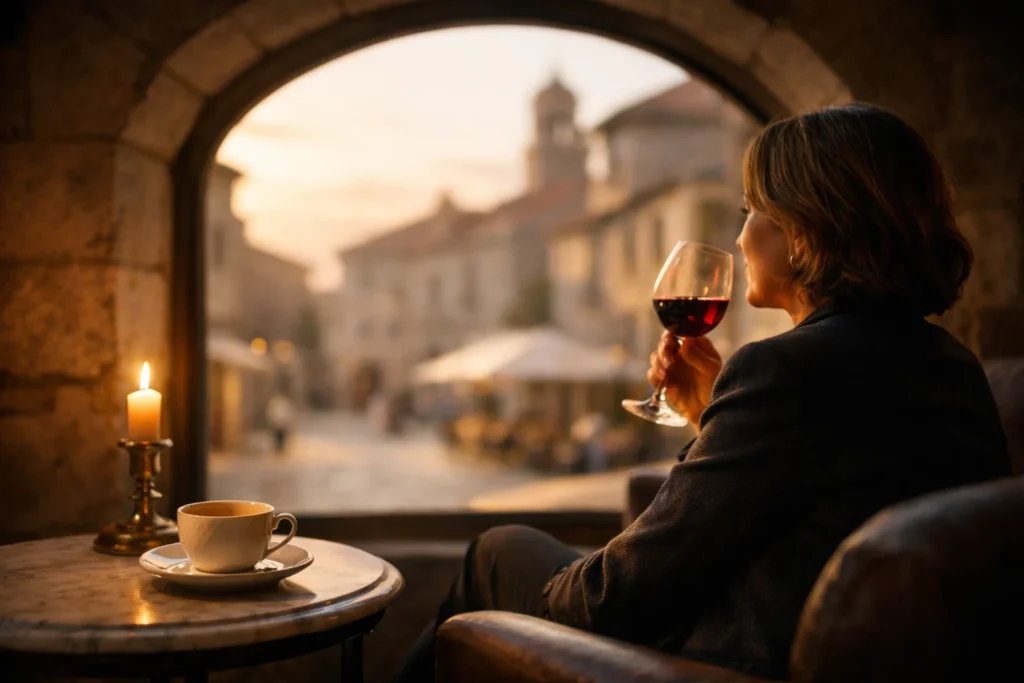
The best luxury travel alternatives to Paris in 2026 are Porto, Tbilisi, Antwerp, and San Sebastián — cities that now offer comparable cultural weight, genuine boutique hotel scenes, and world-class food at meaningfully lower prices and without the crowd friction that Paris increasingly imposes. Paris hotel rates have climbed steadily through the mid-2020s. The streets of the Marais feel more like a theme park than a neighborhood. And the city’s best experiences are increasingly rationed by price and patience. These four cities don’t ask you to settle for less — they offer a different version of the same experience, often better on specific dimensions, at a lower cost.
| City | Best For | Price vs. Paris |
|---|---|---|
| Porto | Contemporary art, boutique hotels, wine | Meaningfully lower |
| Tbilisi | Architecture, natural wine, design hotels | Dramatically lower |
| Antwerp | Old Masters, fashion, design | Noticeably lower |
| San Sebastián | Michelin dining, Basque culture, coastline | Comparable to lower |
Why Paris Alternatives Are Having a Moment in 2026
The shift is structural, not seasonal. Paris hotel rates in peak season have climbed sharply through the mid-2020s, driven partly by post-Olympics demand spillover. The cost gap between Paris and its alternatives is now wider than at any point in the past decade. High-intent travelers are consistently searching for cities that offer cultural depth without the logistical friction of mass tourism — and the alternatives have genuinely caught up on the supply side.
Boutique hotels in Porto, Tbilisi, and Antwerp have reached a standard that makes the comparison to Paris honest rather than aspirational. Contemporary art scenes that were nascent five years ago are now internationally legible. Michelin has been paying attention to places it previously ignored. This isn’t about settling for less. It’s about recognizing that the map of European luxury travel has expanded, and Paris no longer has a monopoly on the experiences that define it.
Porto, Portugal: Paris With an Atlantic Edge

Porto consistently surprises travelers who arrive expecting a lower-stakes version of Lisbon. What they find instead is a city with serious contemporary art infrastructure, a hotel scene that has mastered the conversion of historic fabric into genuinely luxurious stays, and Michelin-starred dining that costs, in several cases, less than a mid-range brasserie on the Île Saint-Louis.
The Art Benchmark
The Serralves Foundation is the anchor. Housed in a landmark building by Álvaro Siza Vieira — one of the most significant architects of the 20th century — it holds one of Iberia’s most important contemporary art collections. For the serious art traveler, this is a direct counterpoint to Paris’s Centre Pompidou: the permanent collection is rigorous, the temporary programming internationally curated, and the surrounding park exceptional. The grounds alone justify a half-day.
Where to Stay
Two properties set the benchmark. The Yeatman sits above the Douro River in Vila Nova de Gaia with panoramic views of Porto’s skyline, a two-Michelin-starred restaurant, and a wine cellar making a credible case for the finest hotel wine program in Portugal. Torel Avantgarde, in the historic Bonfim neighborhood, occupies a converted 19th-century townhouse where each suite is individually designed around a different Portuguese cultural figure — the kind of conceptual rigor you’d expect to pay a significant Paris premium for. Both benchmark favorably against four- and five-star hotels in the 1st and 8th arrondissements at meaningfully lower nightly rates.
Getting There
Direct flights from London, Amsterdam, Frankfurt, and New York via TAP Air Portugal. The city center is compact and walkable — the Ribeira waterfront, Serralves, the Clérigos tower, and the best wine bars in Foz are all within a 20-minute taxi or tram ride. A long weekend is viable; a week feels luxurious without running out of material.
Tbilisi, Georgia: The Underground Luxury Pick
If Porto is the consensus answer for travelers ready to move beyond Paris, Tbilisi is the insider answer — the city that luxury travel editors are writing about now but that most travelers haven’t acted on yet. That window won’t stay open indefinitely.
Art Scene and Boutique Stays
The gallery and design district around Marjanishvili has developed into a credible contemporary art scene with an energy closer to pre-gentrification Berlin than anything in Western Europe. Old Town cave hotel conversions carved into the hillside above the Mtkvari River offer a physical distinctiveness that money simply cannot manufacture elsewhere. And the natural wine culture here is not a trend or an import — Georgia is widely considered the birthplace of natural wine, with winemaking traditions going back several thousand years. The best bottles in Tbilisi restaurants are revelatory.
Stamba Hotel is the benchmark property. Converted from a Soviet-era publishing house, it’s consistently cited by luxury travel press — including Condé Nast Traveler and Travel + Leisure — as one of the most architecturally distinctive boutique hotels in the broader European region. The double-height atrium, curated art installations, and rooftop bar create an atmosphere that comparable Paris properties charge considerably more to approximate.
The Value Proposition
A multi-course dinner at one of Tbilisi’s best restaurants, wine included, costs a fraction of a comparable Parisian brasserie meal. Suite-level accommodation at Stamba prices well below four-star Paris properties. The value isn’t a function of lower quality — it’s a function of where the city sits in its hospitality maturity curve. For travelers who want to eat and sleep at a genuinely high level without the financial friction Paris now imposes, Tbilisi makes the strongest value argument in Europe’s orbit right now.
Antwerp, Belgium: The Fashion Capital Paris Forgot to Mention
Antwerp is criminally underrated, which is remarkable given what it actually offers. The Royal Museum of Fine Arts (KMSKA), after a decade-long renovation completed in 2022, now presents one of the most significant Flemish and Old Masters collections in Europe in a fully modernized setting — yet draws a fraction of the Louvre’s annual visitors. You can stand in front of a van Eyck or a Rubens without a crowd blocking your view. In Paris, that experience is essentially unavailable.
The fashion angle is equally serious. Antwerp’s reputation as a design capital — anchored by the Antwerp Six and sustained by the Royal Academy of Fine Arts — gives the city a retail and aesthetic culture that Paris can match but not exceed. Hotel Julien, intimate and design-forward in a converted 16th-century building, and Botanic Sanctuary, a multi-building wellness complex in a former 17th-century monastery, both compete with Paris boutique hotels at a lower price point with considerably more architectural character.
The logistical case is almost unfair: Antwerp is a two-hour train ride from Paris’s Gare du Nord, making it a viable same-trip extension. Direct rail also runs from Brussels, Amsterdam, and London.
San Sebastián, Spain: The Culinary Destination Paris Can’t Beat
For food-first luxury travelers, this is the decisive destination. San Sebastián has long held the highest concentration of Michelin-starred restaurants relative to population of any city in the world — a culinary density that Paris, for all its prestige, cannot claim.
The experience layers in a way that rewards full engagement. The pintxo bars of the Parte Vieja are the accessible entry point — small plates, standing room, ordered chaos — but the real draw is the restaurant tier: Arzak, Mugaritz, Akelarre, and others have shaped the modern fine dining conversation globally, not just regionally. Hotel Maria Cristina, a Belle Époque landmark on the Urumea River, is the benchmark stay — grand in scale, immaculate in service, and positioned at the intersection of old-world formality and Basque warmth. The surrounding La Concha beach and the compact old town make the city feel like a complete luxury destination rather than a single-note culinary stopover.
Fly into Bilbao (45 minutes by road) or San Sebastián’s own smaller airport for direct access. Two to four nights rewards serious eating, coastal walking, and genuine understanding of why chefs from around the world make the pilgrimage.
How to Choose the Right Alternative for Your Travel Style
- Art-first traveler: Porto for contemporary art with architectural and landscape context; Antwerp for Old Masters at a scale and quality rivaling any European museum, with none of the crowd friction
- Food-first traveler: San Sebastián, without question — no other city on this list competes with its Michelin density and culinary culture from street level to fine dining
- Value-seeking luxury traveler: Tbilisi delivers the widest gap between experience quality and price — design hotels, food, wine, and art all benchmark above what the price tag implies
- Design and fashion traveler: Antwerp is the answer Paris tends not to mention, possibly because it’s a genuine competitor
Essential Internal Resources
These guides on Parandjah Travels cover the related planning layers:
- For timing your trip to any of these destinations: Best Time to Visit Popular Destinations
- For avoiding crowds at major city landmarks: Day Trip Alternatives to Popular Tourist Sites
- For booking flights to any of these cities: Travel Hacks for Saving on Flights
- For finding affordable neighborhoods in any of these cities: Where to Stay in Major Cities on a Budget
- For booking hotels without extra fees: How to Book Hotels Without Paying Booking Fees
Master Your Destination: City Budget Guides
Several of these alternative destinations have dedicated budget guides on Parandjah Travels — useful even for luxury travelers looking to understand the full cost range:
European Budget Hubs
Madrid · Paris · Rome · Dublin · Lisbon · Budapest · Prague · Vienna · Istanbul · Amsterdam · Milan · Barcelona · Berlin
Asia-Pacific and Americas Budget Hubs
Bangkok · Tokyo · Sydney · Toronto · Singapore · Mexico City · Seoul · Buenos Aires · Cape Town · Chicago · New York
Frequently Asked Questions
Is Porto actually comparable to Paris for a luxury trip?
Yes, on several dimensions — and better on some. The Serralves Foundation rivals Centre Pompidou for contemporary art, the Yeatman and Torel Avantgarde both benchmark favorably against top Paris boutique hotels, and Michelin-starred dining costs meaningfully less. The main trade-off is scale — Porto has less total coverage than Paris, but what it has competes directly.
Why is Tbilisi considered a luxury destination?
Tbilisi offers a combination that’s genuinely rare: architecturally distinctive boutique hotels (Stamba being the flagship example), a natural wine culture thousands of years old, a developing contemporary art scene, and pricing well below comparable Western European cities. It’s luxury at a stage of hospitality maturity where the experience exceeds the price tag rather than the reverse.
Is San Sebastián better than Paris for food?
On Michelin density relative to population, yes — San Sebastián holds the highest concentration of starred restaurants per capita of any city in the world. On overall culinary breadth, Paris still has more total options. For a dedicated food trip where every meal matters, San Sebastián is the stronger argument.
How do I get to Antwerp from Paris?
Eurostar or Thalys from Paris Gare du Nord to Brussels, then direct train to Antwerp Centraal — around two hours total door to door. It’s one of the most accessible same-trip extensions in Northwestern Europe and genuinely worth adding a two or three-night detour for the KMSKA alone.
Want More Free Travel Resources?
Grab the free 2026 Travel Dupes Cheat Sheet for more budget-friendly destination ideas across Europe. Subscribe at the top of parandjahtravels.com to download it instantly.
Conclusion
Paris remains one of the world’s great cities. But in 2026, the case for going somewhere else first — or instead — has never been stronger. Porto, Tbilisi, Antwerp, and San Sebastián each offer something Paris has become progressively worse at delivering: the sense that you’re somewhere real, among people who actually live there, at a price that doesn’t require rationalizing every meal. The map of European luxury travel has expanded. These are four of the best places the expansion has taken us.

Marsha Rowe is the Founder and Travel Strategist at Parandjah Travels. She uncovers high-intent travel intelligence, specializing in slow travel frameworks and sports event logistics.