
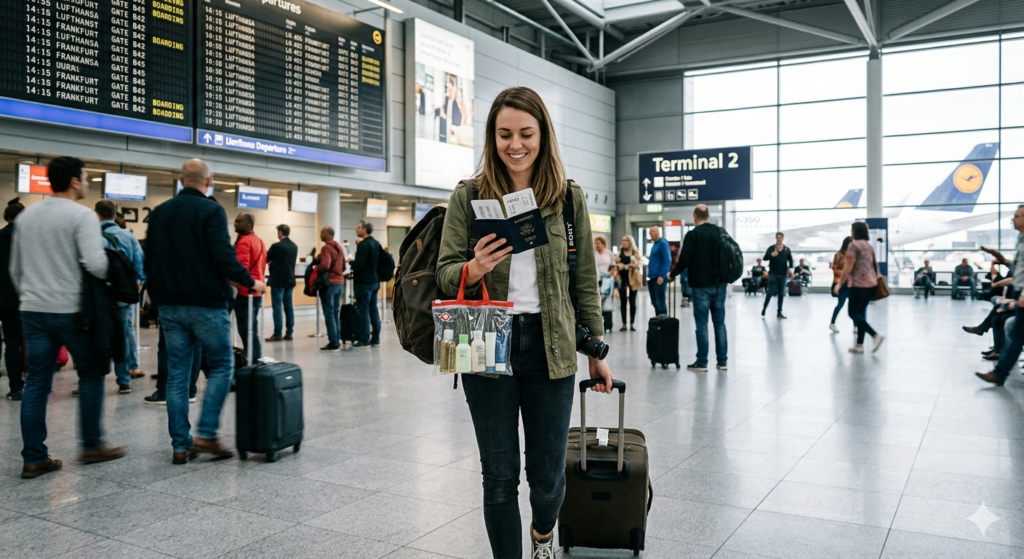
How much liquid you can take on a plane depends on where you pass through security. At US TSA checkpoints, the usual carry-on limit is 3.4oz (100ml) per container, with the containers fitting in one quart-sized bag per passenger, subject to exemptions. UK rules vary by airport: some allow containers up to two litres. Check your departure, connecting and return airports before packing. The sections below explain the US 3-1-1 framework; do not assume it is the exact rule for every international journey.
| The 3-1-1 Rule | Requirement |
|---|---|
| Container size | 100ml / 3.4oz maximum — the label, not the contents |
| Bag type | One clear, resealable, quart-sized (approximately 7×8 inches) |
| Bags per person | One per passenger |
| Where it goes | Separately in the security tray, not buried in your bag |
The US TSA 3-1-1 Rule Explained
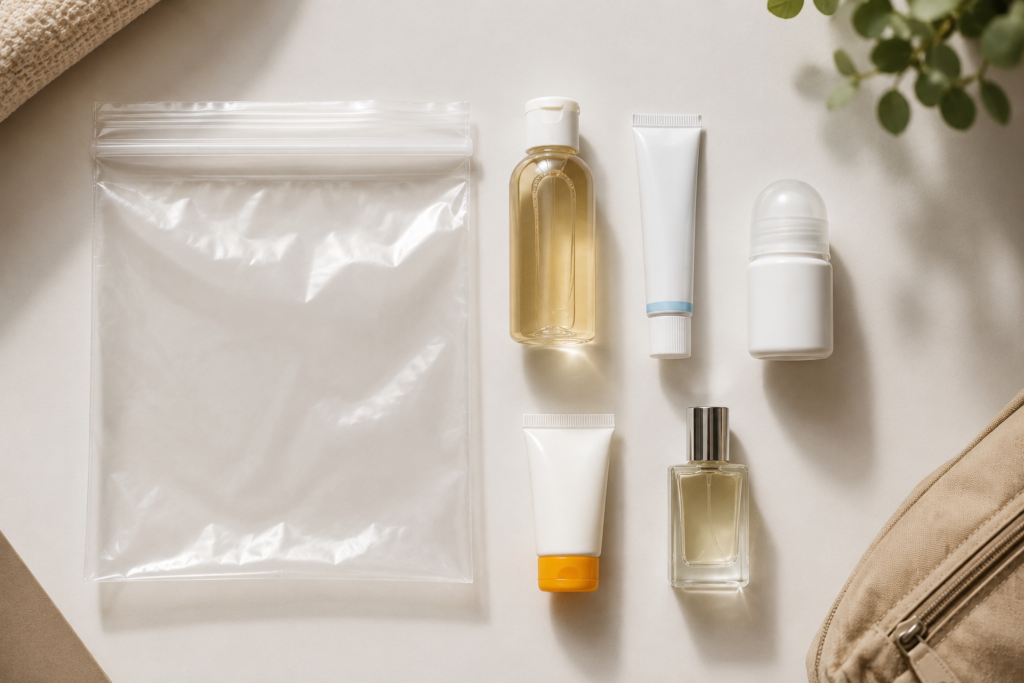
The TSA 3-1-1 liquids rule has three components and all three matter:
1. Each container must be 100ml / 3.4oz or less This is measured by the maximum capacity printed on the container — not the current volume of liquid inside. A 250ml shampoo bottle that’s 90% empty is still a 250ml container and will be confiscated. If you want to bring a large bottle, transfer the contents into a travel-sized container of 100ml or less before you pack.
2. All containers must fit in one clear quart-sized resealable bag The standard size is approximately 7×8 inches (roughly 1 litre volume). The bag must close completely — if your containers prevent the zip from sealing, you’ll be asked to remove items. One overfilled bag causes more confiscation than anything else at security.
3. One bag per passenger Each traveler gets one liquids bag. You can’t use two smaller bags or split your liquids across multiple bags.
At the checkpoint: Remove the liquids bag from your carry-on and place it separately in the security tray. Don’t leave it buried in your bag — security officers will flag your bag for a manual search, which takes longer and occasionally results in a more thorough inspection of everything.
What Counts as a Liquid
This is where most travelers are surprised. The 3-1-1 rule applies to anything that is a liquid, gel, aerosol, cream, or paste:
Definitely subject to the rule:
- Shampoo, conditioner, body wash
- Toothpaste (gel or paste — yes, toothpaste counts)
- Liquid foundation, mascara, liquid lipstick
- Sunscreen (liquid or cream)
- Deodorant (roll-on or gel — not solid stick deodorant)
- Perfume and cologne
- Contact lens solution
- Hair gel, mousse, or spray
- Peanut butter, jam, honey, and other spreadable foods (yes, these count)
- Yogurt, hummus, and similar semi-solid foods
Not subject to the rule:
- Solid deodorant
- Solid shampoo and conditioner bars
- Solid toothpaste tablets
- Mascara wands (not the liquid itself)
- Lip balm in solid stick form
- Powder makeup (eyeshadow, powder foundation, blush)
- Dry snacks and solid food
Exceptions to the 3-1-1 Rule
Baby formula, breast milk, and baby food: These are exempt from the 3-1-1 rule in reasonable quantities for traveling with infants. You don’t need to fit them in the quart bag. Inform the security officer before screening — they may test the liquids separately.
Prescription medications: Medically necessary liquids, including prescription medications and insulin, are exempt from the 3-1-1 rule. Carry them in your carry-on with the prescription label visible. Inform the security officer and they’ll screen them separately.
Over-the-counter medications: These are also exempt in reasonable quantities — liquid children’s medicine, eye drops, nasal spray. Declare them to the security officer.
Duty-free liquids purchased after security: Liquids purchased at duty-free shops after the security checkpoint can be brought onto the plane in their sealed, tamper-evident bags with a receipt showing purchase at the airport. The exception is if you’re transiting through another airport with a separate security screening — some countries (particularly within the EU on connecting flights) may apply their own rules.
New CT Scanners: Is the 100ml Rule Changing?
Major airports including some UK and European hubs have been gradually rolling out 3D Computed Tomography (CT) scanners that can examine liquids contextually inside bags, which has allowed some airports to trial relaxed liquid rules of up to 2 litres in specific terminals.
Check the rules for your route: Scanner upgrades do not create one worldwide liquid allowance. US TSA checkpoints retain the 3-1-1 framework. In the UK, permitted container sizes and whether liquids need a separate bag depend on the airport. Check each airport on your itinerary, including the return journey, rather than relying on another airport’s policy. Use the TSA liquids guidance and UK government liquids guidance as starting points.
Practical advice: Check the specific airport’s current policy before each trip, particularly for UK and EU airports. But always default to 100ml compliance if you’re unsure — the cost of losing your toiletries is higher than the minor inconvenience of using travel-sized containers.
The Smart Packing Strategy: Bypass the Rule Entirely
The most reliable way to never lose toiletries at security is to minimize how many liquids you’re carrying:
Switch to solid alternatives:
- Solid shampoo and conditioner bars — last as long as 2-3 bottles of liquid shampoo and weigh almost nothing
- Solid toothpaste tablets — a month’s supply fits in a small tin
- Solid body wash bars — same as soap, travel-sized bars available everywhere
- Solid deodorant — not subject to the rule at all
Switching to solid alternatives can reduce your liquids bag from overflowing to half-empty, removing the most stressful part of the security process entirely.
Buy on arrival: For trips longer than a week, buying shampoo, conditioner, and body wash at a supermarket in your destination is almost always cheaper than buying travel-sized versions at home and lighter than carrying full quantities through security. A 500ml bottle of local shampoo costs $2-4 in most destinations and can be left behind or given away at the end of the trip.
Check your bag for longer trips: If you need a full toiletry kit and don’t want to compromise, checking a bag on longer trips and packing liquids unrestricted is sometimes the right call. The carry-on only strategy for budget airlines is about avoiding checked baggage fees — if you’re already paying for hold luggage, pack your full toiletry kit there. See the International Flight Baggage Fees guide for the full checked bag fee comparison.
Building Your Compliant Liquids Bag
A compliant, practical liquids bag for most trips needs:
- Shampoo/conditioner — travel-sized 100ml bottles or solid bars
- Body wash — travel-sized or solid bar
- Toothpaste — 75ml or 100ml tube (most standard travel toothpastes are 75ml)
- Deodorant — solid stick (bypasses the rule) or roll-on in 100ml
- Sunscreen — 100ml travel tube
- Face moisturizer — 50ml or 100ml
- Prescription medications — separate from the bag, with prescription label
That typically fills a quart bag to about 60-70% capacity, which is where you want to be — room to close the zip easily and space for one or two extras without overfilling.
Labels matter: Some budget brands don’t print the volume on the container. If a security officer can’t verify the capacity is 100ml or less, they may confiscate it. Stick to containers with clearly printed capacity labels.
For the full carry-on packing framework including the color palette strategy and fabric weight, the Carry On Only Travel Packing guide covers the complete system.
Essential Internal Resources
These guides on Parandjah Travels cover the related planning layers:
- For the full carry-on packing system: Carry On Only Travel Packing
- For baggage fee avoidance across carriers: International Flight Baggage Fees
- For budget airline size and weight limits: Best Budget Airlines for Long Haul Flights
- For the complete travel booking checklist: Travel Booking Checklist Guide
- For the complete trip planning framework: How to Plan a Trip on a Budget
Master Your Destination: City Budget Guides
These city guides cover exactly where to stay for less in 24 major hubs — useful once your carry-on is sorted and your trip is ready to book:
European Budget Hubs
Madrid · Paris · Rome · Dublin · Lisbon · Budapest · Prague · Vienna · Istanbul · Amsterdam · Milan · Barcelona · Berlin
Asia-Pacific and Americas Budget Hubs
Bangkok · Tokyo · Sydney · Toronto · Singapore · Mexico City · Seoul · Buenos Aires · Cape Town · Chicago · New York
Frequently Asked Questions
Can I bring a half-empty 200ml bottle through airport security?
No. The 100ml limit applies to the maximum capacity printed on the container label, not the current volume of liquid inside. A 200ml bottle that is half empty is still a 200ml container and will be confiscated at the security checkpoint. Transfer the contents into a travel-sized container of 100ml or less before you pack.
Does toothpaste count as a liquid for airport security?
Yes. Toothpaste is classified as a paste and is subject to the 3-1-1 rule. It must be in a container of 100ml or less and packed in your quart-sized liquids bag. Most standard travel toothpastes are sold in 75ml tubes, which complies. An alternative is solid toothpaste tablets, which are not subject to the liquids rule at all.
Can I bring food through airport security in my carry-on?
Solid food is generally permitted in carry-on bags. However, spreadable or semi-liquid foods — peanut butter, jam, honey, hummus, yogurt, and similar items — are classified as liquids or gels and must comply with the 100ml / 3-1-1 rule if in your carry-on. In practice, TSA and most international security agencies follow this rule for these food types.
Are prescription medications exempt from the 100ml liquid rule?
Yes. Medically necessary liquids including prescription medications, insulin, and over-the-counter medications in reasonable quantities are exempt from the 3-1-1 rule. Carry them in your carry-on with the prescription label visible and inform the security officer before the screening begins — they will screen these items separately.
Want More Free Travel Resources?
Planning your next trip? Get your free Travel Dupes Cheat Sheet by signing up for destination ideas and travel tips. For the next step in your planning, compare our flight search tools guide.
Conclusion
Before packing liquids, check the current requirements at every airport where you will clear security. For US TSA screening, use containers of 3.4oz (100ml) or less in one quart-sized bag, unless an exemption applies. UK allowances can differ by airport, and bag-removal instructions also vary. Container capacity matters where a size limit applies. Consider solid toiletries where practical, and compare buying essentials on arrival with carrying them from home.

Marsha Rowe is the Founder and Travel Strategist at Parandjah Travels. She uncovers high-intent travel intelligence, specializing in slow travel frameworks and sports event logistics.