

The best travel apps for budget travelers in 2026 are the ones that replace expensive services with free or low-cost alternatives — navigation without roaming charges, translation without a guide, food discovery without tourist-area restaurant pricing, and flight tracking without a travel agent. A well-set-up phone before you leave home is worth more than any guidebook, and costs nothing beyond the time it takes to download and configure. This guide covers the essential apps by category, with honest notes on what each one actually does well.
| Category | Best App | What It Replaces | Cost |
|---|---|---|---|
| Flight search | Google Flights | Travel agent for fare comparison | Free |
| Offline maps | Maps.me or Google Maps (offline) | Data roaming for navigation | Free |
| Translation | Google Translate | Paid guide or phrasebook | Free |
| Food discovery | Too Good To Go + Google Maps | Tourist restaurant pricing | Free |
| Transit | Citymapper | Taxi and rideshare overuse | Free |
| Budget tracking | budgettripai.com | Manual expense spreadsheets | Free |
| Accommodation | Booking.com + direct contact | OTA fees | Free to use |
| Local SIM | Airalo | Expensive roaming packages | From $5 |
Flight Search and Fare Tracking
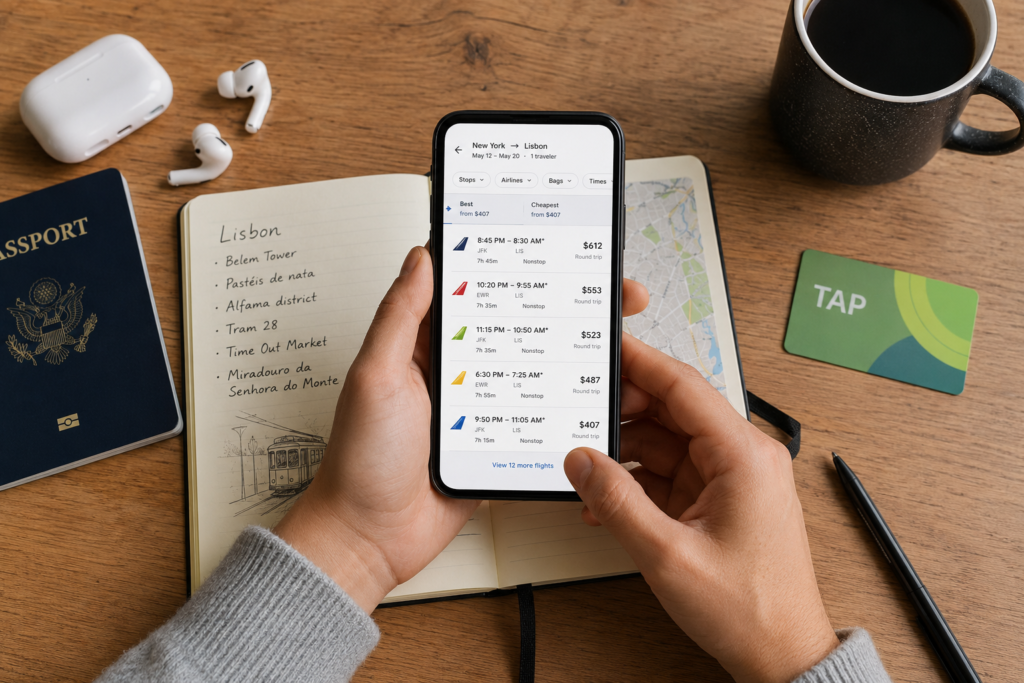
Google Flights remains the gold standard for fare comparison and flexible date searching. The calendar view shows price variation across a full month, the price graph shows 6 months of historical data for any route, and fare alerts notify you when prices drop on a saved route. Use it to establish your baseline before cross-referencing on Skyscanner.
Skyscanner catches carriers that Google misses — particularly Ryanair, EasyJet, Wizz Air, and regional budget airlines across Europe and Southeast Asia. The “Search Everywhere” function finds the cheapest destinations from your home airport across any date range, which is genuinely powerful for open-ended trip planning.
Hopper uses predictive pricing to tell you whether to buy now or wait, with a confidence percentage. More useful for domestic routes with dense historical data than for international long-haul where pricing is more variable. Worth checking if you’re uncertain about whether a fare is at its floor.
For the full flight-saving toolkit including booking windows and when to use each platform, the Travel Hacks for Saving on Flights guide covers the complete strategy.
Offline Maps and Navigation
Google Maps offline is the most important pre-trip download you can do. Before you leave home — or while still on hotel Wi-Fi — download the offline map for every city you’re visiting. The downloaded map covers navigation, business search, and transit routing without any data connection. This eliminates roaming charges for navigation entirely.
Maps.me is the alternative for destinations where Google Maps coverage is thinner — rural Southeast Asia, parts of Central Asia, and smaller cities in Eastern Europe. Maps.me uses OpenStreetMap data and often has more detailed pedestrian paths and trail coverage than Google Maps offline.
What to download before leaving:
- Offline map for every city on your itinerary
- Metro/transit app for each city (Tokyo Metro, London TfL Go, Paris RATP, etc.)
- The airline app for every carrier on your trip
Downloading these on hotel or airport Wi-Fi before you need them means you’re never paying roaming rates for navigation or scrambling for data when you land.
Translation
Google Translate with offline language packs downloaded covers the vast majority of translation needs for budget travelers. The camera feature (point your phone at a menu, sign, or form and see an instant translation overlaid on the image) is the most practically useful feature — it works offline once the language pack is downloaded and eliminates the most common daily friction of traveling in countries where you don’t speak the language.
Download these language packs offline before leaving: Every language you’ll encounter on your trip. Each pack is 50-100MB. Prioritize: Thai, Vietnamese, Arabic, Japanese, Korean, Chinese (simplified and traditional), and any Cyrillic-script languages if you’re traveling in Eastern Europe or Central Asia.
DeepL is more accurate than Google Translate for written text requiring nuance — useful for reading contracts, rental agreements, or longer documents. The free tier covers most needs.
Food Discovery and Budget Eating
Too Good To Go is the single most useful budget food app that most travelers don’t know about. It connects you with restaurants, cafés, and bakeries selling surplus food at the end of service — typically £3-5 for a bag of food originally priced at £10-15. Available across Europe and expanding in North America and Southeast Asia. Download and set your location before arriving in each city.
Google Maps reviews in the local language is an underused technique for finding genuinely local restaurants. Search for a restaurant type in the local language (use Google Translate first) rather than in English — the results surface places that cater to residents rather than tourists, with pricing to match. A simple search for “ราดหน้า” (a Thai noodle dish) in Bangkok returns completely different results from searching “Thai noodles” in English.
HappyCow for vegetarian and vegan travelers — the most comprehensive directory of plant-based restaurants globally, with community reviews and offline functionality.
Local Transit
Citymapper covers transit in 80+ cities worldwide and goes significantly beyond standard transit apps by comparing all transport options — metro, bus, walking, cycling, rideshare — with real-time updates and door-to-door routing. It automatically identifies the cheapest route between two points, which consistently surfaces the transit option over rideshare when the cost difference is meaningful.
Available offline for downloaded cities — download each city’s data package before arriving.
City-specific transit apps are worth downloading for major destinations:
- TfL Go (London) — real-time tube, bus, and Overground with live disruption updates
- Metro LA — essential for LA 2028 Olympics visitors; covers TAP card management
- RATP (Paris) — covers Metro, RER, and bus with offline functionality
- Tokyo Metro — essential for navigating Tokyo’s layered subway system
For the full airport-to-city transit cost comparison including when to use public transit vs rideshare vs pre-booked transfer, the Cheapest Way to Get From Airport to City guide covers the decision framework.
Money and Budget Tracking
budgettripai.com is a free trip budget calculator — enter your destination, trip length, and travel style and it estimates your complete trip cost in seconds. Use it before any non-refundable booking to verify your budget assumptions are realistic. Particularly useful for comparing the true cost difference between two destinations when you’re deciding where to go.
Wise (formerly TransferWise) offers a debit card with real exchange rates and minimal fees. For budget travelers spending across multiple currencies, Wise consistently beats bank exchange rates and eliminates most foreign transaction fees. Load it with your home currency and spend abroad at interbank rates.
Charles Schwab bank account (US-based) offers ATM fee reimbursements globally — any ATM fee charged by a foreign bank is reimbursed at the end of the month. For travelers who use cash, this eliminates one of the most consistent small-scale budget drains of international travel.
Trail Wallet or TravelSpend for daily expense tracking — simple category-based spending trackers that work without an internet connection. Set a daily budget, log each expense, and see at a glance whether you’re on track. More useful than a spreadsheet because the friction is lower and you’re more likely to actually log purchases in real time.
Accommodation
Booking.com for initial price comparison across hotel categories and neighborhoods. The map view with filter by price is the fastest way to understand what a city’s accommodation market looks like before deciding on a neighborhood.
The direct booking move: Once you’ve identified a property on Booking.com, contact the hotel directly — by email or the property’s own website — and ask whether they match or beat the OTA price. Hotels avoid paying 15-25% OTA commissions on direct bookings and many pass some of that back as a discount, upgrade, or added benefit. Full strategy in the How to Book Hotels Without Paying Booking Fees guide.
Hostelworld for hostel-specific inventory — better coverage of budget accommodation than Booking.com in most destinations, with more detailed dorm/private room breakdowns.
SIM Cards and Connectivity
Airalo is the most practical solution for international data without roaming charges — an eSIM marketplace that sells local and regional data packages for 190+ countries starting from $5. You buy, download, and activate the eSIM before you travel. No physical SIM swap needed, no roaming charges, no searching for a phone shop on arrival.
For trips spanning multiple countries: Airalo’s regional eSIMs (Europe, Southeast Asia, etc.) are particularly cost-effective — one package covers multiple countries rather than buying separately for each.
Alternative for longer stays: A physical local SIM from a carrier in your destination country is almost always cheaper than an eSIM for stays of a week or more. Buy at the airport arrival hall (usually the most straightforward option) or at a carrier store in the city center.
Confirm your phone is unlocked before leaving home — a phone locked to your home carrier cannot use a foreign SIM or eSIM.
Safety and Documentation
Google Photos or iCloud with automatic backup — before every trip, confirm your photos are backing up automatically to cloud storage. If your phone is lost or stolen, your documentation photos (passport, visa, accommodation confirmations, travel insurance policy) are recoverable.
TripIt or Google Keep for itinerary organization — forward all confirmation emails to TripIt and it automatically builds a structured itinerary from the details. Alternatively, a simple Google Keep note with all confirmation numbers, hotel addresses, check-in times, and transfer details shared with your travel companions covers the same function without an additional app.
SafetyWing app or Heymondo app — if you’re using either insurer for travel insurance, download their app before leaving. Both allow you to file claims and reach emergency assistance directly through the app.
Essential Internal Resources
These guides on Parandjah Travels cover the related planning layers:
- For the full flight booking platform comparison: Flight Tickets Booking Sites Compared
- For the complete flight-saving strategy: Travel Hacks for Saving on Flights
- For the airport-to-city transit decision: Cheapest Way to Get From Airport to City
- For hotel booking without OTA fees: How to Book Hotels Without Paying Booking Fees
- For the complete trip budget framework: How to Plan a Trip on a Budget
Master Your Destination: City Budget Guides
These city guides cover exactly where to stay for less in 24 major hubs — use them alongside these apps for complete pre-trip research:
European Budget Hubs
Madrid · Paris · Rome · Dublin · Lisbon · Budapest · Prague · Vienna · Istanbul · Amsterdam · Milan · Barcelona · Berlin
Asia-Pacific and Americas Budget Hubs
Bangkok · Tokyo · Sydney · Toronto · Singapore · Mexico City · Seoul · Buenos Aires · Cape Town · Chicago · New York
Frequently Asked Questions
What is the most useful travel app for budget travelers?
Google Maps with offline areas downloaded — it covers navigation, business search, transit routing, and restaurant discovery without any data connection. Download the offline map for every city before you leave home and you eliminate roaming charges for navigation entirely. Pair it with Google Translate (offline language packs downloaded) and you’ve covered the two biggest daily friction points of international travel for free.
How do I avoid roaming charges while traveling internationally?
Download Airalo before you leave home and purchase a local or regional eSIM for your destination — packages start from $5 and activate instantly without needing to find a phone shop. Also download Google Maps offline areas and Google Translate language packs on Wi-Fi before you leave, so navigation and translation work without any data connection.
What is Too Good To Go and how does it help budget travelers?
Too Good To Go connects travelers with restaurants, cafés, and bakeries selling surplus food at the end of service — typically £3-5 for a bag of food originally worth £10-15. It’s available across Europe and expanding globally. It reduces food costs significantly for budget travelers in cities with dense restaurant coverage, and works best when you’re flexible about what you eat rather than committed to a specific cuisine.
Is there a free app for tracking travel expenses?
Trail Wallet and TravelSpend are both free and designed specifically for travel expense tracking — set a daily budget, log expenses by category, and see in real time whether you’re on track. Both work offline. For pre-trip budget estimation by destination, budgettripai.com is a free tool that estimates your complete trip cost in seconds.
Want More Free Travel Resources?
Grab the free 2026 Travel Dupes Cheat Sheet for budget-friendly destination ideas to use these apps in. Subscribe at the top of parandjahtravels.com to download it instantly.
Conclusion
The best travel apps for budget travelers are the ones you set up before you leave — not the ones you’re searching for while jet-lagged at the airport. Download Google Maps offline areas, Google Translate language packs, Citymapper city data, and your airline apps on home Wi-Fi. Buy an Airalo eSIM before departure. Set up Too Good To Go in each city as you arrive. Use budgettripai.com to verify your budget before any non-refundable booking. A well-prepared phone costs nothing beyond 30 minutes of setup and replaces hundreds of dollars of services across a two-week trip.

Marsha Rowe is the Founder and Travel Strategist at Parandjah Travels. She uncovers high-intent travel intelligence, specializing in slow travel frameworks and sports event logistics.