
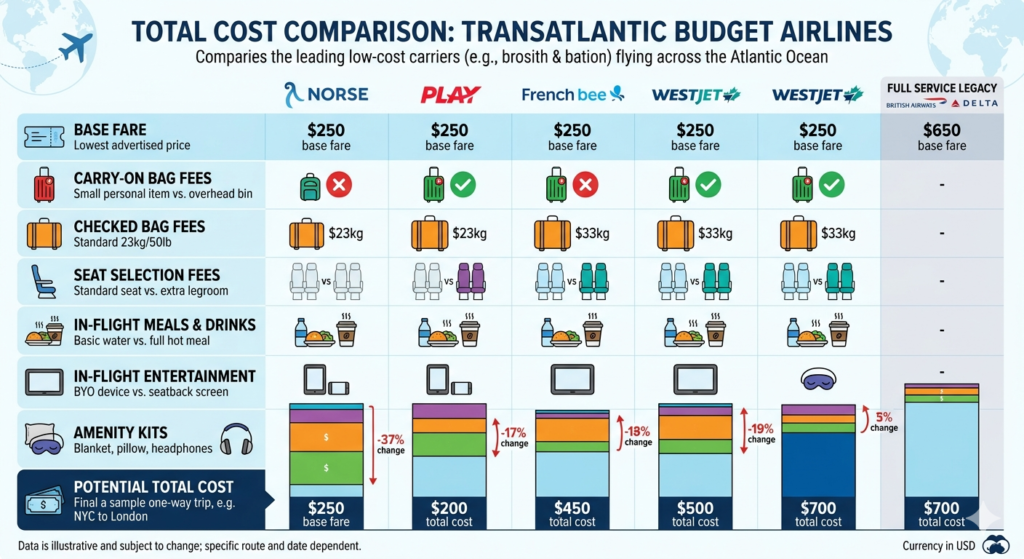
The best budget airlines for long haul flights are Norse Atlantic (transatlantic), Scoot (Asia-Pacific), and Condor (transatlantic with bags included) — but whether any of them actually save you money depends entirely on what you add to the base fare. A $199 transatlantic base fare becomes $620 all-in once you add a checked bag ($150 round-trip), seat selection ($60), and two meals ($60 total). A TAP Air Portugal sale fare on the same route, with everything included, regularly appears at $450-600. The budget carrier isn’t automatically cheaper — it depends on how you travel.
This guide runs that math honestly for each carrier and tells you exactly which traveler profile saves money on budget long-haul, and which traveler would be better off booking a legacy sale fare.
| Carrier | Routes | Bags Included | Best For |
|---|---|---|---|
| Norse Atlantic | Transatlantic (US-Europe) | No — $60-90/bag each way | Carry-on only travelers |
| PLAY Airlines | North America-Iceland-Europe | No | Stopover-open travelers |
| Condor | Transatlantic (Germany-based) | Yes on most fares | Bag-checkers, hybrid value |
| AirAsia X | Asia, Australia, Middle East | No — unbundled | Light packers in Asia |
| Scoot | Southeast Asia, Australia, Europe | No | Asia-Pacific budget travel |
| Jetstar | Trans-Tasman, Asia-Pacific | No | Australia/NZ routes |
Why Most Budget Airline Comparisons Get It Wrong
Most roundups start and end with the base fare. That flatters budget carriers because it ignores the unbundled fee structures that are, by design, how these airlines make their margins. The base fare is the hook. The fees are the business model.
A $199 transatlantic base fare. Add a checked bag ($60-90 each way), a pre-selected seat ($20-50), a meal ($15-25), and an airport check-in fee if you forget to do it online ($40+). That “cheap” ticket has now climbed past what a TAP Air Portugal or Iberia sale fare would have cost with everything included. The budget carrier isn’t always the budget option once you’ve bought back the basics.
The gap is real but narrow, and it only stays in favor of the budget carrier for a specific type of traveler booking in a specific way.
Transatlantic Budget Options
Norse Atlantic Airways
The clearest reference point for transatlantic budget flying right now. Routes between Europe and the US from multiple gateways on both sides, with base fares that frequently undercut legacy carriers. The biggest drawback: the fee structure for bags and seat selection is borrowed directly from short-haul low-cost carriers, which feels more punishing on a nine-hour flight than it does on a two-hour hop. Works best for carry-on-only travelers. Adds up fast for anyone checking bags.
PLAY Airlines
Connects Iceland with North America and Europe, using Reykjavik as a hub. Fares are lean, and it’s a strong option if you’re open to a stopover — but the network is narrow, so it only works for select city pairs. If your route aligns with their schedule, it’s worth pricing. If it doesn’t, there’s no point looking further.
Condor
The German leisure carrier sits in a genuinely interesting middle ground. It flies transatlantic routes with checked baggage included on most fares and offers a business class product. For travelers who need to check a bag, Condor frequently beats pure budget carriers on total value. I’d call it a hybrid worth pricing before defaulting to whatever looks cheapest in the search results — especially on routes where Norse and PLAY don’t operate.
Level (IAG Group)
Operates transatlantic service with budget positioning, primarily out of Barcelona and Paris. Worth checking when timing aligns, though availability on specific routes can be limited. Since it operates under the IAG umbrella (same group as Iberia), you can sometimes find it in the same search flow as legacy carriers.
Asia-Pacific and Long-Haul Budget Options
AirAsia X
Covers long-haul routes across Asia, Australia, and the Middle East out of Kuala Lumpur. Fares are aggressive, but the unbundling is thorough — expect to pay extra for bags, meals, and anything resembling a comfortable seat assignment. For slow travel through Southeast Asia with carry-on only, it’s a strong tool. For anyone checking bags on a return flight, run the total cost before assuming it beats a regional full-service carrier.
Scoot (Singapore Airlines)
The long-haul arm of Singapore Airlines, covering Southeast Asia, Australia, and some routes into Europe. Scoot’s ScootPlus cabin upgrade meaningfully closes the comfort gap with a full-service economy, making it one of the more thoughtfully tiered budget products in the region. If you’re planning extended travel through Southeast Asia, Scoot deserves serious consideration — the gap between its standard and premium tiers is smaller in price than most people expect.
Jetstar (Qantas)
Covers trans-Tasman and Asia-Pacific routes. Reliable, but fees add up quickly and the base product is no-frills. Best suited for specific Australia and New Zealand routes where it has strong route coverage and competitive base fares.
Cabin Space and Comfort: The Honest Trade-Off
Budget long-haul cabins are tighter than full-service economy — that’s the trade. On a two-hour flight, a few inches of seat pitch is an inconvenience. On a ten-hour overnight, it’s the difference between arriving functional and arriving wrecked.
Most long-haul budget carriers configure economy seats at around 29-31 inches of seat pitch. Full-service economy typically offers 31-33 inches. Width follows a similar pattern — budget carriers often add seats per row, narrowing each individual seat.
The smarter budget carriers have addressed this with premium tiers worth pricing at booking:
- Norse Atlantic Premium — more generous pitch and recline on transatlantic routes, often priced below full-service economy
- Scoot’s ScootPlus — the same approach across Asia-Pacific
On routes over nine hours, the jump from standard to premium on a budget carrier is frequently smaller than expected, and often genuinely worth it. For standard economy on long-haul budget carriers, book a window or aisle seat near the front of the cabin early — it won’t fix the pitch but it reduces the misery ceiling.
Where Cheap Flights Stop Being Cheap: The Full Fee Breakdown
Baggage Fees
Checked baggage is the single biggest fee variable. Most budget long-haul carriers charge per bag, per direction — $50-100 per checked bag each way is a realistic range on transatlantic routes. Round-trip with two bags: $200-400 before you’ve eaten or chosen a seat. Carry-on allowances also vary — always verify the size and weight limit for your specific carrier before flying, as some have tightened these rules.
Seat Selection
Seat selection fees apply on almost every budget long-haul carrier unless you accept a random assignment at check-in. On a ten-hour flight, this is a meaningful cost to consider carefully. For a solo traveler comfortable with randomness, skipping it is one of the cleaner ways to keep the total down. For couples or groups who need to sit together, it’s unavoidable.
Meals, Wi-Fi, and Other Extras
Budget long-haul carriers don’t serve free meals. Budget $20-40 for food on a long-haul flight if you don’t pack your own. Wi-Fi is a paid add-on where available. Airport check-in fees ($30-50) are avoidable if you check in online but punishing if you forget. Some carriers add credit card surcharges that don’t appear until the final payment screen.
Layered together, these extras regularly push a cheap-looking base fare into the same pricing territory as a full-service ticket that bundled everything from the start.
Budget Airlines vs Legacy Carriers: Running the Real Numbers
A concrete scenario: solo traveler, round-trip transatlantic, New York to Lisbon, on a budget carrier at a $350 base fare.
- One checked bag round-trip: $150
- Seat selection both ways: $60
- Two meals per direction: $60
Total: $620
A TAP Air Portugal or Iberia sale fare on the same route, booked at a similar window, regularly appears at $450-600 with a checked bag, seat assignment, and a meal included. The budget carrier is now more expensive and delivered less comfort.
The gap holds widest for carry-on-only travelers who eat before boarding. It narrows fastest for travelers checking bags and wanting food. The budget airlines vs legacy carriers decision is really a question about what kind of traveler you are on that specific trip.
When Budget Long-Haul Actually Makes Sense
Budget wins clearly for:
- The carry-on-only traveler, booking 6-10 weeks out, flying off-peak, comfortable with a random seat
- Routes where the full-service alternative requires a connection that adds time and its own costs
- Budget carriers where secondary airports are the only non-stop option
Budget loses clarity for:
- Families or groups with checked bags — fees compound per person, per bag, per direction
- Travelers who need flexibility — most budget long-haul fares are non-refundable or carry steep change fees
- Peak travel windows — budget carrier base fares climb dynamically while fees stay fixed, and full-service sale fares can undercut them
- Overnight routes over 10 hours — the seat comfort gap is real enough to justify paying more for a better product
On booking windows: Budget long-haul fares are cheapest 6-12 weeks before departure on established routes, and expensive when booked inside three weeks or during peak periods. The cheap fare screenshotted in January for August travel often doesn’t look the same in June.
On positioning flights: If the nearest budget gateway requires a separate flight or long train ride, add that cost to the comparison. Secondary airport savings disappear quickly when you factor in the ground transfer.
Essential Internal Resources
These guides on Parandjah Travels cover the related planning layers:
- For the full seasonal flight timing strategy: Finding Flights Off Peak Season
- For the complete flight-saving toolkit: Travel Hacks for Saving on Flights
- For event-specific flight strategy: How to Save on Festival Travel
- For budget destination ideas to pair with cheap flights: 6 Europe Travel Dupes Under $50/Day
- For slow travel routes where budget carriers are the gateway: Slow Travel Guide for Southeast Asia
Master Your Destination: City Budget Guides
Once your flight is locked in, these city guides cover exactly where to stay for less in 24 major hubs:
European Budget Hubs
Madrid · Paris · Rome · Dublin · Lisbon · Budapest · Prague · Vienna · Istanbul · Amsterdam · Milan · Barcelona · Berlin
Asia-Pacific and Americas Budget Hubs
Bangkok · Tokyo · Sydney · Toronto · Singapore · Mexico City · Seoul · Buenos Aires · Cape Town · Chicago · New York
Frequently Asked Questions
Are budget airlines actually cheaper than legacy carriers for long-haul flights?
Sometimes — but only for a specific traveler profile. Carry-on-only travelers booking 6-10 weeks out on popular routes during off-peak windows can genuinely capture the base fare with minimal fee erosion. Anyone checking bags, wanting food, or needing flexibility should run the all-in total cost comparison before assuming the budget carrier is cheaper.
Which budget airline is best for transatlantic routes?
Norse Atlantic is the most established budget transatlantic option, with routes between Europe and the US. Condor is worth comparing when you need to check a bag, since it includes baggage on most fares and its all-in price often undercuts budget-then-add-fees competitors. PLAY is worth checking for Iceland routing specifically.
How do I avoid getting caught by budget airline hidden fees?
Price the all-in cost before committing: base fare + checked bags (both ways) + seat selection + meals. If you don’t need checked bags and will eat before boarding, budget carriers often win clearly. If you need bags and a meal, run the comparison against a legacy sale fare — the gap is frequently smaller than it appears.
Are budget long-haul flights worth it for overnight routes?
Depends on your tolerance for discomfort. On routes under eight hours, standard budget economy is manageable. Over ten hours, the seat pitch difference is real enough to consider a budget carrier’s own premium tier — it’s often closer in price to budget economy than people expect, and significantly better than ten hours in 29-inch pitch.
Want More Free Travel Resources?
Grab the free 2026 Travel Dupes Cheat Sheet for budget-friendly destination ideas to pair with your cheap long-haul flight. Subscribe at the top of parandjahtravels.com to download it instantly.
Conclusion
The best budget airlines for long haul flights save real money — but only for the right traveler on the right booking. Carry-on only, off-peak, flexible seat: the base fare holds. Checked bags, meals, peak travel, overnight route: run the numbers against a legacy sale fare before assuming the discount carrier wins. The math is simple once you do it. Most travelers never do.

Marsha Rowe is the Founder and Travel Strategist at Parandjah Travels. She uncovers high-intent travel intelligence, specializing in slow travel frameworks and sports event logistics.