

A useful travel insurance comparison for budget trips starts with the policy wording and your itinerary, not a universal cheapest provider. Premiums and eligibility depend on residence, age, destination, duration and cover. Compare actual quotes and check existing benefits before deciding what additional protection you need.
Compare cover before comparing premiums
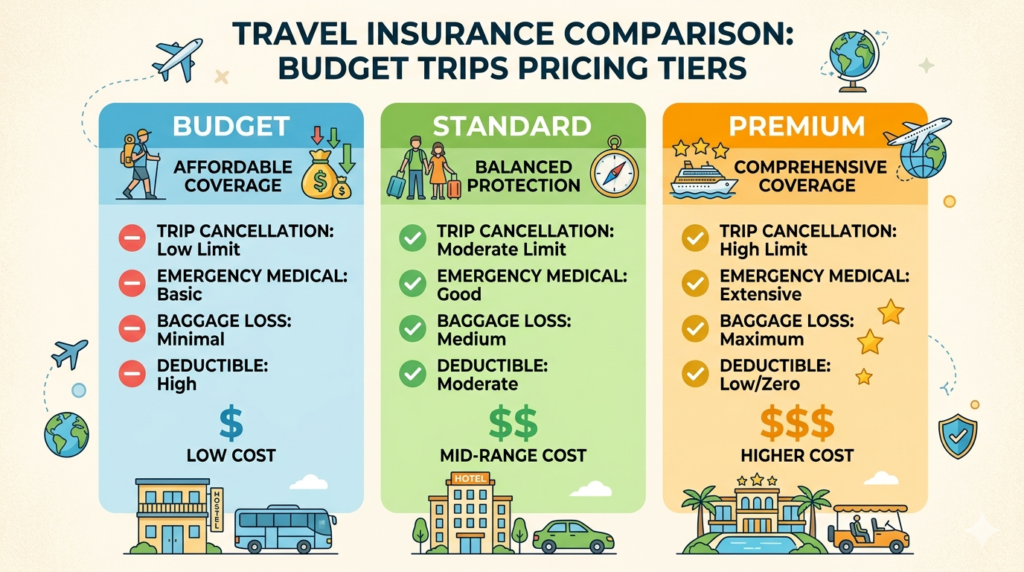
Put two or three quotes side by side with the same traveller details and dates. Record medical limits, evacuation and repatriation provisions, cancellation reasons, interruption benefits, baggage limits, excesses and exclusions. A lower premium with a larger excess or a smaller single-item limit may be a poor match for the losses you are trying to insure. Marketing labels such as basic or premium are not standardised coverage tiers.
Check existing insurance and card benefits
Read your health insurer’s overseas provisions and your card’s current benefit certificate. Card cover varies: it may require eligible purchases with the card, limit trip duration or cover only named people. Some cards include medical or evacuation benefits; others do not. Crossing an EU border does not universally determine card coverage. Identify any gaps in writing rather than assuming a short domestic trip is automatically covered.
Match the policy to every travel day
The FCDO’s insurance guidance advises checking the full trip length and destinations. Annual multi-trip cover can limit each individual journey, so it is not automatically suitable for several months of continuous travel. Check long-stay or other eligible options against the complete itinerary, including transit stops and any planned return visits home.
Medical treatment, evacuation and assistance
Check how medical cover, emergency evacuation and repatriation are defined, who authorises transport and what you may have to pay upfront. There is no single dollar limit that is sufficient for every destination and traveller. Ask the insurer about the destination and intended activities when choosing limits. Save the assistance number and policy reference offline; follow the emergency procedure in the wording when practicable.
Cancellation is tied to specified reasons
Standard cancellation cover generally pays only when the policy’s conditions and covered reasons are met. A change of mind is not automatically insured. Record the non-refundable amount you would lose if you cancel, rather than insuring costs that the supplier will refund. Check when cancellation cover begins and whether purchase timing affects any benefit.
Check conditions and activities before buying
Declare information the insurer requests accurately and ask how pre-existing conditions are treated. For trekking, diving, cycling or scooter use, check the relevant activity wording, limits and licence or equipment requirements. An activity may be included, excluded or available through an extension. Obtain clarification in writing when a definition is unclear.
Understand baggage and delay benefits
A total baggage limit is different from a single-item or valuables limit. Compare those limits with the items you actually carry and check unattended-property exclusions. Delay benefits may have a waiting period and a daily or overall cap. Airline obligations and insurance benefits are separate; neither should be described as universally absent for budget carriers.
A hypothetical price comparison
Imagine policy A costs $45 with a $200 excess and policy B costs $70 with a $50 excess. For a covered $500 loss subject to that excess alone, the possible payment would be $300 or $450 respectively. This illustration is not a quote or a promise of payment: limits, exclusions and claim conditions still apply. Compare the entire policy before paying more solely for a lower excess.
Keep documents and follow the claim procedure
Save the policy, receipts and booking confirmations securely. Check the required notification deadlines and evidence for the type of claim; a universal 24–48-hour reporting rule should not be assumed. Ask the insurer about authorisation before committing to significant replacement travel when circumstances allow. In an emergency, obtain appropriate help and contact assistance as soon as practicable.
Questions to settle before checkout
Can you buy this policy as a resident of your country? Does it cover all trip dates and destinations? Are your conditions and activities eligible? Is the cancellation amount appropriate? What is the excess for each claim type? If a broker or insurer cannot resolve an important uncertainty, keep comparing before purchasing.
Essential Internal Resources
These guides on Parandjah Travels cover the related planning layers:
- For destination dupes specifically: 6 Europe Travel Dupes Under $50/Day
- For avoiding crowds at major destinations: Day Trip Alternatives to Popular Tourist Sites
- For timing your flights around this trip: Finding Flights Off Peak Season
- For eating well on a budget once you land: Food Tour Alternatives for Local Eating Travel
- For Balkan-specific slow travel: Balkan Budget Rotation Guide
Master Your Destination: City Budget Guides
Pair your insurance plan with a smart, affordable home base. These city guides cover exactly where to stay for less in 24 major hubs:
European Budget Hubs
Madrid · Paris · Rome · Dublin · Lisbon · Budapest · Prague · Vienna · Istanbul · Amsterdam · Milan · Barcelona · Berlin
Asia-Pacific and Americas Budget Hubs
Bangkok · Tokyo · Sydney · Toronto · Singapore · Mexico City · Seoul · Buenos Aires · Cape Town · Chicago · New York
Frequently Asked Questions
Is travel insurance really necessary for a short budget trip?
Trip length alone does not determine whether existing cover is sufficient. Check overseas medical cover, cancellation exposure and the current wording of any card benefits. Compare additional eligible insurance against the gaps you identify.
How much does budget travel insurance actually cost per day?
There is no reliable universal daily price. Obtain quotes using your residence, age, dates, destinations and required cover, then compare limits, excesses and exclusions as well as the premium.
Does my credit card’s travel insurance cover international medical evacuation?
It depends on the specific card’s benefit certificate and eligibility conditions. Some cards offer medical or evacuation benefits and others do not. Check the wording and any requirement to pay travel costs with the card.
What’s the most common reason a travel insurance claim gets denied?
Claims can fail because a loss is excluded, eligibility conditions are not met or required evidence is missing. This guide does not rank denial reasons. Follow the policy’s own reporting deadlines and documentation requirements.
Want More Free Travel Resources?
Explore more practical accommodation, transport and packing guides at Par & Jah Travels.
Conclusion
Choose insurance by matching eligible cover to your actual itinerary and potential losses. Compare the wording, limits and excesses, and keep the assistance and claim instructions accessible.

Marsha Rowe is the Founder and Travel Strategist at Parandjah Travels. She uncovers high-intent travel intelligence, specializing in slow travel frameworks and sports event logistics.