
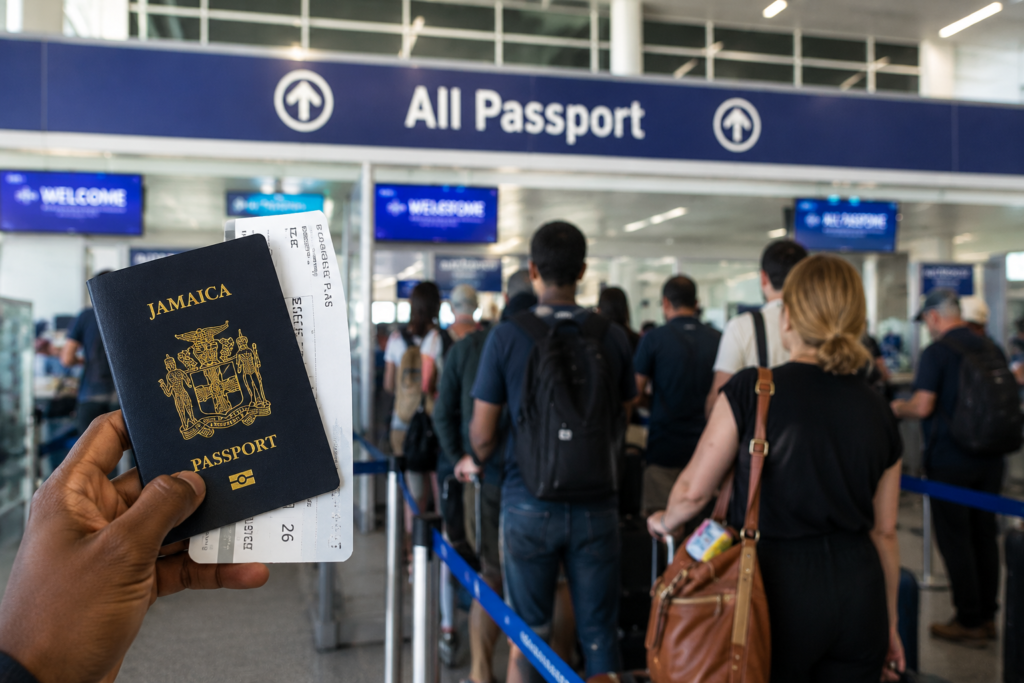
Your FIFA World Cup 2026 match ticket does not get you across any border. To legally enter the United States, Canada, or Mexico during the tournament, you need a valid passport plus the specific visa, eTA, ESTA, or FMM card required for your nationality and entry method — and each of the three host countries has its own separate rules. If your trip spans more than one country, you potentially need three separate entry documents, not one.
Here’s the live breakdown of what’s actually required at each border, current as of this writing.
| Destination | Air Arrival Requirements | Land Border Requirements |
|---|---|---|
| United States | Approved ESTA or B1/B2 visa + onward travel proof | Passport + completed I-94 electronic form |
| Canada | Approved eTA or visitor visa + Advance Declaration | Passport + standard customs declaration |
| Mexico | Physical passport book + FMM card | Passport book or card + FMM card |
Why a Match Ticket Doesn’t Replace a Visa
This is the single most important thing to understand before booking anything: a World Cup ticket creates no special immigration category, no fast track at the border, and no automatic right of entry to any of the three host countries. Every fan still needs valid travel authorization, and the final decision always sits with the border officer at the port of entry — not with FIFA, and not with your ticket confirmation email.
With three host nations involved, immigration agencies are expecting major pressure on processing systems. U.S. Customs and Border Protection received over 5.9 million ESTA applications between October 2025 and April 2026 alone, with the United Kingdom, France, Germany, Japan, and South Korea leading in approval volume. That kind of demand means longer lines and longer processing times the closer you get to kickoff — applying early isn’t just good advice, it’s the only way to guarantee you have time to recover if something goes wrong with your application.
Entering the United States
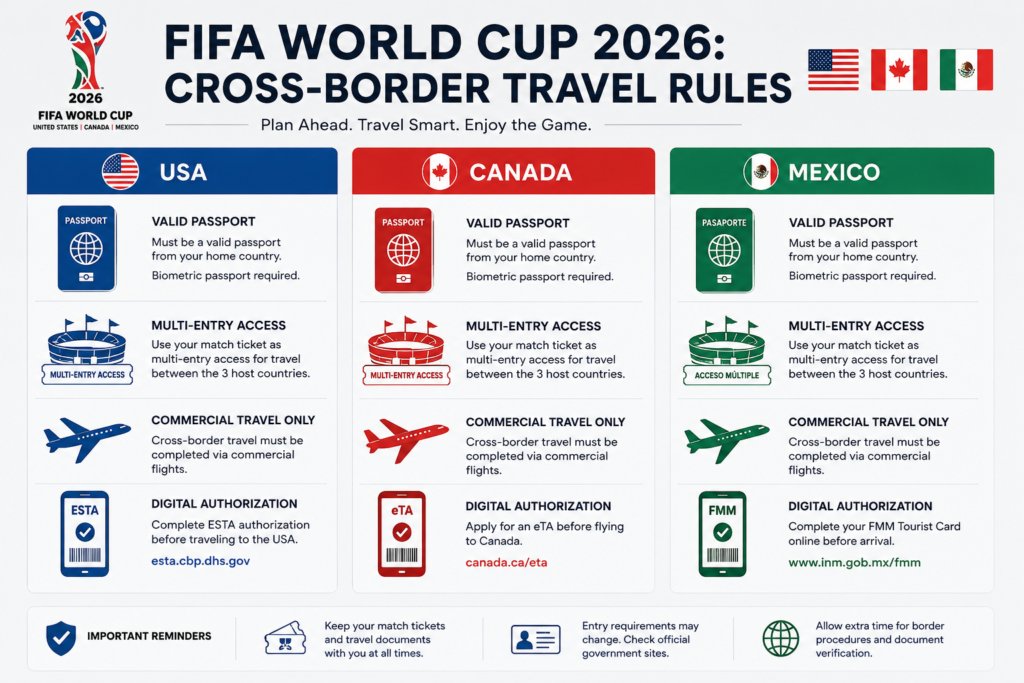
U.S. Customs and Border Protection enforces the same standard immigration rules at every air, land, and sea port of entry — there is no separate “World Cup visa.”
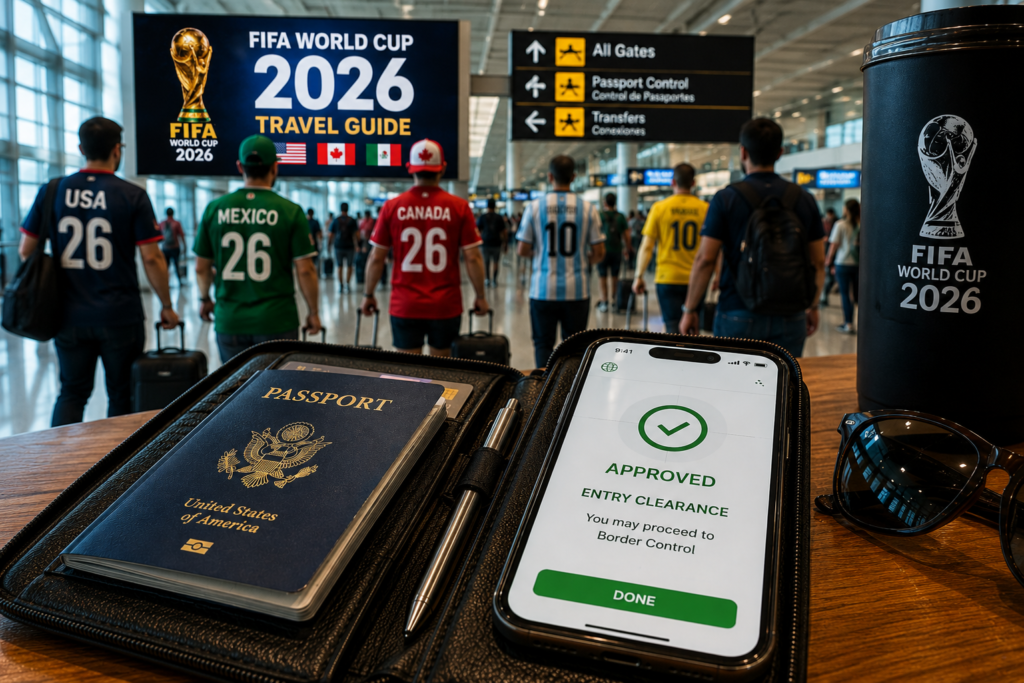
Visa Waiver Program (ESTA)
Citizens of the 42 Visa Waiver Program countries — including the UK, Australia, Japan, South Korea, Chile, and most of the EU — need an approved ESTA linked to their passport before boarding. Applications are typically processed within 72 hours, but given the volume CBP is handling for this tournament, applying weeks in advance rather than days is the safer move. Canadian and Bermudan passport holders don’t need an ESTA, a B1/B2 visa, or FIFA PASS at all — a valid passport is sufficient for U.S. entry as a tourist.
B1/B2 Visas and FIFA PASS
If your nationality isn’t covered by the Visa Waiver Program, you’ll need a standard B1/B2 visitor visa. FIFA PASS (Priority Appointment Scheduling System) is available to fans who purchased World Cup tickets directly — it gives you access to an earlier or dedicated visa interview slot at participating embassies and consulates. It’s worth being clear about what FIFA PASS actually does: it only affects appointment scheduling. It doesn’t change visa eligibility, admissibility standards, or the standard security screening every applicant goes through. Some FIFA PASS participants who bought tickets by the required deadline may also qualify for an exemption from the visa bond requirement under the Visa Bond Pilot Program — but that exemption removes only the bond, not the rest of the application process.
Onward Travel and Land Border Requirements
If you’re entering on an ESTA, carry physical or digital proof of an onward itinerary departing the U.S. — match tickets, hotel confirmations, and return flight details all help demonstrate this at the port of entry. Driving in from Canada or Mexico requires completing an electronic CBP I-94 Arrival Record online, which logs your authorized stay duration. Overstaying that authorized period, including the standard 90-day ESTA limit, carries real consequences for future U.S. travel eligibility — not just for this trip.
Trusted Traveler Programs Worth Checking
With millions of fans expected at airports and land crossings simultaneously, it’s worth checking whether you qualify for a Trusted Traveler Program for expedited clearance: Global Entry for eligible international travelers using automated kiosks, SENTRI for land crossings from Mexico, and NEXUS for expedited US-Canada border crossings. None of these are World Cup-specific, but the existing infrastructure becomes considerably more valuable during a tournament of this scale.
CBP has also built a dedicated virtual assistant called COMPASS specifically for World Cup travelers, designed to give official answers to common entry and documentation questions in one place. Using it directly is a more reliable way to verify your specific requirements than relying on general travel advice, including this guide — rules can shift, and COMPASS reflects CBP’s current position in real time.
Entering Canada
The Canada Border Services Agency has been explicit: there is no special World Cup visa. Standard immigration checks apply to every fan regardless of ticket status.
Electronic Travel Authorization (eTA)
Air travelers from visa-exempt countries need an approved eTA before flying — it’s linked electronically to the passport used in the application. If your nationality isn’t on Canada’s visa-exempt list, you’ll need a Temporary Resident Visa (TRV) instead of an eTA. Canadian authorities have specifically encouraged applicants to mention “FIFA World Cup 26” in their application, which may help with processing and tracking during the surge in tournament-related travel.
Advance Declaration
To skip long lines at major Canadian airports, complete your customs declaration in advance through the official Advance Declaration system, available up to 72 hours before landing.
Strict Prohibitions and Minors Traveling Alone
It’s illegal to bring cannabis in any form, vaporizers, e-cigarettes, or firearms across the Canadian border — even with a valid medical prescription or permit from your home country. Children under 18 entering Canada without both parents need a physical parental consent letter signed by the non-traveling parent or parents.
Entering Mexico
Mexico is broadly accessible for international visitors, but the specific documents required depend on how you cross the border.
Passport Book vs. Passport Card
If you’re a U.S. citizen driving across a land border into Mexico, a standard U.S. Passport Card works fine. If you’re flying into Mexico City, Guadalajara, or Monterrey — the three Mexican host cities, together hosting 13 matches including the tournament opener at Estadio Azteca — you need a physical U.S. Passport Book. A passport card alone won’t get you through airport immigration.
The FMM Tourist Card
If you’re a U.S. citizen driving across a land border into Mexico, a standard U.S. Passport Card works fine. If you’re flying into Mexico City, Guadalajara, or Monterrey — the three Mexican host cities, together hosting 13 matches including the tournament opener at Estadio Azteca — you need a physical U.S. Passport Book. A passport card alone won’t get you through airport immigration.
The FMM Tourist Card
All foreign visitors need a Forma Migratoria Múltiple (FMM) tourist card, which is increasingly handled digitally and covers stays of up to 180 days for most nationalities. It can be completed in advance online through Mexico’s Instituto Nacional de Migración, which is worth doing before you travel rather than scrambling at the airport.
Visa Waivers for Third-Country Nationals
Many nationalities that would normally need a Mexican visa can skip that process entirely if they already hold a valid, unexpired visa or residence permit from the United States, Canada, the UK, Japan, or a Schengen Area country. This is a genuinely useful shortcut if you already have one of those documents from prior travel.
Planning a Multi-Country Trip
If your itinerary includes matches in more than one host country — say, Mexico City, then Toronto, then a quarterfinal in New York — treat each country’s entry requirements as completely independent. Entry approval for the U.S. doesn’t transfer to Canada or Mexico, and you need to qualify for each one separately. Given that immigration agencies across all three countries are anticipating their highest demand in tournament history, building in extra buffer time between applications and matches is genuinely worth it — a delayed visa interview in one country shouldn’t be allowed to threaten your itinerary in another.
Essential Internal Resources
These guides on Parandjah Travels cover the related planning layers:
- For neighborhood-level lodging in the Mexican host cities: Mexico 2026 World Cup Accommodation Guide
- For protecting your trip financially: Travel Insurance Comparison for Budget Trips
- For timing your flights around tournament dates: Finding Flights Off Peak Season
- For event-specific budget strategy: How to Save on Festival Travel
- For choosing where to stay in any host city: Where to Stay in Major Cities on a Budget
- Live Logistics & Match-Day Transit : FIFA World Cup 2026 Travel Guide
Master Your Destination: City Budget Guides
Extending your World Cup trip into other destinations? These city guides cover exactly where to stay for less in 24 major hubs:
European Budget Hubs
Madrid · Paris · Rome · Dublin · Lisbon · Budapest · Prague · Vienna · Istanbul · Amsterdam · Milan · Barcelona · Berlin
Asia-Pacific and Americas Budget Hubs
Bangkok · Tokyo · Sydney · Toronto · Singapore · Mexico City · Seoul · Buenos Aires · Cape Town · Chicago · New York
Frequently Asked Questions
Does a FIFA World Cup ticket guarantee entry to the host countries?
No. A ticket alone never guarantees border entry to the United States, Canada, or Mexico. It can support a visa application in some cases, but immigration officers in each country make the final entry decision independently, regardless of ticket status.
Do I need separate travel authorization for each host country?
Yes. Entry approval for the United States does not automatically grant entry to Canada or Mexico, and vice versa. If your trip spans multiple host countries, you need to independently qualify for entry into each one.
What is FIFA PASS and does it guarantee a US visa?
FIFA PASS is a priority appointment scheduling system for World Cup ticket holders who need a US visitor visa. It only affects how quickly you can get a visa interview — it does not change visa eligibility, admissibility standards, or guarantee approval. Standard screening and security checks still apply.
How early should I apply for ESTA, eTA, or an FMM card before the tournament?
As early as possible. ESTA and eTA approvals are typically valid for two years, so there’s no downside to applying well ahead of your trip. Given the scale of demand expected across all three host countries, applying weeks or months in advance — rather than the standard 72-hour minimum — gives you time to recover if an application is delayed or denied.
Want More Free Travel Resources?
Grab the free 2026 Travel Dupes Cheat Sheet for budget-friendly destination ideas to extend your World Cup trip. Subscribe at the top of parandjahtravels.com to download it instantly.
Conclusion
The 2026 World Cup is the first tournament hosted across three countries with three completely separate legal systems governing entry. There’s no unified World Cup visa and no shortcut around standard immigration rules — your ticket gets you into the stadium, not across the border. Apply for whatever documentation your nationality requires as early as possible, treat each host country’s requirements independently if your trip spans more than one, and use official sources like CBP’s COMPASS tool to verify anything that’s changed since this guide was last updated.

Marsha Rowe is the Founder and Travel Strategist at Parandjah Travels. She uncovers high-intent travel intelligence, specializing in slow travel frameworks and sports event logistics.