

The travel hacks for saving on flights that still work in 2026 come down to three things: automated fare alerts set against a researched price ceiling before you start watching, secondary airport routing that trades a short ground transfer for a meaningful fare drop, and flexible departure dates that let the price calendar work in your favor. Incognito mode, Tuesday booking, and cookie-clearing don’t work — airline pricing is session-independent and pulled from a central database, not your browser history. I’ll cover what actually does.
| Strategy | What It Does | Realistic Saving |
|---|---|---|
| Automated fare alerts | Tracks historical price ceilings via Hopper or Google | Zero manual effort |
| Secondary airport routing | Targets airports 60 minutes from destination | 30%+ off base fare |
| Flexible departure dates | Uses price calendar to find cheapest window | 20-40% on popular routes |
Why Generic Flight Advice Stops Working
Airlines run sophisticated dynamic pricing systems. When a strategy goes mainstream enough — “book six weeks out,” “fly on Wednesdays” — enough travelers act on it to close the arbitrage gap, and the tip becomes self-defeating. The version of timing advice you find in a top-10 list is rarely the version that still holds.
What still works is built on fare structure mechanics and automation, not on habits that airlines have already priced into their systems.
Fare Alert Automation: Stop Checking Manually
Watching prices every day is exhausting and statistically worse than setting a structured alert and walking away.
Setting Alerts That Trigger at the Right Price
The key move is anchoring on a target price before you set an alert, not after you’ve been watching a route and adjusted your expectations upward. Research the historical price range first, set your ceiling, then let the alert do the work.
Google Flights lets you track any route with email alerts when the fare changes. The price graph showing the past few months of fare movement is particularly useful for calibrating what “cheap” actually means on a specific corridor.
Hopper’s “Watch a Trip” feature goes further — it uses historical data and a predictive model to advise whether to buy now or wait, and pushes a notification when it detects a dip toward its predicted low. Not always right, but a useful second opinion on routes where you have timing flexibility.
Kayak offers price forecasting with a buy-or-wait recommendation alongside standard alerts. Less precise than Hopper on predictions but covers more route types.
The discipline: set a target price ceiling, then close the tab. Watching prices daily creates psychological anchoring that makes you rationalize paying more than you should.
Booking Windows by Route Type
- Domestic and short-haul: 3-6 weeks out. Airlines release seats in waves, and the mid-range window before last-minute premiums kick in is where the value sits.
- International long-haul: 2-5 months out. Far enough that airlines are still filling the cabin, close enough that most fare inventory has been released. Booking 9-12 months out often means paying full flexible-fare prices.
- Peak travel periods: pull both windows 4-6 weeks earlier. The heuristic holds — the calibration shifts.
Flight Search Strategies That Surface Real Savings
Incognito Mode and VPNs: The Honest Assessment
Incognito mode does not lower flight prices. This myth has been circulating for over a decade. Modern airline and OTA pricing is session-independent — fares are pulled dynamically from a central database based on seat inventory, not stored in your browser cookies. Clearing cookies changes nothing.
VPNs are a partial exception, but not for the reason most people think. Switching your IP to a different country won’t unlock secret prices on most major routes. What does occasionally work: some regional OTAs display fares in local currency at rates that, after conversion, undercut the same fare priced in USD or EUR — most reliably when searching for flights originating from a lower-cost market. Worth a quick check, not a reliable strategy to build around.
The bigger version of this is simply using multiple search tools. Google Flights is excellent for flexibility searches. Skyscanner and Momondo sometimes surface fares that Google misses, particularly on low-cost carriers that don’t always feed into Google’s index.
Nearby Airport Routing
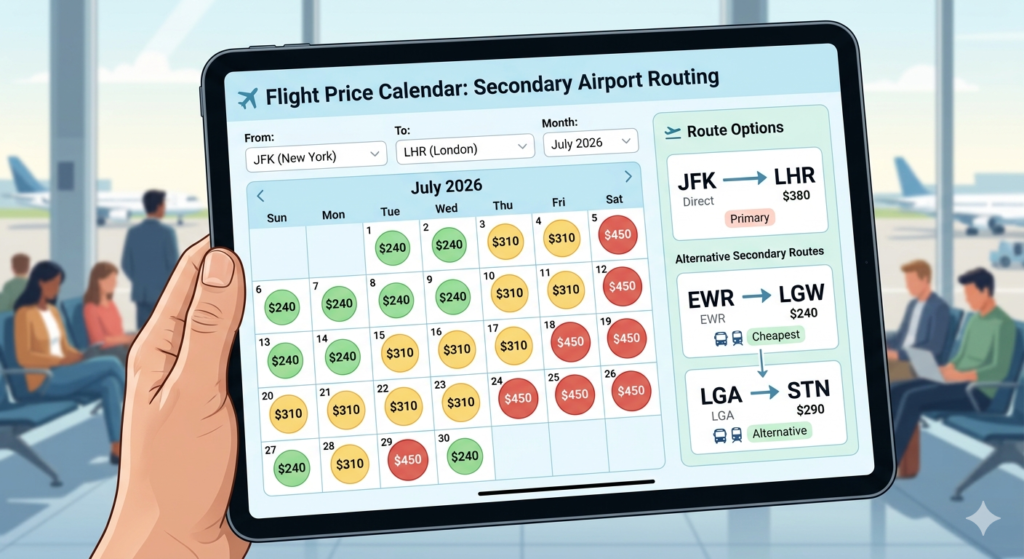
Flying into a secondary airport 60-90 minutes from your destination often cuts the fare significantly — London Stansted vs. Heathrow, Paris Beauvais vs. CDG are the classic examples. Always factor in the actual ground transfer cost before declaring the savings real. A cheaper flight that requires an expensive bus or taxi can easily cost more than the convenient option.
Open-Jaw Routing
Fly into one city, depart from another. Airlines price each leg independently, so an open-jaw itinerary often costs the same as or less than a standard round trip — while also eliminating the need to backtrack. Build it in Google Flights’ multi-city mode and compare against a standard return.
Hidden-City Ticketing: The Real Risks
Hidden-city ticketing is the most misunderstood strategy in flight booking. It involves booking a connecting itinerary where the layover city is your actual destination, because that connecting fare is cheaper than flying direct to that city.
Example: A nonstop New York to Chicago might cost $280. A New York → Chicago → Denver itinerary might be priced at $190 because Denver is a highly competitive route. You book it, get off in Chicago, and never board the final leg. Skiplagged is the primary tool built around surfacing these routes.
Before using this, the risks are not optional reading:
- Carry-on only, no exceptions. Your bags travel to the final destination on the ticket, not your layover city.
- One-way bookings only. Airlines automatically cancel your entire return leg the moment you miss a segment on the outbound.
- Account bans are real. Major carriers track this pattern — repeated use puts your frequent flyer miles and loyalty status at genuine risk of permanent cancellation.
For an occasional low-stakes trip where you’re carry-on only with no status to protect, the savings can be real. For anyone building toward a points redemption or traveling with checked bags, skip it.
Points, Errors, and Mistake Fares
Transferable Points Currencies
Chase Ultimate Rewards, Amex Membership Rewards, and Capital One Miles are the most consistently powerful lever for unlocking business class at something closer to economy prices — transfer points to partner airlines and book award seats at rates that don’t exist at cash prices on transatlantic or transpacific routes. The mechanism rewards people who pay attention to transfer bonuses and airline partner charts.
Before assuming budget carriers are always cheaper on long-haul, check the real cost including bag fees, seat selection, and meals — this can quickly close the gap with a full-service carrier, especially when a points redemption is in play.
Mistake Fares
Mistake fares happen when airlines publish tickets at a fraction of the real price — a business class seat to Tokyo accidentally priced at economy rates, or a transatlantic fare under $300 because a fuel surcharge didn’t apply. Going (formerly Scott’s Cheap Flights), Secret Flying, and Airfarewatchdog document these regularly.
The window to act is short, typically a few hours. Rules for acting:
- Book immediately — the fare disappears fast
- Don’t buy non-refundable ancillaries (bags, seat upgrades, insurance) until the fare has been held 24-48 hours and looks confirmed
- Keep plans flexible for 48 hours — some mistake fares get cancelled and refunded; don’t book connecting travel or hotels until the ticket is solid
- Check DOT rules if you’re in the US — the Department of Transportation has historically required airlines to honor mistake fares in some circumstances, though enforcement has evolved
Finding Cheap Flights for Slow Travel and Long Trips
If your dates are flexible across a 2-4 week window, you’re playing a fundamentally different game than most travelers. Flexibility in departure date is worth more than almost any other single variable in airfare savings.
Google Flights’ “Explore” mode and Skyscanner’s “Everywhere” search are built exactly for this — enter your origin, leave the destination open, sort by price. You’ll regularly find a destination you’d genuinely enjoy visiting at 40-60% below the place you originally planned.
For slow travel through Southeast Asia, this approach is particularly powerful. Regional hubs like Kuala Lumpur, Bangkok, and Taipei are served by dense low-cost carrier networks, and the “everywhere” search frequently surfaces entry points that position you well for overland travel onward. Fly into the cheapest hub, not the most obvious one. The same logic applies in Europe — find what’s cheapest from your home airport, then build a slow itinerary outward from that entry point.
Essential Internal Resources
These guides on Parandjah Travels cover the related planning layers:
- For the full seasonal timing strategy: Best Time to Visit Popular Destinations
- For destination dupes specifically: 6 Europe Travel Dupes Under $50/Day
- For event and festival-specific flight strategy: How to Save on Festival Travel
- For the complete trip-planning framework: How to Plan a Trip on a Budget
- For finding flights off-peak specifically: Finding Flights Off Peak Season
Master Your Destination: City Budget Guides
Once your flight is locked in, these city guides cover exactly where to stay for less in 24 major hubs:
European Budget Hubs
Madrid · Paris · Rome · Dublin · Lisbon · Budapest · Prague · Vienna · Istanbul · Amsterdam · Milan · Barcelona · Berlin
Asia-Pacific and Americas Budget Hubs
Bangkok · Tokyo · Sydney · Toronto · Singapore · Mexico City · Seoul · Buenos Aires · Cape Town · Chicago · New York
Frequently Asked Questions
Does incognito mode actually lower flight prices?
No. This is one of the most persistent myths in travel. Modern airline and OTA pricing is session-independent — fares are pulled from a central inventory database, not tied to your browser cookies or search history. Clearing cookies changes nothing.
What’s the best tool for tracking flight prices?
Google Flights for flexibility searches and price history graphs, Hopper for buy-now-or-wait predictions on specific routes, and either Skyscanner or Momondo as a secondary check to catch low-cost carriers that don’t always appear in Google’s index. Running two tools simultaneously catches deals that any single platform misses.
Is hidden-city ticketing legal?
It’s not illegal, but it violates most airlines’ terms of service, which means they can cancel your remaining flights and ban your loyalty account if they detect a pattern of it. It only makes sense carry-on only, on one-way bookings, and for travelers with no frequent flyer status to protect.
How far in advance should I book an international flight?
The general sweet spot is 2-5 months out for long-haul international routes. Too early (9-12 months) often means paying full flexible-fare prices before airlines have released promotional inventory; too late (under 3 weeks) means paying a last-minute premium for whatever seats remain.
Want More Free Travel Resources?
Grab the free 2026 Travel Dupes Cheat Sheet for budget-friendly destination ideas to pair with your savings on flights. Subscribe at the top of parandjahtravels.com to download it instantly.
Conclusion
The flight-saving strategies that still work in 2026 are built on fare structure mechanics and automation, not on tips airlines patched years ago. Set your price ceiling before you start watching a route, use multiple search tools simultaneously, consider secondary airports and open-jaw routing when the ground transfer math works out, and sign up for at least one mistake-fare alert service. The travelers paying full price are almost always the ones who skipped the setup.

Marsha Rowe is the Founder and Travel Strategist at Parandjah Travels. She uncovers high-intent travel intelligence, specializing in slow travel frameworks and sports event logistics.