

The most reliable way how to book hotels without paying booking fees is to use major platforms like Booking.com and Expedia as price research tools, then book directly with the hotel. Every OTA charges hotels a 15-25% commission, which hotels typically pass to you in the listed price — then the platform adds its own service fee on top. Going direct removes both layers, and hotels can now legally offer you a better price than their OTA listing since rate parity clauses have been weakened or banned across Europe and are increasingly unenforceable in the US.
Here’s the full playbook, including which loyalty programs are worth your time in 2026 and the discounts most travelers never think to ask about.
Why Booking Fees Exist and Who Actually Pays Them
How OTAs Make Their Money
Booking.com, Expedia, and their rivals charge hotels a commission of 15-25% on every reservation — a range consistent across hotel industry trade bodies and hospitality finance analysts. Hotels have two choices: absorb that cost, or bake it into the listed rate. Most do the latter. That “deal” price on a major platform is often the same as or higher than what the hotel would charge you directly, before you factor in platform service fees, currency conversion markups, or mandatory resort fees that appear only at the checkout screen.
What Resort Fees Actually Are
Resort fees are charged by the hotel itself, usually mandatory, and frequently invisible until the final checkout screen. They exist partly as recoverable revenue regardless of which channel you booked through. The US Federal Trade Commission has pushed for clearer disclosure, but enforcement remains uneven. The practical advice: always search the all-in total price, not the headline nightly rate, before comparing options.
The Rate Parity Shift That Changes Everything
Rate parity clauses once contractually forced hotels to never publicly undercut their OTA-listed price. France and Germany have banned them. The UK’s Competition and Markets Authority effectively weakened them there. They’re increasingly unenforceable in the US market. That legal shift means hotels can now quietly offer a better price to guests who contact them directly — most won’t advertise this, but you can ask.
How to Book Directly and Actually Get a Better Price
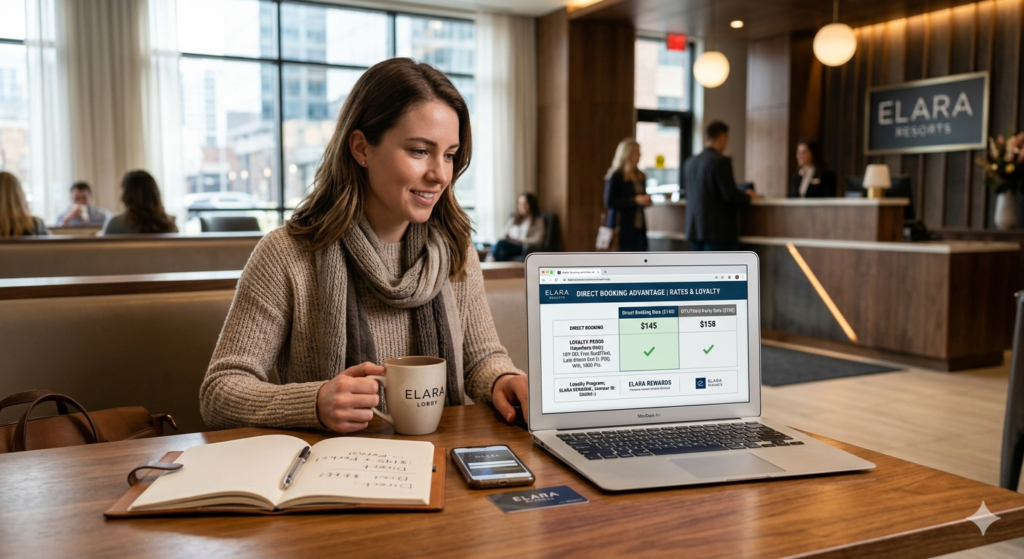
The process is straightforward once it becomes a habit:
- Find the room you want on an OTA — use it as a price research tool, not a booking tool
- Go to the hotel’s official website directly — search the hotel name plus “official site” to avoid sponsored OTA listings masquerading as the property’s own page
- Look for a Best Rate Guarantee badge — most chain hotels and a growing number of independents publish one, promising to match any lower rate you find
- Call or email the front desk — ask directly: “Is there a direct-booking rate or any incentive for booking with you instead of an OTA?” At independent hotels especially, the answer is often a room upgrade, complimentary breakfast, or a 5-10% discount off the listed rate
- Book through the hotel’s own secure payment page — not a third-party redirect
When Direct Booking Wins Most Reliably
Direct booking beats platforms most consistently in two situations. First, at independent boutique hotels, where OTA commission eats a larger share of a smaller operation’s margin, making direct incentives genuinely worth offering — these are exactly the kind of properties featured in the hidden gems and affordable city guides on this site. Second, on longer stays: the more nights you’re booking, the more the hotel saves on commission, and the more flexibility they have to reward you for going direct. A 10-day direct booking at an independent property can unlock a negotiated weekly rate that no platform will ever surface — these don’t appear online, you get them by asking.
Hotel Loyalty Programs Worth Using in 2026
Three programs dominate the conversation and they’re not equal:
World of Hyatt is the best-value program for infrequent travelers. Points don’t expire while your account is active, free-night thresholds are lower than at Marriott or Hilton, and a single co-branded card sign-up bonus can cover a free night at a category 1-4 property without staying a single additional night.
Hilton Honors has the widest property footprint and runs frequent points promotions. Redemption rates per point are lower than Hyatt’s, but its strength is coverage — especially in secondary cities and airport-adjacent locations.
Marriott Bonvoy is the largest program by property count. Points are worth less individually, but the volume of earning opportunities and the depth of the soft-brand portfolio make it compelling for frequent travelers.
Stacking Points With Credit Card Rewards
The fastest path to a free night without extra travel: pair a hotel co-branded credit card with your chosen program. Hyatt’s card with Chase, Hilton’s with Amex, and Marriott’s with both Chase and Amex all offer sign-up bonuses large enough to cover one to several free nights if you hit the minimum spend threshold.
For travelers who want locally distinctive properties, Marriott’s Autograph Collection and Hilton’s Curio Collection let boutique-feel hotels participate in major loyalty ecosystems — you earn and redeem points at a converted 19th-century townhouse or a design-forward coastal inn without sacrificing program benefits.
OTA vs. Direct Booking: The Honest Comparison
| Factor | OTA Booking | Direct Booking |
|---|---|---|
| Price transparency | Strong — easy to compare many properties | Requires checking multiple hotel sites |
| Total cost | Often higher once service fees added | Usually lower, no platform markup |
| Loyalty points | Generally not earned | Earned and status credited |
| Cancellation flexibility | Varies by platform policy | Hotels extend more goodwill to direct guests |
| Upgrades/perks | Rare | Higher probability |
| Unpublished rates | Not available | Accessible by asking directly |
The verdict: Use OTAs to research. Book direct to pay less. The platforms are better price-comparison tools than booking tools, and treating them that way costs you nothing.
The Cheapest Way to Book Hotels: Combining Strategies
Price Alert Tools and Rate Trackers
Google Hotels is the cleanest free tool for comparison — it aggregates prices without charging a booking fee and links directly to hotel sites. Hotelscombined does similar work across a wider OTA inventory. Use both to establish a price floor, then contact the hotel directly.
The repeatable playbook:
- Set a Google Hotels price alert for your destination and dates
- When the rate drops to your target, check the hotel’s own site for a match or better
- If you’re a loyalty member, check the program portal — member rates are often 5-10% below the public direct rate
- If booking more than a week out, call the hotel, reference the lowest rate you found, and ask if they can match it with any added benefit
Timing Your Booking
Mid-week arrivals (Tuesday-Thursday check-in) consistently yield lower nightly rates than weekend arrivals. A 21-30 day advance booking window hits the sweet spot between availability and competitive pricing — too far out and hotels hold rates high; too close and prices spike or rooms sell out.
For last-minute bookings within 48 hours, HotelTonight remains the best tool for genuine same-day discounts. Hotels would rather fill a room at 60% of rack rate than leave it empty — that’s a supply reality, not a loyalty play.
Hotel Discounts Most Travelers Never Think to Ask For
The most underused discounts are the ones hotels keep quiet because they’d rather you pay rack rate:
- AAA and AARP rates — knock 5-15% off at most major chains for members who remember to enter the code at booking
- Government and military rates — reliable and rarely require more than an ID at check-in
- Corporate rate codes — large companies negotiate discounted rates with hotel chains, and many of these codes circulate publicly. Entering a corporate code is technically a terms violation at some properties, but front desks rarely verify employment
- Extended-stay negotiation — for stays of 10+ days, a direct conversation with a front desk manager before booking can unlock 20-30% off a rate that doesn’t exist anywhere online
Essential Internal Resources
These guides on Parandjah Travels cover the related planning layers:
- For where to stay in affordable neighborhoods globally: Where to Stay in Major Cities on a Budget
- For timing your trip to avoid peak hotel pricing: Best Time to Visit Popular Destinations
- For event-specific accommodation strategy: How to Save on Festival Travel
- For the complete trip-planning framework: How to Plan a Trip on a Budget
- For finding flights as cheaply as the hotel: Travel Hacks for Saving on Flights
Master Your Destination: City Budget Guides
These city guides cover exactly where to stay for less in 24 major hubs — useful for identifying which neighborhoods to target before applying these booking tactics:
European Budget Hubs
Madrid · Paris · Rome · Dublin · Lisbon · Budapest · Prague · Vienna · Istanbul · Amsterdam · Milan · Barcelona · Berlin
Asia-Pacific and Americas Budget Hubs
Bangkok · Tokyo · Sydney · Toronto · Singapore · Mexico City · Seoul · Buenos Aires · Cape Town · Chicago · New York
Frequently Asked Questions
Is it always cheaper to book a hotel directly?
Usually, but not always. Direct booking wins most reliably at independent boutique hotels and on longer stays. For last-minute bookings within 48 hours, OTA platforms or apps like HotelTonight sometimes surface genuine discounts that beat what a hotel would offer directly.
Do hotels actually offer better rates when you call?
Yes, particularly at independent properties. Rate parity clauses that once forced hotels to match their lowest publicly listed price have been weakened or banned in key markets. Ask directly for a direct-booking rate or any available incentive — the answer is frequently a discount, a room upgrade, or a complimentary breakfast.
Which hotel loyalty program is the best value?
For infrequent travelers, World of Hyatt consistently offers the best value per point and the lowest free-night thresholds. For the widest property coverage, Hilton Honors wins. For frequent travelers who want the most earning opportunities, Marriott Bonvoy’s scale makes it compelling despite lower per-point value.
What’s the best free tool for comparing hotel prices?
Google Hotels aggregates prices from multiple sources without charging a booking fee and links directly to hotel websites. Use it alongside the hotel’s own site to establish a true price floor before deciding where to book.
Want More Free Travel Resources?
Grab the free 2026 Travel Dupes Cheat Sheet for budget-friendly destination ideas to pair with these hotel booking tactics. Subscribe at the top of parandjahtravels.com to download it instantly.
Conclusion
The whole system comes down to three steps: Once you understand how to book hotels without paying booking fees, the system is repeatable on every trip. use OTAs to see the market, use direct booking to beat it, and use loyalty programs to eventually make it free. Platforms are better research tools than booking tools — treating them that way costs nothing and consistently saves real money. The travelers paying full rack rate are almost always the ones who stopped at the first price they saw.

Marsha Rowe is the Founder and Travel Strategist at Parandjah Travels. She uncovers high-intent travel intelligence, specializing in slow travel frameworks and sports event logistics.