

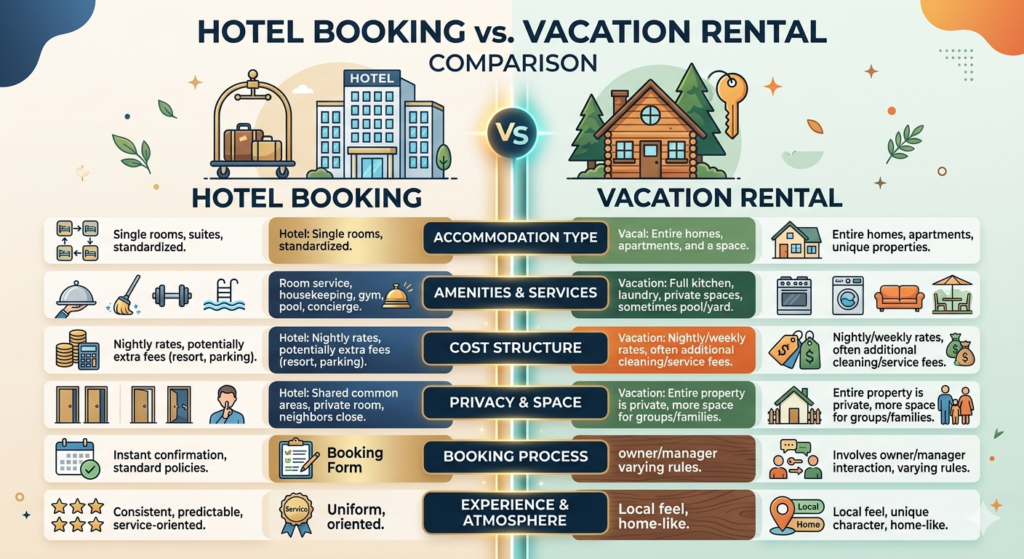
A hotel and a vacation rental can both work for a short stay, a family trip or an event weekend. Choose by the final cost, sleeping arrangements, arrival support and location of the actual property. The category alone does not guarantee space, privacy, service or flexible cancellation.
Compare the Same Group and Stay Length
Write down the number of guests, usable beds, separate bedrooms and bathrooms you need. Check occupancy rules and whether children count toward the stated limit. Compare the same dates and number of nights. Two hotel rooms may provide more privacy than one apartment with a sofa bed; an apartment may provide useful shared space. Read the floor plan and listing carefully rather than treating guest capacity as a bedroom count.
Calculate the Complete Price
Include taxes, required property or cleaning charges, parking, meals you will buy and extra transport. Keep refundable security deposits separate from costs while allowing for the temporary hold. In a hypothetical four-person, four-night comparison, two hotel rooms at $100 each per night total $800. A rental at $170 per night plus $100 in mandatory charges totals $780. If the rental adds $40 in transport, its total becomes $820. These inputs show how a small headline advantage can reverse; replace them with final quotes for your dates.
Know How Fees Should Be Disclosed
For covered US lodging offers, the FTC rule requires known mandatory fees in upfront total prices, with limited exclusions such as government charges disclosed before payment. It does not eliminate fees. Check the final payable amount on either property type, including charges due on arrival. A lower nightly figure is not enough to establish better value.
Verify the Support You Need
Hotels may have staffed reception, but do not assume every hotel has 24-hour service, room service or a concierge. Rentals may offer managed reception or remote support, but a key code does not guarantee a smooth late arrival. Ask how you enter, who can help if access fails and whether there is a response arrangement at your arrival time. If you need lifts, step-free access, medical equipment storage or other facilities, verify them directly for the actual property.
Check Kitchen, Laundry and Privacy Details
A kitchen helps only if it has the equipment you will use and you expect to cook. Check whether laundry is private, shared, chargeable or off site. A whole-property rental can offer shared living space, but a shared-room listing is a different option. Hotels can have connecting rooms, suites or kitchens too. Noise depends on the building and surroundings rather than the category. Read recent reviews for recurring issues and confirm any feature central to the booking.
Read Cancellation Terms Before Comparing Flexibility
Both hotels and rentals can offer refundable and nonrefundable rates. Record the exact cutoff, time zone, refund deductions and payment schedule. Check what happens if the host or property cancels, and identify who handles the refund. Do not rely on a broad claim that hotels always provide a 24- or 48-hour cancellation window. If your dates may change, compare the premium for flexibility with what you could lose under each actual policy.
Match the Location to Your Itinerary
Test door-to-door routes from the address to the airport, sights or venue. Include evening service and the return after an event. Road restrictions can affect either property type; a nearby hotel does not automatically avoid them. Use official event and transport notices once published, and ask the property about arrival access. For short-term rentals, check local permission or registration requirements before paying. The NYC guidance, for example, restricts short stays in entire homes in permanent residential buildings; do not assume a listing establishes a legal visitor stay.
Choose the Property That Solves the Trip
Create a shortlist with final price, beds and bathrooms, useful facilities, arrival support, travel time and cancellation terms. Agree with your group who pays and how shared costs or changes will be handled. A rental is not automatically cheaper for four people or five nights, and a hotel is not automatically better for a couple. Select the property whose verified conditions meet the itinerary, then save the confirmation and access details offline.
Essential Internal Resources
These guides on Parandjah Travels cover the related planning layers:
- For where to stay in affordable neighborhoods: Where to Stay in Major Cities on a Budget
- For booking hotels at the lowest possible price: How to Book Hotels Without Paying Booking Fees
- For event and festival-specific accommodation strategy: How to Save on Festival Travel
- For the Mexico World Cup accommodation specifically: Mexico 2026 World Cup Accommodation Guide
- For protecting your trip financially: Travel Insurance Comparison for Budget Trips
Master Your Destination: City Budget Guides
These city guides cover exactly where to stay for less in 24 major hubs — useful for applying this framework to a specific destination:
European Budget Hubs
Madrid · Paris · Rome · Dublin · Lisbon · Budapest · Prague · Vienna · Istanbul · Amsterdam · Milan · Barcelona · Berlin
Asia-Pacific and Americas Budget Hubs
Bangkok · Tokyo · Sydney · Toronto · Singapore · Mexico City · Seoul · Buenos Aires · Cape Town · Chicago · New York
Frequently Asked Questions
Is a vacation rental always cheaper than a hotel for groups?
No. Compare final totals for the required beds, nights, fees, meals and transport. Group size alone does not establish a winner.
Which is better for attending a major event like the World Cup?
Choose a property with practical routes to and from your venue, confirmed arrival access and suitable cancellation terms. Official event transport and road notices matter for hotels and rentals alike.
Do vacation rentals offer any cancellation flexibility?
Some do and some do not. Read the exact policy, cutoff and refund deductions for the rate you are buying; property type does not determine flexibility.
What’s the biggest hidden cost people miss when comparing options?
Mandatory charges, meals or parking you require, and transport created by the location. Compare the full stay total, and distinguish refundable deposits from actual costs.
Want More Free Travel Resources?
Explore more practical accommodation, transport and packing guides at Par & Jah Travels.
Conclusion
Choose between actual properties rather than general promises about hotels or rentals. Matching the full cost, sleeping arrangements, arrival support and cancellation conditions gives your group a clearer decision.

Marsha Rowe is the Founder and Travel Strategist at Parandjah Travels. She uncovers high-intent travel intelligence, specializing in slow travel frameworks and sports event logistics.