
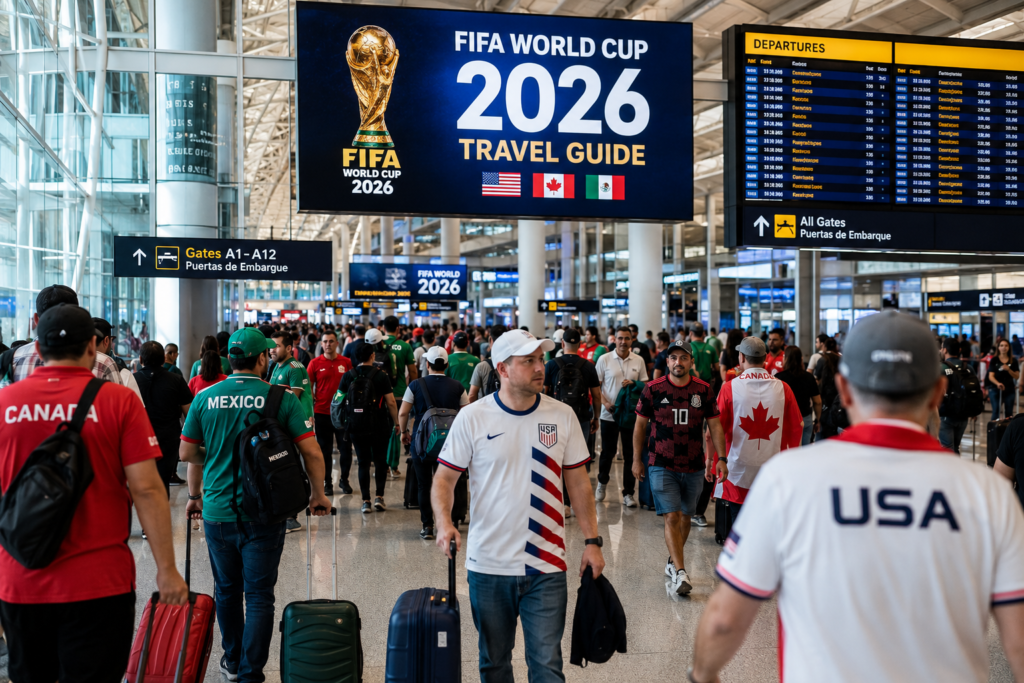
This FIFA World Cup 2026 Travel Guide covers the knockout stage specifically — which begins June 28 and runs through the final on July 19 at MetLife Stadium in New Jersey. Travel planning right now means preparing for the knockout stage, which begins June 28 and runs through the final on July 19 at MetLife Stadium in New Jersey. The group stage ends June 27 — if your team is still in the tournament, you have days, not weeks, to lock in flexible flights and refundable hotels for the Round of 32 host cities. This guide covers everything you need: the host city layout, cross-border entry requirements, currency management across three countries, ground transit on matchday, and the full pre-departure checklist.
Key dates:
- Group stage ends: June 27, 2026
- Round of 32 begins: June 28, 2026
- World Cup Final: July 19, 2026 — MetLife Stadium, East Rutherford, New Jersey
Live Tournament Status
Last updated: June 24, 2026 — Day 14 of the group stage
Teams confirmed through to the Round of 32 so far: Mexico (Group A winners), USA (Group D winners), Germany (Group E), Colombia, Norway, France, England, and Brazil among others advancing.
The final group stage matchday is June 25-27, with all remaining group outcomes decided simultaneously. The full Round of 32 bracket locks in immediately after.
For real-time standings and the complete bracket as it develops, check FIFA.com/standings directly — that page updates continuously as matches conclude.
The 16 Host Cities: Where Matches Are Being Played
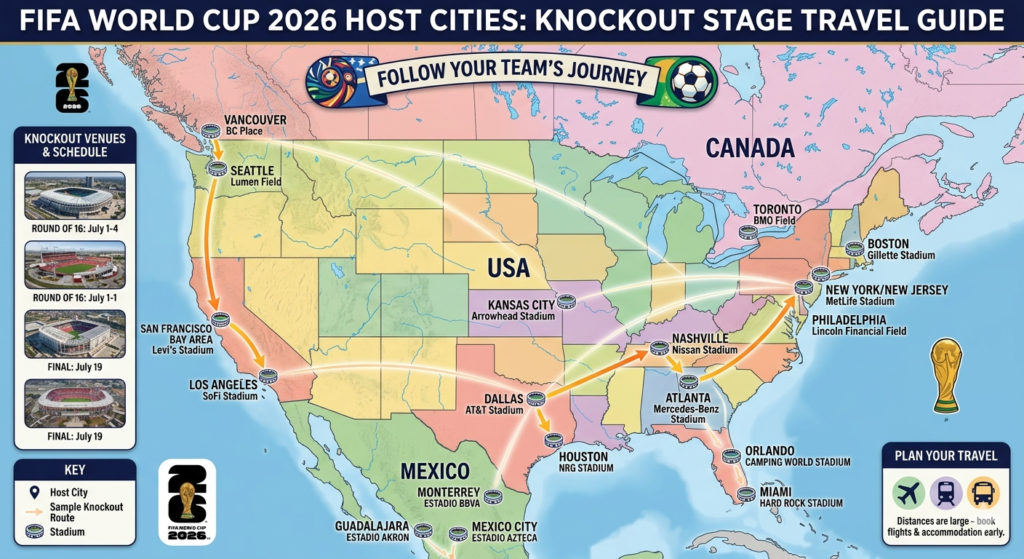
Understanding the geographic layout is the foundation of any knockout-stage travel plan. FIFA organized host cities into three regional clusters to minimize extreme cross-continental travel during the group stage — but as a fan following your team through the knockouts, your path through the bracket may cross all three clusters.
Mexico (13 matches):
- Mexico City — Estadio Azteca (Group A hub, knockout matches through Round of 16)
- Guadalajara — Estadio Akron
- Monterrey — Estadio BBVA
Canada (13 matches):
- Toronto — BMO Field
- Vancouver — BC Place
United States (78 matches — all quarterfinals, semifinals, and the Final): Atlanta, Boston, Dallas, Houston, Kansas City, Los Angeles/Inglewood, Miami, New York/New Jersey (MetLife — the Final), Philadelphia, San Francisco Bay Area, Seattle
The US hosts every knockout match from the quarterfinals onward. If your team reaches the final eight, all your remaining travel is domestic within the US.
The Final: MetLife Stadium, New Jersey
The World Cup Final takes place July 19 at MetLife Stadium in East Rutherford, New Jersey. Hotels throughout Manhattan and northern New Jersey are already experiencing unprecedented demand — if you’re targeting the final, book immediately with free cancellation on both potential finalist city options.
Cross-Border Entry: The Three-Country Checklist
Because the tournament spans three countries with completely separate immigration systems, entry authorization for one country does not cover the others. Apply for each independently.
United States:
- Visa Waiver Program ESTA for eligible nationalities — applied online before travel
- B1/B2 visitor visa for non-eligible nationalities
- FIFA PASS available for priority appointment scheduling for visa applicants
- Proof of onward travel required for ESTA holders
- Land crossings require an electronic I-94 form
Canada:
- Electronic Travel Authorization (eTA) for visa-exempt air travelers
- Complete Advance Declaration via ArriveCAN portal up to 72 hours before landing
- Cannabis, vaporizers, and firearms prohibited at all border crossings
Mexico:
- Physical passport book required for air entry (passport card valid for US citizens crossing by land only)
- FMM tourist card required on arrival — complete online via Mexico’s INM before traveling
- Many nationalities holding valid US, Canadian, UK, or Schengen visas can enter Mexico visa-free
Processing backlogs: if you still need a visa for any host country, apply immediately.
For the complete entry breakdown with application links, see the FIFA World Cup 2026 Cross Border Travel Rules guide.
Managing Currencies Across Three Countries
You’ll transition between three currencies: US Dollar (USD), Canadian Dollar (CAD), and Mexican Peso (MXN). Stadium venues are almost entirely cashless — credit cards and digital mobile wallets work everywhere inside.
Outside stadiums, local transit, street food stalls, and independent fan zones still prefer physical cash in the local currency. The most cost-effective approach:
- Use a multi-currency travel card like Wise or Revolut — these convert at near-market rates with minimal fees, and you can hold all three currencies on one card
- Avoid airport currency exchange counters — they carry the worst conversion rates of any option
- ATMs in each country are widely available and typically offer better rates than airport counters, though check your bank’s international fee structure first
For quick reference: most casual expenses in Mexico run cheapest per dollar, Canadian cities mid-range, and US host cities (especially New York and Miami) are the most expensive on average.
Booking Flights and Hotels for the Knockout Stage
The fundamental knockout-stage booking challenge: your team’s next city depends on match results you don’t know yet. The strategy that protects your budget:
For flights: Never book non-refundable, base-fare tickets when your destination is conditional on match results. Use flexible or changeable fare classes, or book with airline miles that allow penalty-free modifications. For East Coast host cities (Boston, New York, Philadelphia), Amtrak trains are often faster, cheaper, and more convenient than regional flights. For West Coast venues (Los Angeles, Seattle, San Francisco), flying is necessary.
For hotels: Book refundable rooms in both potential next-round cities — the city your team goes to if they finish first in the group, and the alternate if they finish second. Cancel the unused reservation once standings confirm. Major chains (Marriott, Hilton, Hyatt) offer free cancellation up to 24-48 hours before arrival. For independent properties, ask directly — they’d rather hold a conditional booking than risk an empty room.
For flight research: Google Flights, Skyscanner, and Hopper are the most reliable fare-monitoring tools. Set alerts for the specific routes connecting your potential next-round cities — fares climb within hours of a decisive match whistle.
Ground Transportation on Matchday
Urban mass transit consistently outperforms rental cars and rideshare apps on matchday. Rideshare surge pricing during high-demand knockout matches is severe, and venue perimeter zones restrict vehicle access entirely.
By city:
- New York/New Jersey (MetLife): New Jersey Transit trains from Penn Station and Secaucus Junction run direct to the stadium on matchdays
- Los Angeles/Inglewood (SoFi): Metro K Line to Downtown Inglewood Station, then event shuttles on dedicated lanes
- Dallas (AT&T Stadium): Trinity Railway Express from Dallas Union Station
- Miami (Hard Rock): Miami-Dade Metrorail to Government Center, then game-day shuttle
- Boston (Gillette): Commuter Rail from South Station — the most straightforward stadium train connection in the tournament
- Mexico City (Estadio Azteca): Metro Line 2 to Tasqueña, then the Tren Ligero (light rail) to CU
- Toronto (BMO Field): TTC streetcar on King Street directly to the stadium
Essential apps to download before you fly:
- Official FIFA World Cup 2026 App — mandatory for managing and scanning digital match tickets at turnstiles
- Google Maps — real-time road closures, walking directions around fan zones
- Transit App — covers most North American city transit systems in one interface
- Waze — useful for any driving segments outside stadium perimeters
FIFA Fan Festivals: Free Entry, No Ticket Required
Each of the 16 host cities is running a free-entry FIFA Fan Festival with large high-definition screens, live entertainment, international food, and official merchandise. These are genuinely useful for days when you don’t have a match ticket — you can watch any game live alongside thousands of other international supporters without stadium access. Check the official FIFA Fan Festival page for each host city’s schedule and location.
Essential Internal Resources
These guides on Parandjah Travels cover the related planning layers in detail:
- For cross-border entry requirements: FIFA World Cup 2026 Cross Border Travel Rules
- For Follow My Team ticket packages: Follow My Team World Cup 2026
- For stadium bag policy and ticket rules: World Cup 2026 Ticket and Transit Rules
- For Mexico host city accommodation: Mexico 2026 World Cup Accommodation Guide
- For event-specific budget strategy: How to Save on Festival Travel
Master Your Destination: City Budget Guides
These city guides cover exactly where to stay for less in the World Cup host cities and beyond:
Americas Budget Hubs
Mexico City · Toronto · New York · Chicago · Buenos Aires · Cape Town
European Budget Hubs
Madrid · Paris · Rome · Dublin · Lisbon · Budapest · Prague · Vienna · Istanbul · Amsterdam · Milan · Barcelona · Berlin
Asia-Pacific Budget Hubs
Bangkok · Tokyo · Sydney · Singapore · Seoul
Frequently Asked Questions
Is this FIFA World Cup 2026 travel planning guide updated for the current tournament?
Yes — this guide reflects the live tournament as of June 24, 2026. The group stage ends June 27 and the Round of 32 begins June 28. The live standings section is updated periodically; for real-time scores and the complete knockout bracket, check FIFA.com directly.
Who should use this guide?
Any international or domestic fan traveling between host cities in the US, Canada, or Mexico during the tournament. It’s most immediately useful for fans whose teams are still in the group stage or preparing for the knockout rounds beginning June 28.
Do I need separate entry documents for each host country?
Yes. The US ESTA, Canadian eTA, and Mexican FMM tourist card are completely independent systems with no cross-compatibility. If your tournament itinerary crosses two or three host countries, you need to qualify for entry into each one separately before you travel.
Should I rent a car or use public transit to get to matches?
Use public transit for matchday travel to stadiums — rideshare surge pricing is severe during knockout matches and perimeter zones restrict vehicle access. Rental cars are useful for regional day trips between matches when you’re not heading directly to a stadium. The cities with the best direct transit links to their venues are Boston, New York, Toronto, Vancouver, and Mexico City.
Want More Free Travel Resources?
Grab the free 2026 Travel Dupes Cheat Sheet for budget-friendly destination ideas to extend your World Cup trip. Subscribe at the top of parandjahtravels.com to download it instantly.
Pre-Departure Verification Checklist
Before boarding your flight to any knockout match:
- Match tickets verified and active inside the official FIFA app (screenshot saved as backup)
- Passport valid for at least six months past your return date
- ESTA, eTA, and/or FMM card confirmed — one for each host country you’ll cross
- Flexible or changeable flights booked — no non-refundable base fares
- Refundable hotels reserved in both potential next-round host cities
- Stadium bag policy checked (12 x 6 x 12 inch clear bag required at all venues)
- Local transit route to the stadium confirmed before matchday
- FIFA app, Google Maps, and Transit App downloaded and tested
Conclusion
FIFA World Cup 2026 travel planning for the knockout stage means staying flexible on every booking that depends on match results, locking in your cross-border documentation now, and trusting urban mass transit over rideshare on matchday. The Round of 32 begins in four days. The final is in 25 days. Whatever your team’s path through the bracket, the logistics above hold across every host city from Monterrey to MetLife.

Marsha Rowe is the Founder and Travel Strategist at Parandjah Travels. She uncovers high-intent travel intelligence, specializing in slow travel frameworks and sports event logistics.