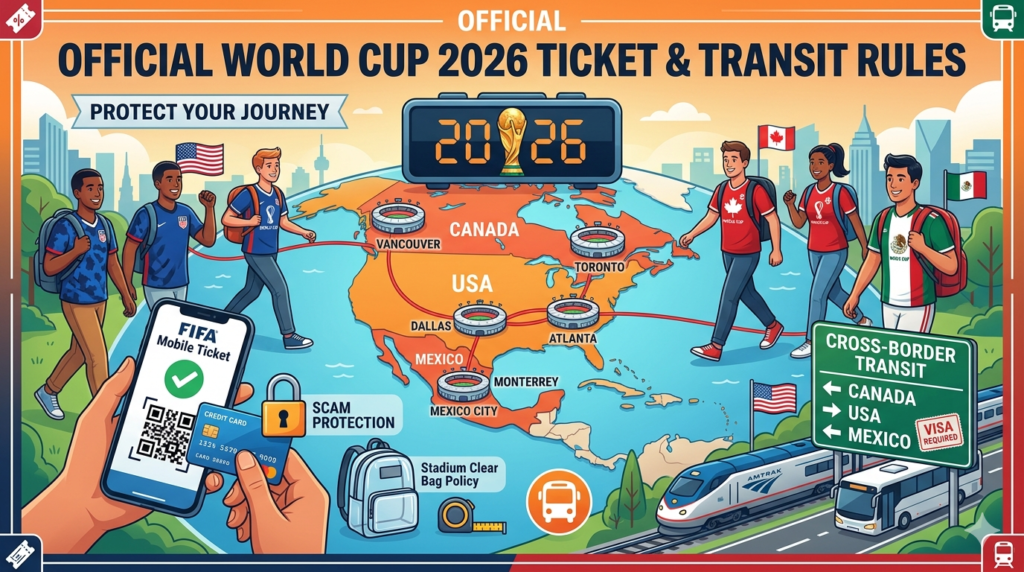
World Cup 2026 Ticket and Transit Rules: The Complete Fan Guide

Traveler laptop with digital world cup 2026 ticket and transit rules checklist on desk

The World Cup 2026 ticket and transit rules that matter most right now: your ticket must be presented as a live QR code in the official FIFA app (not a screenshot as your primary entry method), your bag must be clear plastic vinyl or PVC at a maximum 12 x 6 x 12 inches, and your border entry documents for the US, Canada, and Mexico are completely separate — an approved ESTA doesn’t cover Canada, and an eTA doesn’t cover the US. Get those three things right and most matchday problems disappear.

This guide covers everything else: the scam risk on secondary platforms, the baby ticket exception, the water bottle rule that changed mid-tournament, flight buffer times between host cities, and the cross-border compliance checklist.

Ticket Safety: How to Avoid Scams and Invalid Entries

Never Buy Outside the Official Channels

Purchasing tickets from unauthorized third-party brokers, secondary resale platforms, or classified listings carries a high fraud risk. FIFA enforces strict digital terms of service — any ticket found on an unauthorized scalping site can be permanently cancelled without a refund. Valid tickets are issued exclusively through the official FIFA mobile ticketing app, accessible via FIFA.com/tickets.

The only legitimate secondary market is the Official FIFA Resale Marketplace at collect.fifa.com. This is the only authorized platform for fans to buy and sell verified tickets at regulated prices. For hospitality packages, purchase only through On Location or officially appointed sales agents listed at fifa.com/hospitality.

Digital Tickets: Live QR Code Required

The tournament uses a dynamic, encrypted barcode system that updates regularly within the official FIFA app. The live QR code in your digital wallet is your primary entry method. Screenshots are not accepted as your main entry credential — security scanners will reject a static image.

That said: FIFA’s own current guidance recommends screenshotting your QR code as a backup in case the app is slow to load at the turnstile. The sequence is: have the app open and the live QR code displayed first; if the app fails to load, show the screenshot and request manual verification at the on-site box office. Do not rely on a screenshot as your only entry method.

No Matchday Box Office Sales

There are no physical ticket sales at any stadium box office on matchday. All admissions must be secured digitally before arriving. On-site box offices exist only to resolve digital app errors, assist with verified account issues, or confirm corporate hospitality credentials.

The Baby Ticket Exception Most Fans Miss

The original guidance from some sources stated every single person needs a ticket — that is incorrect. The official FIFA rule is: each ticket holder may be accompanied by one “baby in arms” who does not need their own ticket, provided the baby is 2 years old or under on matchday, is no more than 34 inches tall, and does not occupy a seat. They must sit on the ticket holder’s lap, and they are not permitted in standing sections. Bring proof of age — FIFA staff may request it.

Children above this threshold (over 2 years old or over 34 inches) require their own individually assigned ticket.

Stadium Bag Policy: Confirmed Rules as of June 2026

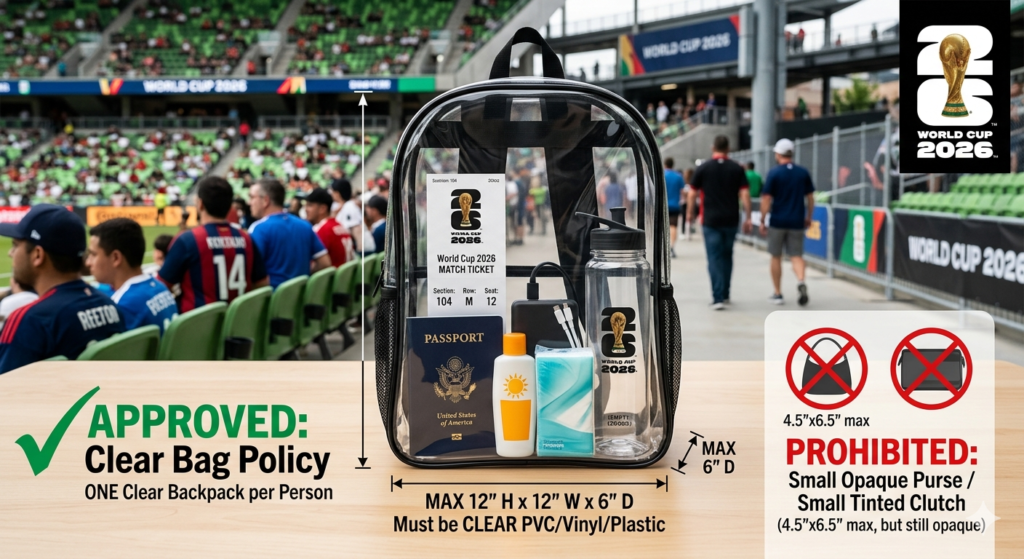
Official World Cup 2026 stadium clear bag policy guidelines showing approved dimensions
Be sure to review the official 12x12x6 inch clear bag restrictions to guarantee smooth entry on matchday.

FIFA enforces a uniform clear bag policy across all 16 host venues in the US, Canada, and Mexico. Get this wrong and you will be turned away — stadiums have no bag check or storage inside. Your only options if you arrive with a non-compliant bag are to discard it, walk it back to your car or hotel, or find a third-party luggage storage service near the stadium.

What Bags Are Allowed

  • Primary bag: Clear plastic, vinyl, or PVC — fully transparent, no tinting or colouring — maximum 12 x 6 x 12 inches. One-gallon resealable clear plastic bags (approximately 11 x 11 inches) also qualify.
  • Secondary bag: One small non-clear clutch, wallet, or wristlet per person — maximum 4.5 x 6.5 inches. This is the only bag that doesn’t need to be clear. Can hold your phone, cards, and keys.
  • Each ticket holder is allowed one clear bag plus one small clutch — both at the same time.

What Bags Are Banned

Backpacks of any kind (including small daypacks), opaque purses, camera bags, coolers, insulated bags, fanny packs, and any non-clear bag larger than 4.5 x 6.5 inches are prohibited across all 16 venues.

Diaper bags are prohibited unless they meet the clear bag requirements. Pack baby essentials inside your compliant 12 x 6 x 12 inch clear bag. Medical exemptions for formula and medication are available — contact the stadium’s accessibility team at least 48 hours in advance and bring a doctor’s certificate in English, French, or Spanish.

Water Bottles: What Changed

FIFA’s water bottle policy changed during the tournament. The current confirmed rule: one soft plastic, 20-ounce (590ml) factory-sealed disposable water bottle is permitted per fan at all US and Canada venues. Hard-sided reusable water bottles are prohibited for safety reasons. Refillable reusable bottles are also no longer permitted after FIFA reversed its earlier guidance — the factory-sealed requirement applies.

Buy a compliant clear bag before you travel. Walmart, Target, and Amazon stock them for $8-20. Prices inflate near stadiums on matchdays and stock runs out.

Multi-City Transit: Flight and Ground Logistics

Flight Times Between Host Cities

Cross-continental flights between distant host cities can run 5-6.5 hours of airtime — not including check-in, security, baggage claim, and ground transit at both ends. Plan for a full travel day between cities that are not on the same coast. For East Coast matches (Boston, New York, Philadelphia), Amtrak trains between these cities are frequently faster, cheaper, and drop you directly downtown — avoiding airport transfers entirely.

Flight Buffer Times During the Knockout Rounds

Minimum recommended buffer time:

  • Domestic connections (same country): 3-4 hours
  • Cross-border connections (US/Canada/Mexico): 5-6 hours

During knockout rounds, airport volumes are significantly higher — customs lines, security screenings, and baggage delays all run longer than normal. Missing a knockout match flight because you left a 90-minute buffer is a real risk. Always book flexible or changeable fare classes for connections that depend on your team’s match results.

Official Shuttle Buses Require a Valid Ticket

The majority of official park-and-ride shuttles and stadium express buses require a valid match ticket or confirmed digital booking pass. These dedicated express corridors are reserved for ticketed fans. If you’re attending a fan festival zone without a match ticket, use standard city transit, commuter rail, or rideshare instead.

Cross-Border Entry: The Three-Country Compliance Checklist

Your match ticket grants you stadium access. It does not grant you entry into any country. US ESTA, Canadian eTA, and Mexican FMM tourist cards are completely separate national systems with no cross-compatibility. An approved ESTA only covers entry to the United States — it carries no validity for Canada or Mexico.

Full breakdown of what each country requires:

United States: Visa Waiver Program ESTA (visa-exempt nationalities), or B1/B2 visitor visa. FIFA PASS is available for priority appointment scheduling for visa applicants. Proof of onward travel required for ESTA holders. Land crossings require an electronic I-94 form.

Canada: Electronic Travel Authorization (eTA) for visa-exempt air travelers. Complete the Advance Declaration in the ArriveCAN portal up to 72 hours before landing. Cannabis, vaporizers, e-cigarettes, and firearms are prohibited at the border regardless of home country permissions.

Mexico: Physical passport book required for air travel — a passport card is only valid for US citizens crossing by land. FMM tourist card required on arrival; can be completed in advance online through Mexico’s INM.

For the complete breakdown with application links and visa processing timelines, see the FIFA World Cup 2026 Cross Border Travel Rules guide.

Visa processing backlogs: international embassies were experiencing extended processing timelines leading up to the tournament. If you still need a visa for any host country, apply immediately — do not wait.

Matchday Entry Process at All 16 Venues

Expect airport-style security at every venue. The process is identical across all 16 stadiums:

  1. Outer perimeter — ticket verification: Digital ticket scanned at the outer perimeter. Have the FIFA Ticket app open with your live QR code displayed. Screenshot as a backup only.
  2. Security screening — bag check: Metal detectors, clear bag inspection. All bags are searched regardless of compliance status.
  3. Inner perimeter — turnstile scanning: Final QR code scan at the turnstile gate.

Arrive at least 90 minutes before kickoff. For high-profile knockout matches, 2 hours is safer. Security queues at major quarterfinal and semifinal venues will be significantly longer than group stage matches.

Pre-Departure Compliance Checklist

Before leaving for any match:

  • All tickets verified and accessible in the FIFA Ticket app (screenshot saved as backup)
  • Individual tickets secured for everyone over 2 years old or 34 inches tall
  • Baby in arms documentation ready if applicable (proof of age under 2)
  • ESTA, eTA, or FMM card confirmed for every country on your itinerary — applied for separately
  • Clear compliant bag packed (12 x 6 x 12 inches max, transparent)
  • One small clutch packed for phone, wallet, keys
  • One factory-sealed 20oz disposable water bottle (US and Canada venues)
  • Flight connections include 3-4 hour domestic buffer or 5-6 hour cross-border buffer
  • Refundable hotel reservations in both potential knockout host cities if team advancement is uncertain

Essential Internal Resources

These guides on Parandjah Travels cover the related planning layers:

Master Your Destination: City Budget Guides

These city guides cover exactly where to stay for less in the World Cup host cities and beyond:

Americas Budget Hubs

Mexico City · Toronto · New York · Chicago · Buenos Aires · Cape Town

European Budget Hubs

Madrid · Paris · Rome · Dublin · Lisbon · Budapest · Prague · Vienna · Istanbul · Amsterdam · Milan · Barcelona · Berlin

Asia-Pacific Budget Hubs

Bangkok · Tokyo · Sydney · Singapore · Seoul

Frequently Asked Questions

Do babies and infants need a separate ticket for World Cup 2026 matches?

No — one baby in arms per ticket holder is permitted without a separate ticket, provided the child is 2 years old or under on matchday and no more than 34 inches tall. They must sit on the ticket holder’s lap and are not permitted in standing sections. Children over these thresholds require their own ticket. Bring proof of age as FIFA staff may request it.

Can I use a screenshot of my ticket at the stadium gate?

The live QR code in the FIFA Ticket app is your primary entry method. FIFA’s own current guidance recommends screenshotting the QR code as a backup in case the app is slow to load — not as a replacement. Present the live app first; use the screenshot only if the app fails to load.

What’s the current water bottle rule at World Cup stadiums?

One soft plastic, factory-sealed 20-ounce (590ml) disposable water bottle per fan is permitted at US and Canada venues. Hard-sided reusable water bottles and empty refillable bottles are prohibited. This rule changed after initial guidance prohibited all bottles — check fifa.com/en/tournaments/mens/worldcup/canadamexicousa2026/stadiums/fan-safety for any further updates.

Does my ESTA cover entry to Canada for matches in Toronto or Vancouver?

No. The US ESTA and Canadian eTA are completely separate national systems with no cross-compatibility. An approved ESTA is valid only for United States entry. Canadian matches require a separate eTA (for visa-exempt nationalities) or a Temporary Resident Visa. Apply for both independently before your trip.

Want More Free Travel Resources?

Grab the free 2026 Travel Dupes Cheat Sheet for budget-friendly destination ideas to extend your World Cup trip. Subscribe at the top of parandjahtravels.com to download it instantly.

Conclusion

Getting the World Cup 2026 ticket and transit rules right before matchday protects your entire trip investment. Three things matter most: your ticket is live in the FIFA app (screenshot as backup only), your bag is clear plastic at 12 x 6 x 12 inches or smaller, and your border documents for each host country are applied for independently. Get those three right and the rest of the matchday runs smoothly.

Leave a Comment

Your email address will not be published. Required fields are marked *