
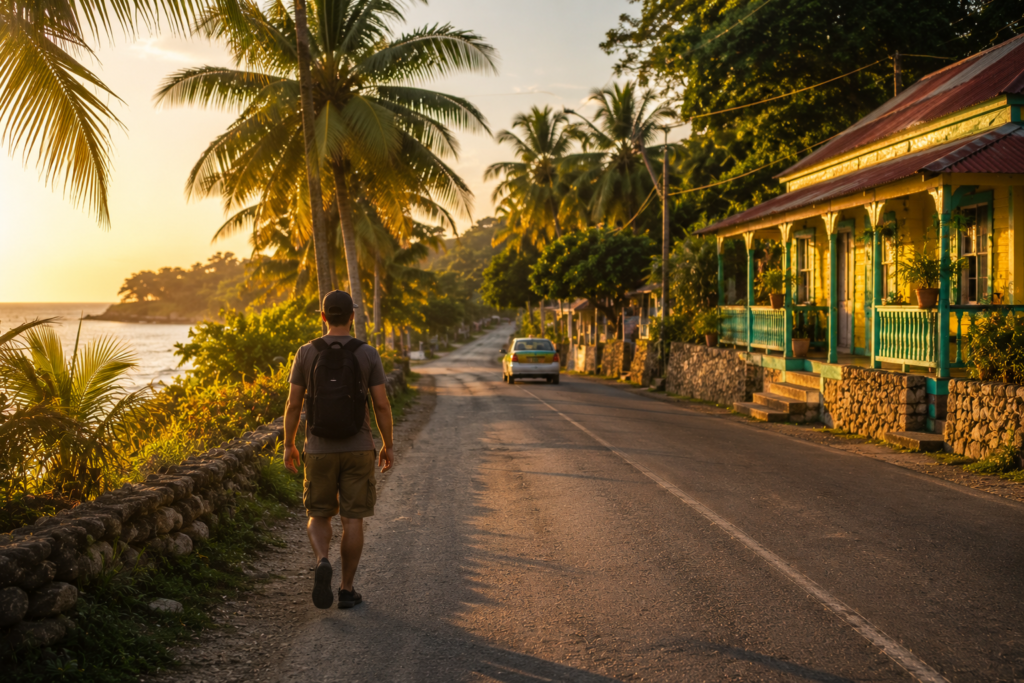
Knowing how to travel Jamaica without a resort comes down to one practical shift: you book each piece separately instead of booking one package, and you trade the all-inclusive convenience for an island experience the resort corridor was never designed to deliver. Most first-time visitors default to the resort model because it’s the path of least resistance — one website, one price, one decision. I understand why. But I also know, having grown up on this island, that the resort model shows you almost nothing of Jamaica. This guide is the practical mechanics of doing it independently — building the itinerary, booking the accommodation, getting between parishes, and knowing what to expect day to day, written for someone who has never traveled Jamaica any other way.
Why People Default to Resorts (And Why You Don’t Have To)
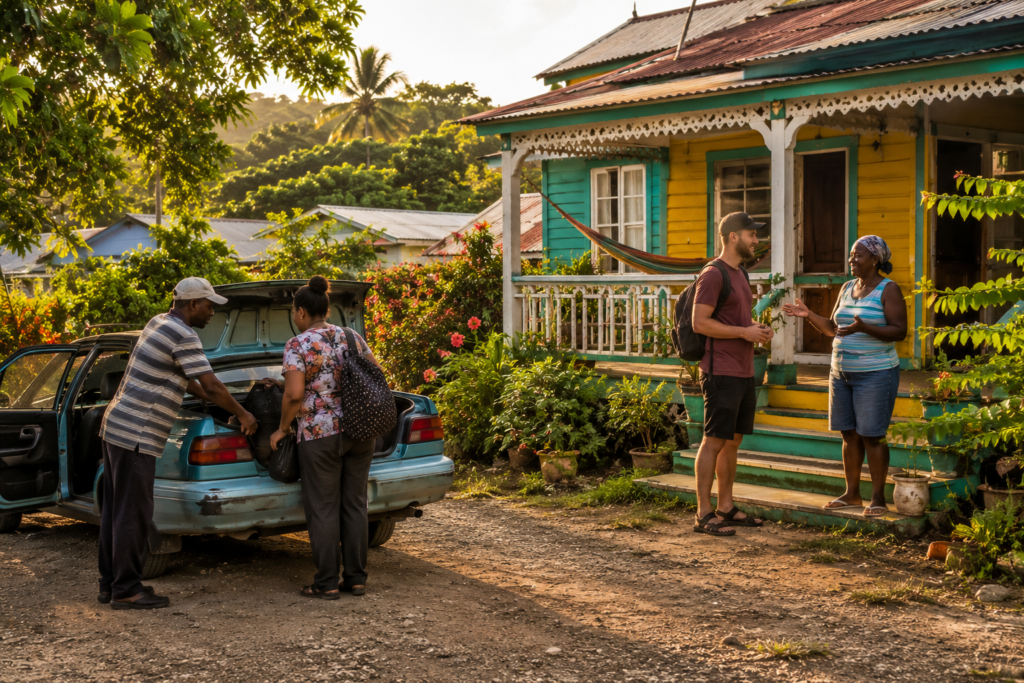
The resort model solves three specific anxieties for first-time Jamaica visitors: not knowing where to stay, not knowing how to get around, and not knowing if it’s safe. Each of these has a straightforward independent-travel answer.
“I don’t know where to stay”: Guesthouses and small hotels in Jamaica are bookable through the same platforms you’d use anywhere else — Booking.com, Airbnb, and Hostelworld all have substantial Jamaica inventory. The difference from resort booking is that you’re choosing a specific location and property rather than a brand, which requires slightly more research but delivers a much better-located, more characterful stay for less money.
“I don’t know how to get around”: Jamaica has a functioning, if informal, transport network — route taxis, coaster buses, and licensed private taxis. It requires more patience than a resort shuttle but costs a fraction of the price and shows you the island as you travel through it.
“I don’t know if it’s safe”: This is the most legitimate concern and deserves an honest answer, not a dismissal. Jamaica has real safety considerations in specific areas, and independent travel requires you to know which areas those are — covered in detail below. The tourist-frequented areas of New Kingston, Port Antonio, Negril, Treasure Beach, and the Blue Mountains are genuinely safe by any reasonable standard.
Building Your Itinerary: How Much Time, How Many Parishes
The biggest mistake first-time independent Jamaica travelers make is trying to see too much. Jamaica’s roads are slower than they look on a map, and route taxis don’t run on a fixed schedule — budget more transit time than you think you need.
For a one-week trip: Two parishes is the right number. A strong combination: 3 nights in Kingston (city, food, Blue Mountains day trip) plus 4 nights in Port Antonio (Boston Bay, Blue Lagoon, Reach Falls). Alternatively: 3 nights Kingston plus 4 nights on the south coast (Treasure Beach, Middle Quarters, Pelican Bar).
For a 10-14 day trip: Three parishes becomes comfortable. Kingston, Portland, and the south coast (St. Elizabeth) covers the strongest independent-travel destinations on the island without excessive transit days. Add the north coast (Negril specifically, which has more independent-traveler infrastructure than Montego Bay or Ocho Rios) if beach time is a priority.
What to skip on a first trip: Montego Bay and Ocho Rios are built almost entirely around the resort and cruise ship economy — there’s relatively little independent-travel infrastructure or reason to base yourself there if you’re not staying at a resort. If your itinerary includes the north coast, Negril is the better independent-travel choice between the three main north coast towns.
The realistic daily pace: Plan one significant activity or transit day, not both, for most days. A day spent traveling from Kingston to Port Antonio is a travel day — don’t also plan to hike to a waterfall that afternoon. A day already in Port Antonio can comfortably include Boston Bay, the Blue Lagoon, and a relaxed afternoon.
Booking Accommodation: What to Look For
Use Booking.com, Airbnb, and Hostelworld: All three have meaningful Jamaica inventory, particularly in Kingston, Negril, Port Antonio, and Treasure Beach. Filter by review score (8.0+ minimum) and read the most recent reviews specifically — Jamaica’s tourism infrastructure has improved substantially in some areas in recent years, and older reviews may not reflect current conditions.
What “guesthouse” means in Jamaica: Most independent accommodation outside Kingston’s hotel district is family-run — a private room or small cottage on a property where the owners live, often with breakfast included and genuine local knowledge available on request. This is different from a commercial hotel and is generally the better choice for independent travelers who want both privacy and local connection.
Location matters more than the listing photos suggest: Check the specific address against a map before booking. “Near the beach” can mean anything from a two-minute walk to a 25-minute drive. For Kingston specifically, confirm the property is in New Kingston or an adjacent uptown neighborhood (Liguanea, Half-Way Tree, Cherry Gardens) rather than downtown.
Booking the first two nights only: For a first trip, book your first two nights of accommodation in your first destination before departure. This gives you a confirmed arrival point and removes the stress of arranging anything while jet-lagged. Beyond that, especially for shorter stays in subsequent destinations, you have flexibility to adjust once you’ve arrived and gotten a feel for the place.
What it costs: Guesthouses and budget hotels run $35-70/night for a private room. Airbnb apartments and cottages run $40-90/night depending on location and season. For the complete cost breakdown across every category, the How Much Does It Cost to Travel to Jamaica guide covers every line item in detail.
Getting Between Parishes: The Practical Mechanics
Route taxis (the cheapest option): Shared Toyota Corollas and minivans that run fixed routes between towns, picking up and dropping off passengers anywhere along the route. They leave when full rather than on a schedule — this is the trade-off for the low price. Ask your guesthouse host where the local route taxi stand is; they’ll know the current going rate and can help you negotiate if needed as a visitor.
Coaster buses (more reliable for longer routes): Minibuses running between major towns — Kingston to Montego Bay, Kingston to Port Antonio — depart from designated terminals (Half-Way Tree and Papine in Kingston are the main ones) with somewhat more predictable timing than route taxis, though still not a fixed schedule in the way Western travelers might expect.
Knutsford Express (the most reliable and comfortable option): An air-conditioned coach service connecting major towns on a genuinely fixed schedule, bookable in advance online. More expensive than route taxis or coasters (approximately $16 for Montego Bay-Ocho Rios) but worth it for longer routes or when you have a flight to catch and need reliability.
Private taxis: JUTA (Jamaica Union of Travellers Association) licensed taxis — identifiable by red plates — are the standard private option. Rates are negotiated based on destination rather than metered, so confirm the price before getting in. InDriver (an app-based rideshare similar to Uber) operates in Kingston and Montego Bay and removes the negotiation step.
Rental car: Worth considering if your itinerary spans multiple parishes within a tight timeframe, or if you want the flexibility to stop at unmarked spots (Holland Bamboo, smaller beaches) along the way. Driving is on the left; main roads are generally in good condition, rural roads vary. Rental runs $40-80/day plus insurance.
Food: What to Expect Without a Resort Buffet
Without a resort’s all-you-can-eat buffet, you’ll be choosing where to eat for every meal — which initially feels like more effort but quickly becomes one of the most enjoyable parts of independent travel in Jamaica.
The default pattern that works: Patty or ackee and saltfish for breakfast from a local bakery or restaurant near your accommodation. A casual lunch — jerk chicken, a fish plate, or a local restaurant’s daily special — wherever you happen to be exploring. A slightly more considered dinner, which might be a local restaurant your guesthouse host recommends or something you’ve researched in advance.
Asking your accommodation host: This is the single best resource for finding good food without a resort concierge. Guesthouse owners in Jamaica are consistently happy to recommend where they actually eat, which is reliably better guidance than any online review aggregator.
Budgeting for food without a resort: $20-40/day covers good eating across breakfast, lunch, and dinner without resort pricing — local restaurants, roadside stalls, and the occasional sit-down dinner. This is detailed further in the Budget Travel Guide Jamaica.
Safety: The Honest Independent-Travel Framework
Traveling independently means you’re responsible for your own safety decisions rather than relying on a resort’s controlled environment — which requires more awareness but isn’t fundamentally more dangerous if you follow a few consistent rules.
Know which areas to avoid: Specific downtown Kingston neighborhoods (Trench Town, Tivoli Gardens, areas west of King Street) carry genuine risk and aren’t areas independent travelers need to visit. Stay in New Kingston or the uptown neighborhoods. Outside Kingston, the tourist-frequented areas of Port Antonio, Negril, Treasure Beach, and the Blue Mountains carry no special risk beyond normal travel awareness.
Use licensed transport after dark: JUTA taxis or InDriver rather than unmarked vehicles, particularly at night in Kingston.
Keep valuables secured, not flashy: The same advice that applies to any independent travel anywhere — don’t carry large amounts of cash, secure your passport, and avoid displaying expensive electronics unnecessarily in crowded public areas.
Trust your accommodation host’s local knowledge: If a guesthouse owner tells you an area isn’t worth visiting or a particular route taxi stand isn’t the right one for visitors, take that seriously — they have current, specific local knowledge that’s more reliable than any guidebook.
The honest assessment: Independent travel in the areas covered in this guide carries no meaningfully higher risk than independent travel in any other popular Caribbean or Latin American destination, provided you follow the area-specific guidance above.
What a Realistic Day Looks Like Without a Resort
Morning: Breakfast at a local spot near your guesthouse — a patty and coffee, or ackee and saltfish if you want a fuller meal. No buffet line, no resort schedule.
Midday: Whatever the day’s plan is — a route taxi to a waterfall or beach, a walk through a town, a coffee tour in the Blue Mountains. You’re moving at your own pace rather than a tour bus schedule.
Afternoon: Lunch wherever you happen to be — a jerk centre, a local restaurant, a roadside stall. This is genuinely one of the best parts of independent Jamaica travel; the food discovery becomes part of the day’s adventure rather than a predetermined buffet.
Evening: Dinner at a recommended local spot, then an early night or, depending on the location, some evening atmosphere — live music in Negril, a quiet evening in Treasure Beach, or exploring Kingston’s nightlife if you’re in the capital.
The overall feeling: More decisions to make throughout the day than a resort trip, but each decision is small and the cumulative effect is a much deeper, more memorable experience of the actual island rather than a controlled approximation of it.
Essential Internal Resources
These guides on Parandjah Travels cover the related planning layers:
- For the complete parish-by-parish destination overview: Budget Travel Guide Jamaica
- For the real cost breakdown across travel styles: How Much Does It Cost to Travel to Jamaica
- For the specific best places to visit: Best Places to Visit in Jamaica on a Budget
- For the best food cities in the world including Kingston: Best Food Cities in the World
- For carry-on only packing for Caribbean travel: Carry-On Only Packing Guide
Master Your Destination: City Budget Guides
Planning to combine Jamaica with other Caribbean or global destinations? These city guides cover where to stay for less across 24 major hubs:
Americas Budget Hubs
New York · Chicago · Toronto · Mexico City · Buenos Aires · Cape Town
European Budget Hubs
Madrid · Paris · Rome · Dublin · Lisbon · Budapest · Istanbul · Amsterdam · Milan · Barcelona · Berlin
Asia-Pacific Budget Hubs
Bangkok · Tokyo · Sydney · Singapore · Seoul
Frequently Asked Questions
Is it hard to travel Jamaica without a resort?
Not hard, but it requires more active decision-making than resort travel — booking accommodation separately, arranging your own transport, and choosing where to eat each meal rather than having everything pre-arranged. Most first-time independent travelers find that the slightly higher effort is rewarded with a significantly richer and more memorable experience of the actual island.
How do I get around Jamaica without booking a private tour?
Route taxis (shared cars and minivans running fixed routes), coaster buses between major towns, and Knutsford Express (a reliable air-conditioned coach service) cover inter-parish travel at a fraction of private transfer costs. Within towns, walking and short route taxi rides handle most needs. A rental car adds flexibility for itineraries spanning multiple parishes.
Is independent travel in Jamaica safe for first-timers?
Yes, in the areas covered by typical independent-travel itineraries — New Kingston, Port Antonio, Negril, Treasure Beach, and the Blue Mountains. The genuine safety considerations in Jamaica are concentrated in specific downtown Kingston neighborhoods that independent travelers have no reason to visit. Following standard travel safety practices (licensed transport after dark, secured valuables, local guidance) applies here as it would anywhere.
How much does it cost to travel Jamaica without a resort compared to with one?
Independent travel runs $50-80/day for budget travelers and $78-146/day for mid-range comfort, compared to $210-550+/day per person for all-inclusive resorts. A week of independent travel typically costs 50-70% less than an equivalent all-inclusive resort week, while delivering a substantially different and, for many travelers, more memorable experience of the island.
Want More Free Travel Resources?
Grab the free 2026 Travel Dupes Cheat Sheet for budget-friendly Caribbean destination alternatives and ideas. Subscribe at the top of parandjahtravels.com to download it instantly.
Conclusion
Knowing how to travel Jamaica without a resort comes down to replacing one big decision (which all-inclusive package) with several smaller ones (where to stay tonight, how to get to the next parish, where to eat lunch) — and discovering that those smaller decisions are where the actual texture of the island lives. Book your first two nights, learn the route taxi system, ask your guesthouse host where to eat, and follow the area-specific safety guidance. The Jamaica that exists beyond the resort gates has been there the whole time, waiting for travelers willing to do it slightly differently.

Marsha Rowe is the Founder and Travel Strategist at Parandjah Travels. She uncovers high-intent travel intelligence, specializing in slow travel frameworks and sports event logistics.