
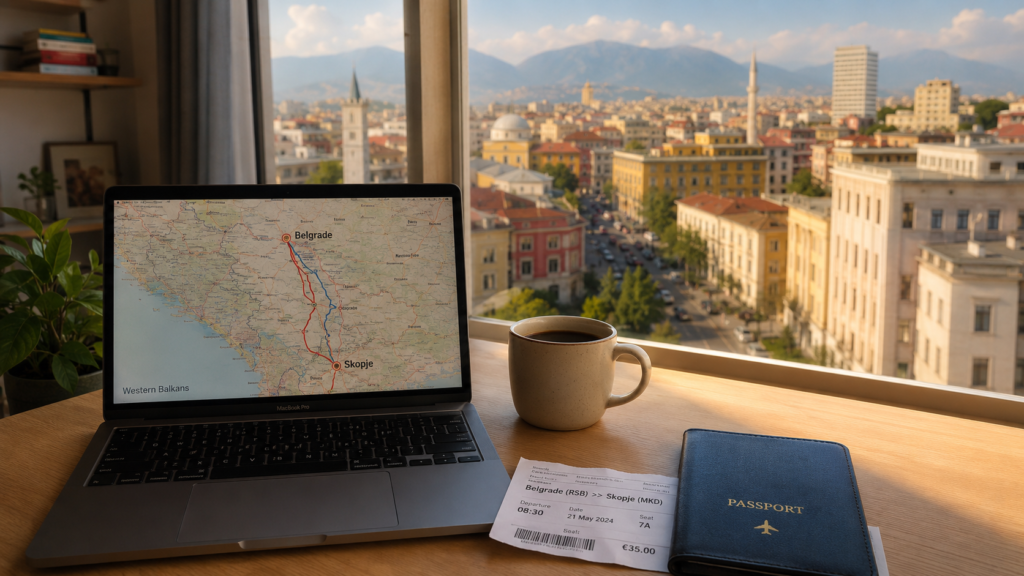
A Balkan slow-travel route can combine Albania, Serbia and North Macedonia, but it must fit the entry permission and budget that apply to each traveller. These countries have separate systems, not a shared promise of 90 days on every arrival. This guide offers a planning framework rather than a guaranteed year-long visa-free loop or a fixed $45 daily cost.

Plan Visits, Not Automatic Border Resets
Write down each proposed entry and exit date before booking accommodation. A short trip to a neighbouring country does not automatically create a fresh allowance when you return. Rules can use rolling periods, nationality-specific limits or visa validity, and admission remains subject to the relevant requirements. Do not build a 12-month itinerary around repeated tourist entries without checking the official basis for every stay. Separate visits to different countries may be possible, but each must independently comply with its rules.
Check Serbia for the Actual Passport
Use Serbia’s official visa guidance and nationality table. The rules are not identical for every Western or Caribbean passport. For example, the Serbian table for Jamaica states visa-free visits up to 30 days within one year for ordinary passports; it does not state an automatic 90-day stay. Other qualifying documents can have their own conditions. Also check stay-registration requirements, including the 24-hour registration arrangements, and confirm how your accommodation handles them.
Check Albania and North Macedonia Separately
Albania’s official entry guidance describes passport-specific eligibility, qualifying visa or residence-document exemptions and documentation that border authorities may request. Check the nationality table and any conditions on a supporting visa. North Macedonia’s official guidance also distinguishes entry categories: some third-country travellers relying on particular foreign visas or residence documents have a 15-day per-entry limit, not 90 days on arrival. Verify the rule that applies to your own documents and intended travel dates.
Keep Work and Residence Questions Separate
Tourist entry does not by itself prove permission to work remotely or establish residence. Having clients or income outside the host country is not a universal exception. If you intend to work or remain for an extended period, check the relevant official immigration, employment and tax requirements for your circumstances before relying on the itinerary. A short-stay route is not a substitute for any permit you need. Keep these requirements in the planning worksheet rather than treating them as a zero-cost administrative advantage.
Compare Bases by Your Routine
Belgrade, Tirana, Skopje and Ohrid are candidates to compare rather than ranked winners for all travellers. List the facilities you need: reliable internet, usable workspace, laundry, grocery access, quiet sleeping conditions and practical local journeys. Verify them for the actual property. A central furnished apartment is not available everywhere at one regional monthly price. Coastal or lakeside dates can have different availability from a city stay, so test the dates and services relevant to your route.
Build the Monthly Budget From Final Quotes
A hypothetical 30-day worksheet might contain $650 accommodation, $120 utilities and connectivity, $450 food, $80 local journeys and $120 activities: $1,420 before international travel, inter-base transfers, documents, coverage and contingency. The example explains the calculation and already exceeds a $1,350 ceiling. It is not a local price estimate. Ask what utilities, cleaning and deposits are included in a long-stay quote and compare the required payment schedule. Replace all inputs with amounts you can verify for your dates.
Treat Each Overland Leg as a Real Booking
Check the current operator timetable, boarding point, arrival location, border crossing and bag charges for every leg. Do not assume all three capitals have cheap daily direct coaches or that a border queue fits a fixed journey time. Include the cost and time of reaching accommodation at the other end. Confirm that you are eligible to enter transit countries as well as the destination. Keep a practical alternative if a service is cancelled, and avoid a tight connection after an international bus journey.
Use a Dated Route Worksheet
For each country, record the passport or permission basis, permitted days, earlier visits that may count, entry and exit dates, accommodation total, registration process and onward transport. Recheck the official requirements close to departure. If your itinerary also visits Schengen, calculate its rolling allowance separately; time in the Balkans does not instantly reset it. Decide the order from lawful entry, transport availability, season and budget rather than a supposed reset circuit. Save the confirmations and documentation needed for the actual route.
Related planning guides
Compare destination choices in our European alternatives guide. For a different region, use the Southeast Asia planning guide. Neither guide establishes your entry or work permission.
Compare a short route before committing to a long stay
Build one permitted visit at a time. A practical worksheet can compare Belgrade, Tirana and Skopje or Ohrid without assuming you can stay three months in each. Record the applicable permission, dates, complete housing quote and onward route for every stop. A trip to Mexico or Southeast Asia does not erase earlier Balkan visits.
Check the housing agreement
For a long rental, ask who owns or manages the property, what utilities and cleaning cost, how deposits are returned and whether unused nights can be cancelled. Request recent evidence of internet performance if you need it. A social-media listing or direct payment does not establish legitimacy, reliable service or a lower total than a platform booking.
Compare the same dates and facilities across bases. A low advertised monthly rent may exclude heating, electricity or other charges. Shorten the stay or choose another property if the complete quote exceeds your budget; do not treat $45 per day as a regional ceiling.
Work, registration and tax checks
Tourist entry is not general permission for remote work. Foreign clients alone do not settle immigration or tax status. Identify the official rule for your planned activities, and obtain qualified advice where your circumstances require it. Confirm accommodation registration and who completes it; retain evidence rather than assuming the landlord has done so.
Final route checklist
Verify passport validity under each destination’s rules, the permitted stay for your own documents, registration, funds and onward-travel requirements. Check transit-country eligibility and current operator timetables. Save your confirmed accommodation, transport and relevant official guidance offline. Use actual day counts and earlier visits, not a three-month approximation.
Frequently Asked Questions
Is the Balkan budget rotation legal?
A route must comply with each country’s entry and stay conditions for your passport and activities. There is no blanket approval for repeated border resets or foreign remote work on tourist entry.
How much does it actually cost to live in the Balkans per month?
Use final accommodation and utility quotes plus your food, transport, activities and other costs. The hypothetical worksheet in this guide totals $1,420 before several additional items; $45 a day is not guaranteed.
What’s the best order for the Balkan budget rotation?
Choose the order from permitted stays, seasonal conditions and current transport connections. Belgrade, Tirana, Skopje and Ohrid can be compared, but there is no universally best loop.
Do I need to show proof of onward travel at Balkan borders?
Check each country’s official documentation requirements for your passport and route. Have appropriate accommodation, funds, entry permission and onward arrangements; a hotel booking is not automatically a substitute for an exit ticket.
Master Your Destination: City Budget Guides
These city guides cover where to stay for less across 24 major European and global destinations — useful for planning the Western European legs around your Balkan rotation:
European Budget Hubs
Madrid · Paris · Rome · Dublin · Lisbon · Budapest · Prague · Vienna · Istanbul · Amsterdam · Milan · Barcelona · Berlin
Asia-Pacific and Americas Budget Hubs
Bangkok · Tokyo · Sydney · Toronto · Singapore · Mexico City · Seoul · Buenos Aires · Cape Town · Chicago · New York
Conclusion: Maximize Your Freedom and Your Capital
Use a Balkan itinerary as a series of properly planned visits. Verified entry rules, real room quotes and checked transport legs provide a stronger foundation than promises of automatic resets or a universal daily budget.

Marsha Rowe is the Founder and Travel Strategist at Parandjah Travels. She uncovers high-intent travel intelligence, specializing in slow travel frameworks and sports event logistics.