
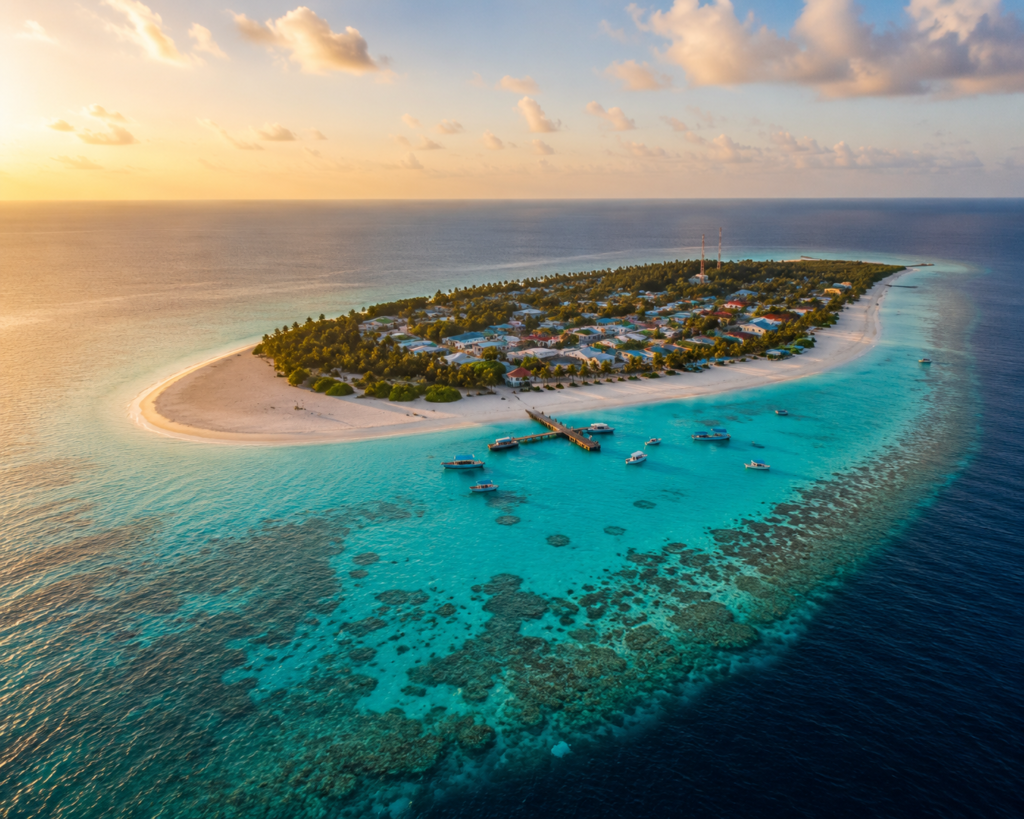
The Maldives on a budget is genuinely possible — and it’s not a compromise version of the destination. Before 2009, tourists could only stay on private resort islands. A single policy change that year allowed guesthouses to open on inhabited local islands, and a second Maldives has grown up since. It now operates over 900 guesthouses across 100+ inhabited islands, offers the same turquoise water and white sand as the resorts, and costs approximately 20% of what a resort stay costs. The trade-offs are real — no alcohol on local islands, modest infrastructure, conservative dress codes outside bikini beaches — but the water is identical, the sunsets are identical, and you are in a real Maldivian community rather than a manicured resort island where you never see a local resident. A 7-day budget Maldives trip costs approximately $500-700 excluding international flights. Here’s how it works.
| Budget Tier | Daily Cost | What It Covers |
|---|---|---|
| Budget (local island) | $75-100/day | Guesthouse with breakfast, local meals, public ferry, 1-2 activities |
| Mid-range (local island) | $100-150/day | Better guesthouse, mix of local and restaurant meals, excursions |
| Hybrid (local + resort) | $150-250/day averaged | 4 nights local island, 3 nights mid-range resort |
| Resort only (mid-range) | $400-800/night | Full resort experience, overwater villa extra |
| Resort only (luxury) | $800-3,000+/night | The classic Maldives postcard experience |
The Two-System Tourism Model: What You Need to Know
The Maldives operates on a two-system tourism model. Understanding it before you book prevents confusion and disappointment.
Resort islands: Private islands where one resort occupies the entire landmass. You fly in, take a seaplane or speedboat transfer ($150-600 per person round trip), and don’t leave until you fly out. Alcohol is available. Bikinis on all beaches. Butler service, overwater villas, and all-inclusive packages are the standard. Beautiful, exclusive, expensive — and genuinely isolated from actual Maldivian life.
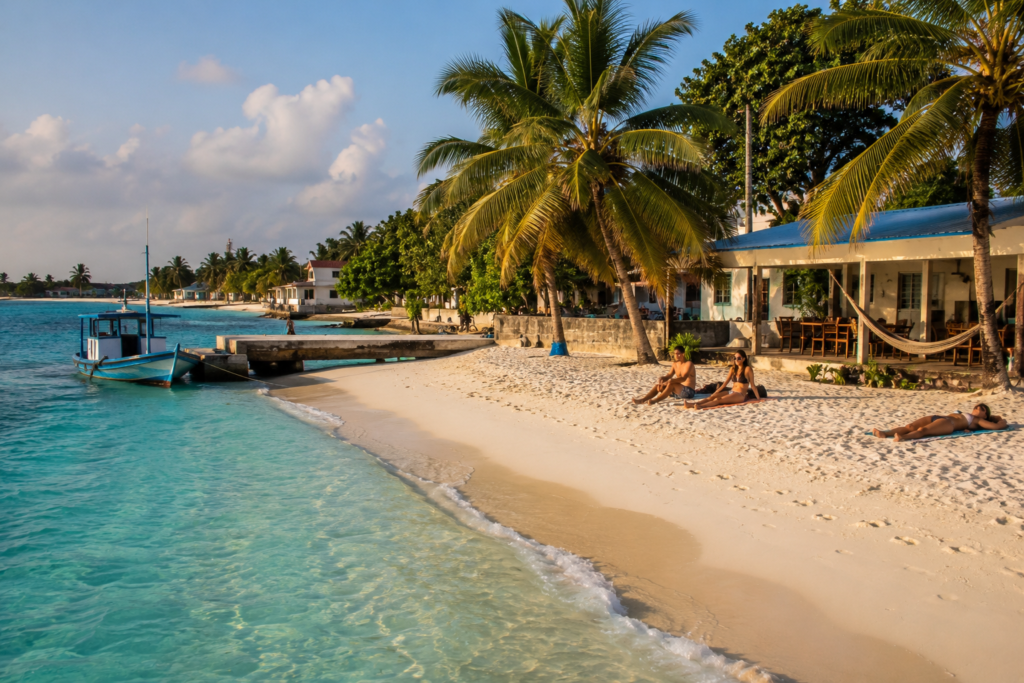
Local islands (inhabited islands): These are permanent homes to Maldivians — typically 500-3,000 residents, a mosque, a school, a football pitch, a fish market, local cafés, and a growing cluster of family-run guesthouses. Guesthouses are legally restricted to a maximum of 50 rooms each. Most are family-run, 8-20 rooms, with air-conditioning, wifi, and access to a designated bikini beach. No alcohol. Conservative dress codes apply outside the designated bikini beach areas. Guesthouses run $50-150 per night.
The key cultural rules on local islands:
- Dress conservatively in the village areas — cover shoulders and knees
- Bikinis and swimwear are permitted only at the designated “bikini beach” (each tourist-receiving local island has one)
- No alcohol is available on local islands — this is non-negotiable
- Respect prayer times — shops and restaurants may close briefly five times daily
- Photography of locals requires permission
These rules are part of what makes the experience real. Those “limitations” are part of what makes the experience genuine — not all local islands are created equal.
The Best Local Islands for Budget Travelers
The original and most popular local island is Maafushi — 30 minutes by public ferry from Malé or 20 minutes by speedboat. Around 80 guesthouses, fully developed tourist infrastructure, bikini beach, multiple floating bars moored offshore, dive schools, and surf schools. Sometimes described as “too touristy” by purists, but the beach is excellent and services are mature. It’s the right choice for first-time local island visitors who want reliable infrastructure.
Thulusdhoo: A 90-minute ferry from Malé. Home to the world-class Cokes and Chickens surf breaks. Grittier and more local than Maafushi. Smaller guesthouse scene but growing. Coca-Cola’s Maldives factory is here. Best for surfers and travelers who want less tourist infrastructure and more authentic local atmosphere.
Ukulhas: Small, authentic, quieter — about 90 minutes by ferry. 700 residents, around 10 guesthouses, good house reef. Often cited as the cleanest local island in the Maldives, having won national awards for waste management. Genuinely beautiful bikini beach and good snorkeling. Best for travelers who want a quieter, more genuinely local experience.
Dhigurah: This island has one of the longest beaches in the Maldives — four kilometers of white sand running down the west side. The sandbar at the southern tip is stunning. And crucially, Dhigurah sits in South Ari Atoll, which means whale shark excursions are excellent year-round. Best for beach lovers and whale shark seekers.
Dharavandhoo (Baa Atoll): Manta rays and access to Hanifaru Bay season — guesthouses on Dharavandhoo run Hanifaru excursions at $70-100 per person, versus the significantly higher resort equivalent. Best for divers and marine life enthusiasts during manta ray season (June-November).
Maafushi avoidance note: Maafushi, once a sleepy little island, is now the victim of uncontrolled development. Hotels were going up left and right, boats were making frequent trips to Malé to pick up tour groups, and there was just one small overcrowded and overbuilt beach. If authentic local island experience is your priority, Thulusdhoo, Ukulhas, or Dhigurah will serve you better.
Accommodation: What Guesthouses Actually Deliver
In 2026, you can expect to find comfortable guesthouse rooms ranging from $50 to $150 USD per night. Some can even be found for as low as $30-40 per night. Many guesthouses include breakfast in their nightly rate, which is a significant saving. Rooms typically come with air conditioning, private bathrooms, and sometimes even a small balcony.
Family-run, clean, breakfast included, and often the owners will help arrange everything — transfers, excursions, dinner reservations. Typical costs: $50-100 USD per night for a double room with AC, private bathroom, and WiFi. What to expect: simple but comfortable — clean tile floors, decent mattress, hot water, reliable WiFi.
Booking tip: Use booking sites to research, then email guesthouses directly. Sometimes you’ll get better rates, and you can ask questions before committing. Booking.com, Expedia, and Hotels.com all list local island guesthouses — compare across platforms before contacting properties directly.
What guesthouses include that resorts don’t: Direct access to real Maldivian daily life. The football pitch at sunset, children playing on the jetty, the local café where you drink the same tea every morning. Faces you recognise at the café, same guy making your coffee every morning, kids playing football near the jetty at sunset — that sort of thing.
Getting There: Ferries vs Speedboats vs Seaplanes
Public ferries: Public ferries run Maldivian inter-island routes at $2-8 per trip. They exist for locals, not tourists, and are slow (2-4 hours to most islands). The cheapest option by far — check schedules on the MTCC (Maldives Transport and Contracting Company) website before arrival.
Speedboats: $20-50 per person for most routes from Malé. Significantly faster than public ferries (20-45 minutes to Maafushi vs 30 minutes on the public ferry). Many guesthouses organize shared speedboats for groups of arriving guests — ask when booking.
Seaplanes: A seaplane transfer to a resort in Baa Atoll can cost upwards of $500 per person. Only necessary for distant atolls and resort islands — not required for local island stays near Malé and Kaafu atoll.
Getting to Malé: Velana International Airport sits on an island adjacent to Malé. A short ferry crossing takes 10-15 minutes to reach the capital ($1-2). Direct flights connect to major hubs including Dubai, Singapore, Kuala Lumpur, and Colombo — look for connections through these hubs rather than expensive direct European flights.
Activities: What They Cost on Local Islands vs Resorts
Guesthouses on local islands offer excursions like snorkeling trips, diving, sandbank visits, and dolphin cruises at a fraction of resort prices. A half-day snorkeling trip to multiple reefs might cost $25-40 per person, including equipment and water.
| Activity | Local Island Price | Resort Price |
|---|---|---|
| Snorkeling trip (half-day) | $25-40 | $50-100 |
| Scuba diving (single dive) | $50-70 | $100-200 |
| Whale shark excursion (South Ari) | $60-80 | $120-200 |
| Manta ray excursion (Baa Atoll) | $70-100 | $150-300 |
| Sandbank visit | $20-35 | $80-150 |
| Dolphin cruise | $25-40 | $60-100 |
| Fishing trip | $30-50 | $80-150 |
The house reef advantage: Many local islands have excellent snorkeling directly from the beach — no boat required, no fee. Bring your own snorkeling gear if possible ($10-15/day rental at guesthouses) to reduce the daily activity cost.
South Ari Atoll is one of the best places on earth to swim with whale sharks. Year-round presence, good chances of sightings. Multiple tour operators run trips from Dhigurah and other South Ari islands.
Food: Eating on Local Islands
Most guesthouses include breakfast — typically fresh fruit, eggs, toast, and tea or coffee. This single inclusion saves $15-25/day compared to paying for breakfast separately.
If you stick to local ferries, guesthouses, and local food (fish, rice, curry), you can get by for under $75 USD a day.
Local food: Maldivian cuisine centers on tuna — mas huni (shredded smoked tuna with coconut and lime for breakfast), rihaakuru (tuna paste), and fresh grilled fish with rice and curry for lunch and dinner. Local cafés on inhabited islands charge $5-10 per meal. This is significantly cheaper than anything available at a resort and genuinely good.
The alcohol consideration: No alcohol is available on local islands. This is the single most significant lifestyle difference from resort travel. Floating bars are moored offshore near some popular local islands (Maafushi) for visitors who want to drink — you take a short boat ride to the bar, which operates in international waters. Budget travelers who drink heavily will find local island travel meaningfully less enjoyable than resort travel.
The Hybrid Trip: The Best of Both
Three or four nights at a guesthouse on a local island (snorkel, culture, value), then three or four nights at a resort (privacy, overwater villa, the “postcard”). Two different Maldives in one week, for 50-60% of what a full resort stay would cost.
This is the approach I’d recommend for most visitors considering the Maldives for the first time. You get the authentic local island experience — the real Maldives that most resort guests never see — and the overwater villa experience that represents what people imagine when they picture the destination. The total cost for a 7-night hybrid trip runs $1,500-2,500 per person excluding flights, compared to $3,000-5,000 for a full resort week at a comparable standard.
How to structure it: Start with 3-4 nights on a local island (Thulusdhoo or Dhigurah for a less-developed experience, Maafushi for better infrastructure) then transfer to a speedboat-accessible resort for the remaining nights. Resorts reachable by speedboat from Malé are often cheaper than those requiring a $500+ seaplane transfer.
When to Go: Seasons and Costs
Visit between May and October for the lowest accommodation and flight prices — off-peak season delivers 30-50% lower costs. The wet season (May-October) brings more rain and wind but the rain is typically short afternoon showers rather than all-day downpours. Diving and snorkeling visibility is actually better on the west side of the atolls during this period.
Peak season (November-April): Best weather, higher prices, advance booking essential for popular local islands. Christmas and New Year period commands the highest rates.
Shoulder/wet season (May-October): Manta ray season at Hanifaru Bay peaks June-November — if diving with mantas is the priority, the wet season is when to go.
For the complete Indian Ocean destination comparison including Zanzibar and Mauritius alternatives, the Zanzibar Budget Travel Guide covers the East Africa alternative in detail.
Essential Internal Resources
These guides on Parandjah Travels cover the related planning layers:
- For the Zanzibar comparison (Indian Ocean alternative): Zanzibar Budget Travel Guide
- For travel insurance covering water activities: Travel Insurance Comparison for Budget Trips
- For the complete trip planning framework: How to Plan a Trip on a Budget
- For finding the best flight search tools: Best Flight Search Tools
- For packing for a tropical beach trip carry-on only: Carry On Only Travel Packing
Master Your Destination: City Budget Guides
Planning to combine a Maldives trip with other Indian Ocean or global destinations? These city guides cover where to stay for less across 24 major hubs:
Americas Budget Hubs
New York · Chicago · Toronto · Mexico City · Buenos Aires · Cape Town
European Budget Hubs
Madrid · Paris · Rome · Dublin · Lisbon · Budapest · Istanbul · Amsterdam · Milan · Berlin
Asia-Pacific Budget Hubs
Bangkok · Tokyo · Singapore · Seoul · Sydney
Frequently Asked Questions
Can you really visit the Maldives on a budget?
Yes — a budget trip staying on local islands can cost around $500-700 for a 7-day trip, excluding international flights. This typically covers guesthouses (often with breakfast), meals, and basic activities. The water is the same turquoise, the marine life is the same, and the experience of staying in a real Maldivian community is genuinely different from and often more memorable than a resort stay.
What is a “bikini beach” in the Maldives?
Each local island that receives tourists has a designated beach area — the “bikini beach” — where international swimwear standards apply. Outside this area and in the village, conservative clothing covering shoulders and knees is required. The bikini beach is typically the island’s best beach and is where you’ll spend most of your swimming and sunbathing time.
Is alcohol available on local islands?
No — local islands are alcohol-free. Some popular islands like Maafushi have floating bars moored in international waters offshore that visitors can access by boat. Resort islands have full alcohol service. If alcohol is important to your holiday experience, a hybrid trip combining local island nights with resort nights is a practical solution.
What is the cheapest way to get between Maldivian islands?
The public ferry network is incredibly cheap (some routes under $5) — research schedules on the MTCC website. Public ferries run slowly (2-4 hours) but cost a fraction of speedboat transfers ($20-50/person) and dramatically less than seaplanes ($300-500+/person). For local islands near Malé and Kaafu atoll, public ferries are the most practical budget option.
Want More Free Travel Resources?
Grab the free 2026 Travel Dupes Cheat Sheet for more budget-friendly alternatives to expensive dream destinations including the Maldives local island strategy. Subscribe at the top of parandjahtravels.com to download it instantly.
Conclusion
The Maldives on a budget works because the policy change in 2009 created an entirely parallel tourism system running alongside the resort world. The second Maldives — 911 guesthouses on 100+ local islands, at 20% of the resort cost — offers the same extraordinary marine environment with a completely different human experience. Stay on Thulusdhoo or Dhigurah for the first-time local island experience, use public ferries for inter-island transport, book excursions directly through your guesthouse, follow the cultural rules with respect, and consider the hybrid trip if the overwater villa experience is on your list. The turquoise water is free. The sunsets are free. The whale sharks are $60-80 from a local island guesthouse.

Marsha Rowe is the Founder and Travel Strategist at Parandjah Travels. She uncovers high-intent travel intelligence, specializing in slow travel frameworks and sports event logistics.