
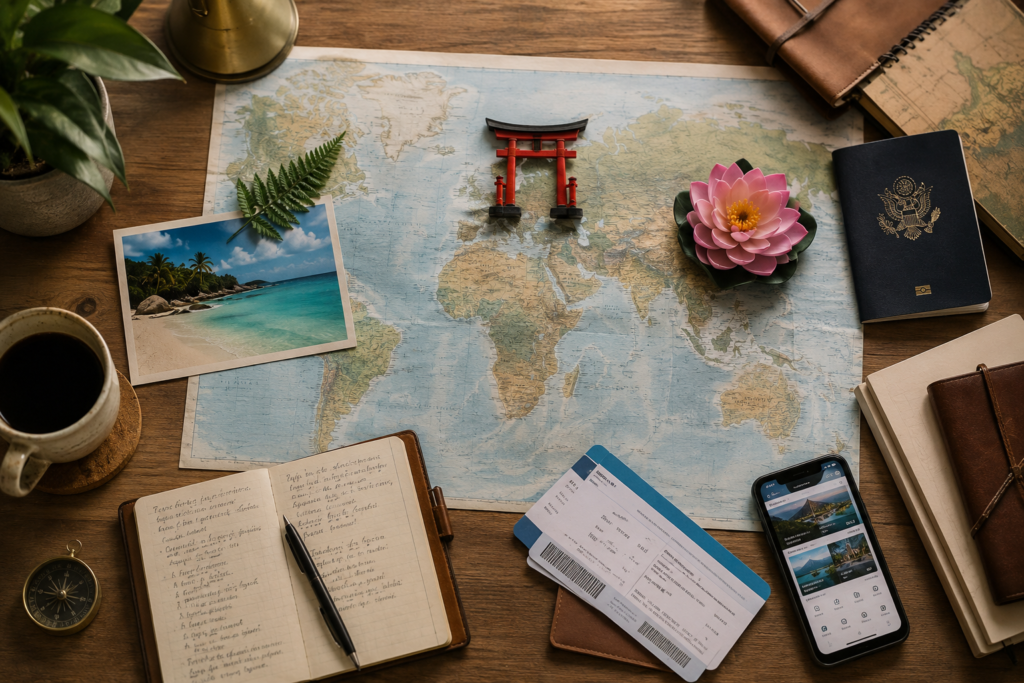
A custom travel planning guide that actually works starts with one question: what is the primary motivation for this trip? Adventure and physical exploration, romantic celebration, independent cultural discovery, or personal reset and wellness — each type of trip has a different optimal structure, different booking sequence, and different pitfalls to avoid. This guide covers four of the most searched destination categories, with practical itinerary frameworks for each one, built for independent travelers rather than tour groups.
Why Building Your Own Itinerary Beats a Package Tour
Pre-packaged group tours treat every traveler the same because they have to — the economics require standardization. Custom planning doesn’t. You control the pace, the accommodation type, the daily rhythm, and the budget allocation. A well-built custom itinerary also adapts to real conditions: a closed trail, a delayed flight, or a destination that turns out to deserve three extra days rather than one.
The practical advantages of planning independently:
- Pace control — you decide how many hours per day are spent moving vs. staying
- Budget allocation — spend more on the experiences that matter to you, less on what doesn’t
- Flexibility — a refundable accommodation booking and a flexible flight fare give you real options if plans shift
- Local spending — independently planned trips more naturally funnel money to local guesthouses, restaurants, and guides rather than to international tour operators
The trade-off is research time. This guide reduces that by giving you the framework for four major trip types — use it as a starting point, not a rigid script.
Adventure Travel: New Zealand
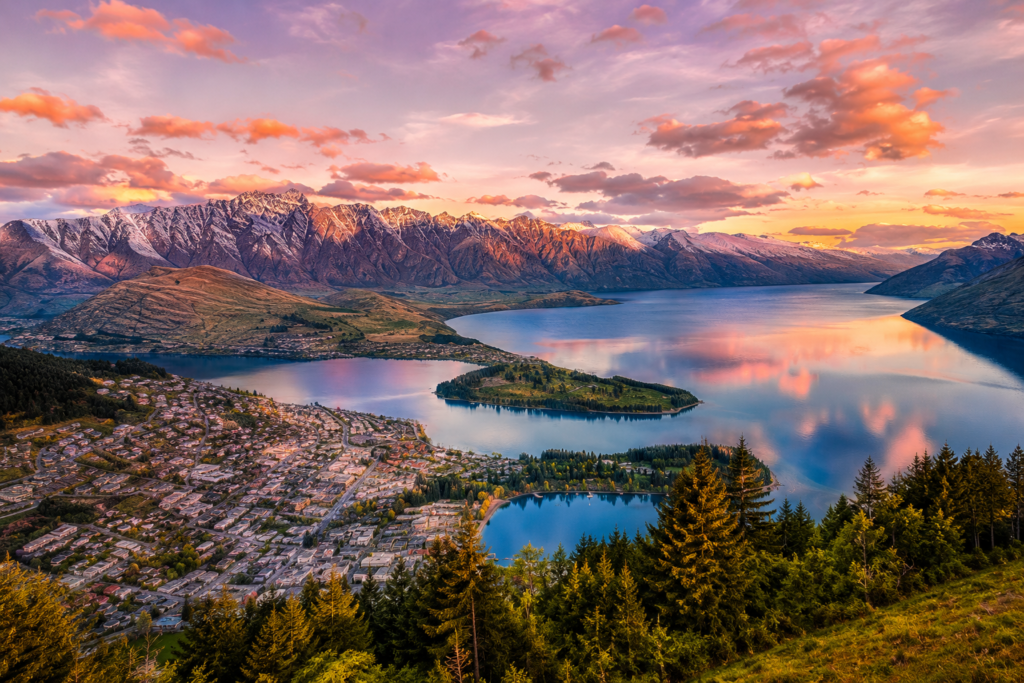
New Zealand is the benchmark destination for adventure travel — a country where you can transition from alpine glaciers to subtropical rainforest in a single afternoon, and where the infrastructure for independent travelers is among the best in the world. The South Island is where most of the dramatic scenery and adventure activity concentrates.
A practical 14-day South Island framework:
- Days 1-3: Queenstown — the adventure hub. Jet boating through the Shotover Canyon, bungee jumping at the Kawarau Bridge, and hiking the Remarkables range are all bookable independently. Queenstown is expensive by New Zealand standards — budget $120-180/day here.
- Days 4-5: West Coast Glaciers — Franz Josef and Fox Glacier. Helicopter heli-hike tours are the main activity ($200-280 per person) and worth the cost. Book 48 hours in advance minimum — weather cancellations are common and you want flexibility to rebook.
- Days 6-9: Fiordland and Milford Sound — one of the world’s great landscapes. The Milford Track is New Zealand’s most famous multi-day hike (4 days, requires booking months in advance for guided or independent hut passes). Day cruises on Milford Sound are accessible without advance booking and deliver most of the visual drama.
- Days 10-14: Christchurch and the Canterbury region — a lower-cost base for the final leg, with good connections back to Auckland for international departures.
Budget note: New Zealand is not a cheap destination. A realistic independent daily budget runs $100-150/day excluding activities. Campervan rental significantly cuts accommodation costs for travelers comfortable with that style, and New Zealand’s freedom camping infrastructure makes it viable.
Booking sequence: Flights first (Auckland or Christchurch entry, opposite exit for open-jaw itinerary), then Milford Track hut passes if you’re doing the Great Walk (these sell out months ahead), then accommodation in Queenstown and Franz Josef, then activities closer to arrival.
Romantic Travel: The Maldives Without the Luxury Price Tag
The Maldives has a reputation as the world’s most expensive honeymoon destination — and at the resort island level, that reputation is accurate. Private island resorts with overwater villas routinely start at $800-1,500 a night. But the Maldives has a parallel economy that most travel guides ignore: the local island guesthouses on inhabited islands that cost $60-120 a night and deliver the same turquoise water, white sand, and marine life at a fraction of the price.
The local island approach:
The most accessible local islands for independent budget travelers are Maafushi, Dhigurah, and Fulidhoo — all reachable by public ferry or speedboat from Malé. Maafushi in particular has a well-developed guesthouse economy with snorkeling, diving, and sandbank excursions bookable directly with local operators.
What you don’t get on local islands: the total privacy of a private resort island, overwater villas, or the white-glove service of a luxury property. What you do get: the same Indian Ocean water, the same marine biodiversity, the same sunsets, and day-trip access to sandbanks and snorkeling reefs — for 10-15% of the cost.
A realistic 7-night Maldives budget on local islands: $60-100/night guesthouse + $30-50/day food + $50-80 for snorkeling and sandbank excursions = roughly $700-1,100 all-in for a week, excluding flights. Compare that to $5,600-10,500 for the same week at a private resort island.
Booking sequence: International flights to Malé first (often routing via Dubai, Singapore, or Colombo). Then guesthouse bookings on your chosen local island — book 4-6 weeks out in peak season (December-April). Then speedboat or ferry transfers from Malé.
Independent Discovery: Solo Japan 2 Weeks
Japan is consistently rated the world’s best destination for solo independent travelers — exceptionally low crime rates, an efficient and comprehensible public transit network, and solo-friendly dining infrastructure (individual counter seats, ramen booths, convenience store culture) make it uniquely suited to going alone.
A practical 14-day independent itinerary:
| Days | Location | Key Experiences |
|---|---|---|
| Days 1-5 | Tokyo | Shibuya Crossing, teamLab digital art, Meiji Jingu Shrine, Shinjuku nightlife, Tsukiji outer market |
| Days 6-7 | Hakone / Mt. Fuji | Traditional ryokan stay, natural onsen, Lake Ashi cruise, Mt. Fuji views (weather permitting) |
| Days 8-11 | Kyoto | Fushimi Inari at dawn, Arashiyama Bamboo Grove, Gion evening walk, Nishiki Market |
| Days 12-14 | Osaka | Dotonbori street food, Osaka Castle, day trip to Nara for the deer park |
The JR Pass question: For a two-week itinerary covering Tokyo-Hakone-Kyoto-Osaka, run the math before buying. The 14-day JR Pass ($480-550) is worth it if you’re doing multiple Shinkansen legs — Tokyo to Kyoto alone is $130 each way, so two legs justify the pass. Add Hiroshima as a day trip from Kyoto and the pass comfortably pays for itself.
Budget: Japan is mid-range to expensive depending on accommodation style. Budget hostels run $25-40/night; capsule hotels $30-50; mid-range business hotels $70-120. Food is genuinely affordable — $10-15/day eating from convenience stores and ramen shops is realistic. Total daily budget: $60-100/day excluding the JR Pass.
Best timing: Spring (late March-early April for cherry blossoms, crowds and premium pricing) or autumn (October-November for fall foliage, same crowd dynamic). Shoulder periods immediately before or after these peaks deliver most of the beauty with notably less competition for accommodation.
Wellness Travel: Yoga Retreats in India
India has been the global center of yoga tradition for millennia — the practice originated here, and the retreats that take it seriously are structurally different from the branded wellness tourism that’s followed it everywhere else. Two distinct regions serve different traveler needs:
Rishikesh, Uttarakhand — the traditional choice. Situated in the Himalayan foothills above the Ganges River, Rishikesh is where most international yoga teacher training programs are based and where the practice is treated as a serious discipline rather than a lifestyle product. Programs run 7-28 days and cover Hatha, Ashtanga, or Iyengar traditions. Prices for a week’s residential program including accommodation and meals run $300-600 at established ashrams — genuinely affordable by international wellness standards.
Kerala, South India — the Ayurvedic alternative. Kerala’s retreat circuit focuses on Ayurvedic medicine alongside yoga — oil therapies, dietary programs, and herbal treatments in a warm tropical setting. Kovalam, Varkala, and the backwaters region around Alleppey are the main bases. A week’s residential Ayurvedic retreat with yoga runs $400-800 at reputable centers.
Practical planning notes:
- Both regions are best visited October-March (post-monsoon, pre-peak-heat)
- Visa: India requires an e-Visa for most Western passport holders — apply online at least 4 days before travel
- Booking: Contact ashrams and retreat centers directly rather than through third-party wellness booking platforms — direct booking is almost always cheaper
- Health: Carry comprehensive travel insurance that covers medical evacuation — not specific to yoga retreats, but essential for any India trip
For the full visa-free entry breakdown for India and surrounding destinations, see the Visa-Free Travel Countries for Long-Term Stays guide.
The Custom Planning Sequence That Works for Any Trip
Regardless of destination type, this sequence consistently produces better results than starting with hotel comparisons:
- Define the primary motivation — adventure, romance, discovery, or wellness. This determines pace, accommodation type, and activity budget allocation.
- Set a realistic total budget — use budgettripai.com to calculate full trip costs by destination before committing to anything non-refundable.
- Book the anchor element first — for Japan, it’s the JR Pass and first Tokyo accommodation. For New Zealand, it’s the Milford Track hut passes. For the Maldives, it’s international flights to Malé. For India retreats, it’s the retreat booking itself.
- Work outward from the anchor — flights, then remaining accommodation, then activities and day trips in the final weeks before departure.
- Build in buffer days — at least one per week of travel. These aren’t wasted days; they absorb delays, extend experiences that turn out to be better than expected, and prevent the exhaustion that turns ambitious itineraries into miserable ones.
For the complete trip planning framework, see the How to Plan a Trip on a Budget guide — it covers the full booking sequence in detail across all destination types.
Essential Internal Resources
These guides on Parandjah Travels cover the related planning layers:
- For the complete trip planning framework: How to Plan a Trip on a Budget
- For timing any of these trips correctly: Best Time to Visit Popular Destinations
- For travel insurance across all four destination types: Travel Insurance Comparison for Budget Trips
- For visa-free entry planning: Visa-Free Travel Countries for Long-Term Stays
- For booking flights to any of these destinations: Travel Hacks for Saving on Flights
Master Your Destination: City Budget Guides
These city guides cover exactly where to stay for less in 24 major hubs — including Tokyo and Seoul as regional reference points for Asian itineraries:
European Budget Hubs
Madrid · Paris · Rome · Dublin · Lisbon · Budapest · Prague · Vienna · Istanbul · Amsterdam · Milan · Barcelona · Berlin
Asia-Pacific and Americas Budget Hubs
Bangkok · Tokyo · Sydney · Toronto · Singapore · Mexico City · Seoul · Buenos Aires · Cape Town · Chicago · New York
Frequently Asked Questions
Is 2 weeks enough time for solo travel in Japan?
Yes — two weeks covers the classic Golden Route (Tokyo, Hakone, Kyoto, Osaka) comfortably with time for day trips to Nara or Hiroshima. The Shinkansen network makes city-to-city travel fast enough that you’re not spending significant time in transit. A 14-day JR Pass covers all Shinkansen travel on this route and typically pays for itself within the first two Shinkansen legs.
Can you visit the Maldives on a budget?
Yes — the local island guesthouse economy on inhabited islands like Maafushi and Dhigurah offers the same Indian Ocean water and marine life at roughly 10-15% of private resort island pricing. A realistic week including guesthouse, food, and snorkeling excursions runs $700-1,100 excluding international flights, compared to $5,600+ at a private resort island.
What’s the best time to visit New Zealand for adventure travel?
December through February (Southern Hemisphere summer) offers the best weather for outdoor activities and Milford Track hiking. The trade-off is peak tourist season and higher prices. October-November and March-April offer shoulder season pricing with still-favorable conditions for most outdoor activities.
How far in advance should I book a yoga retreat in India?
For established ashrams in Rishikesh during peak season (November-February), book 2-3 months in advance. Kerala retreat centers in popular areas like Varkala book out 4-6 weeks ahead during peak winter season. Contact centers directly for the best availability and pricing — third-party wellness booking platforms add a markup.
Want More Free Travel Resources?
Grab the free 2026 Travel Dupes Cheat Sheet for budget-friendly destination ideas to inspire your next custom itinerary. Subscribe at the top of parandjahtravels.com to download it instantly.
Conclusion
Custom travel planning beats package tours on every axis that matters for independent travelers — pace, budget allocation, flexibility, and the ability to spend money where it reaches real people rather than international operators. The framework is the same regardless of destination: define your motivation, set a realistic total budget, book the anchor element first, and build outward. The four destination types covered above — New Zealand, Maldives, Japan, India — each have a different anchor and a different optimal sequence. Start with the right one and the rest of the planning gets significantly easier.

Marsha Rowe is the Founder and Travel Strategist at Parandjah Travels. She uncovers high-intent travel intelligence, specializing in slow travel frameworks and sports event logistics.