
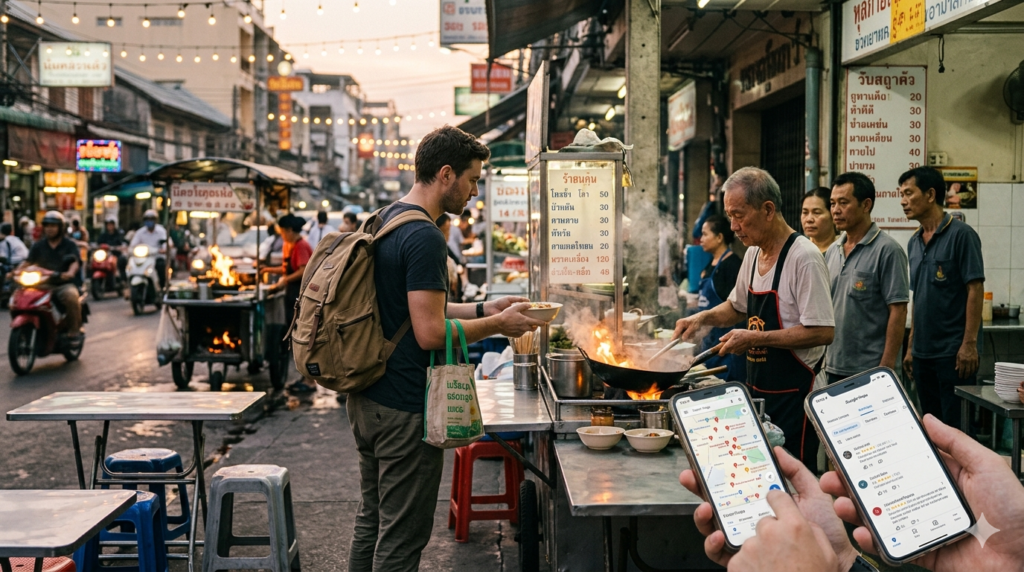
The best food tour alternatives for local eating travel are independent, research-backed culinary frameworks that substitute expensive, slow-moving guided tourist groups for native digital tracking, local neighborhood market anchoring, and raw on-the-ground behavioral observation. While commercial food tours often lock travelers into pre-negotiated, overpriced vendor routes calibrated strictly for foreign wallets, true independent alternatives rely on mapping neighborhood cuisine clusters using local-script search terms, analyzing Google Maps review language ratios, and utilizing language-exchange networks to source recommendations straight from residents who live in the city. For optimal budget efficiency and authentic culinary immersion, travelers should skip structured itineraries completely and construct their own self-guided food maps based on verified local price anchoring.
⚠️Why Commercial Food Itineraries Often Miss the Mark
💸The Proliferation of the Hidden “Tourist-Menu” Problem
To understand why seeking out food tour alternatives for local eating travel is necessary for independent backpackers, one must analyze the economic incentives running behind high-traffic global travel scenes. In prominent culinary destinations like Bangkok or Istanbul, the most visible street-side stalls highlighted on commercial group tours are rarely organic discoveries. Instead, they are highly structured, pre-negotiated financial arrangements hammered out between tour operators and market vendors.
While the food being served remains technically genuine, the portions and price metrics are completely modified for foreign budgets rather than neighborhood regulars. You might find yourself eating a real local plate, but you are absorbing it at three times the standard market rate from a vendor who has dedicated an English-language queue specifically to process your group. Staged authenticity is a highly documented, profit-driven optimization strategy that works directly against the goals of authentic exploration.
🐢The Spatial and Logistical Realities of Guided Groups
A commercial group tour is inherently restricted by the walking pace of its slowest member and the fixed script of the hired guide. You do not get to linger at a fascinating stall, you do not get to wander down a promising alleyway, and you are forbidden from following the aroma of roasting spices down a side street because the schedule requires you to arrive at the next landmark on time. By designing your own routes, these food tour alternatives for local eating travel protect your holiday budget from high vendor markup fees.”
Culinary writers and travel anthropologists agree that the single most reliable sign of an authentic eatery is the composition of its clientele and the complete absence of a translated, laminated English menu. Because commercial operators require stalls that can physically hold a large group and communicate easily in English, the tour format naturally forces you into westernized environments. Shifting to smart food tour alternatives for local eating travel bypasses these institutional filters entirely.
🔍Decoding the Digital Footprint of Local Neighborhood Eaters
The cornerstone of executing highly successful food tour alternatives for local eating travel lies in your pre-trip digital research pipeline. Spending just two hours analyzing regional tracking tools before your flight departs allows you to compile an authentic culinary layout map that no commercial guide could replicate.
               [THE DIGITAL SEARCH PIPELINE]

  Local Script Hashtags ──────► Bypass Algorithm-Optimized English SEO
  Google Review Ratios ───────► Target 80%+ Native Language Comment Tiers
  Image Content Auditing ─────► Prioritize Blurry Table Shots Over Food-Porn
📱Scraping Regional Blogs and Local-Script Social Media Hashtags
To find true culinary gems, you must explicitly search for bloggers who publish text in the destination’s native language, rather than reading articles written by expats tailoring content for English-speaking audiences. Open your browser and search for your destination using the specific pattern [city name] + food + [local language], prioritizing community boards that discuss neighborhood-specific setups over polished “best-of” listicles. These regional writers are not optimizing their sites for international search engines; they are communicating directly with individuals who already live and eat in that environment every single week.
Similarly, social media hashtags must be evaluated using the native script of the destination. Searching for a city name written directly in Thai, Arabic, or Vietnamese pulls up a completely unfiltered repository of local culinary content. These feeds showcase specific stalls, distinct dishes, and true neighborhood price points that standard algorithms completely bury. Bookmarking ten of these precise coordinates forms the base layer of your food tour alternatives for local eating travel framework.
🗺️Leveraging Google Maps as a Language and Review Filter
Google Maps remains one of the most powerful, underutilized authenticity filters available to modern independent travelers. When evaluating a restaurant profile, scroll directly past the highlighted English reviews and audit the actual language distribution ratio of the commentary. If a venue features 800 reviews and 700 of them are written in Vietnamese or Spanish, you have successfully verified that the venue is a neighborhood asset rather than a tourist trap.
Furthermore, check the user photo uploads with a highly critical eye. Commercial, tourist-facing establishments are filled with staged, high-resolution food-porn shots. Genuinely local working-class operations are dominated by blurry, candid phone photos of a messy table, a handwritten bill, or friends sitting across from each other. This visual signal is exactly what you want to target when building out your custom food tour alternatives for local eating travel itineraries.
📊Local Markets: Your Foundational Base Camp for Authentic Meals
If you commit to a single structural shift on your next journey, anchor your very first morning around a working neighborhood market rather than walking into a café recommended by your hotel staff . Initiating local market food shopping while traveling represents the single highest-return move for anyone seeking valid food tour alternatives for local eating travel.
               [NEIGHBORHOOD MARKET CLUSTERING]

  Tourists Targets (High Pricing) ──► Mercado de San Miguel | Tsukiji Outer
  Working Twins (Local Pricing) ────► Mercado de Maravillas  | Ameya-Yokochō
🛒 Navigating the Working Twins of Over-Visited Food Hubs
Famous landmarks like Mercado de San Miguel in Madrid and the Tsukiji Outer Market in Tokyo are textbook examples of historical municipal food spaces that have shifted their operations toward tourist-facing pricing models. Knowing this distinction matters immensely. In almost every major destination, a less-photographed, fully operational public market still serves the working-class community at neighborhood prices within walking distance of the tourist site.
When moving through our comprehensive Madrid budget guide, skip San Miguel and walk straight into the vibrant Mercado de Maravillas. If you are exploring our curated Tokyo budget guide, bypass the primary Tsukiji paths and target the narrow rows of Ameya-Yokochō. Every single tourist-heavy destination marketplace features a working-class twin operating nearby. Isolate these coordinates to keep your food tour alternatives for local eating travel strategy highly disciplined and budget-friendly.
⏰Managing Morning vs. Evening Marketplace Dynamics
Public markets maintain highly distinct transit loops depending entirely on the hour of the day. Morning markets are structured to fuel the active working day, offering fresh agricultural produce, rapid breakfast bites, steaming noodle broths, and robust local coffees. The primary clientele here consists of neighborhood residents heading directly to their jobs. This makes the morning window the best time to locate single-dish specialists and veteran raw produce vendors.
Conversely, evening markets are built to serve the local community’s social hour, shifting their menus toward grilled skewers, cold beverages, and small shared plates. Both environments are incredibly valuable, but they capture entirely different community cross-sections. We consistently find that slow travelers who base themselves in a single neighborhood for a minimum of three days build superior food intelligence compared to fast-moving city-hoppers. They return to the same market stalls, learn which lunch counter hits capacity by noon, and locate the genuine versions of regional dishes at a fraction of the cost.
🛡️Developing the Native-Speaker Connection for Real Leads
The most effective food tour alternatives for local eating travel models utilize direct communication loops with individuals who live and eat in your target city every single week. Bypassing commercial affiliate listicles requires building a warm digital channel directly to native speakers.
                  [THE NATIVE LEAD GENERATION SUITE]

  Expat Community Hubs ───► Target long-term residents via targeted location groups
  Local Subreddits ───────► Post questions in native scripts to bypass SEO roundups
  Language Exchanges ─────► Use weekday lunch icebreakers to map real street coordinates
👥 Extracting Raw Data from Expat Community Groups and Subreddits
Expat Facebook communities in prominent international hubs are packed with long-term foreign residents who have spent years separating real culinary value from over-hyped tourist operations. When posting in these forums, skip generic requests and ask a highly targeted question: “What is a specific working-class market stall or neighborhood lunch counter that is completely missing from English travel blogs?” This specific phrasing yields precise street addresses and vendor coordinates rather than sponsored affiliate links.
Similarly, regional subreddits published in the local language represent an incredible resource. Forums like r/Thailand or r/Korea maintain highly active local communities where questions regarding traditional dishes receive detailed breakdowns from users who grew up eating them. Attempting to post your question using even a basic, translation-assisted version of the local script signals deep cultural respect and consistently triggers much higher-quality, localized responses from the community.
💬Leveraging Language-Exchange Apps and Early-Shift Workers
Modern language-exchange applications like Tandem and HelloTalk host tens of millions of active global users. Creative independent travelers routinely use these platforms not merely for grammar practice, but as a direct channel for sourcing hyper-local culinary recommendations. Asking a digital conversation partner a simple question like, “What specific dish did you eat for lunch on a normal workday this week?” serves as a perfect language icebreaker while securing an authentic food lead.
Once you land on the ground, remember that early-shift hostel workers and neighborhood convenience store owners consistently outperform any digital application. A small shop owner who has managed the same street corner for a decade knows the precise schedule of every mobile food cart within a four-block radius. Purchase a small item from their shop, strike up a conversation, and ask where they personally buy their meals. These simple, human connections are the exact engine driving authentic food tour alternatives for local eating travel.
📋Street Food Literacy: Reading the Visual Signs of Quality
A premier street food stall can be evaluated for safety, freshness, and quality before you purchase a single plate. When operating food tour alternatives for local eating travel, use these four visual indicators to evaluate any street kitchen:
- Clientele Composition Ratios: Look for lines dominated by local residents rather than tourists holding rolling suitcases. A queue featuring ten locals and one confused traveler is a premier quality signal; a stall filled with ten tourists and displaying a translated QR code menu is an avoidance signal. Relying on these intentional food tour alternatives for local eating travel opens up authentic interactions with neighborhood cooks.
- High-Volume Product Turnover: High turnover of cooked items is your absolute best proxy for ingredient freshness. If a vendor is constantly restocking their grill or soup pot right in front of you, the food never has time to sit or spoil.
- The Single-Item Specialization Rule: Master street food vendors specialize because extreme focus yields culinary excellence. A chef who has prepared only one specific type of dumpling or noodle for thirty years is always a safer, superior choice than a multi-page stall attempting to serve twelve different regional items.
- Active, Visible Heat Sources: Avoid any food cart where items have been pre-cooked and are left sitting out at room temperature to be quickly reheated later . Look for an active, roaring flame, visible steam, and a slight wait time that confirms your dish is being prepared fresh to order .
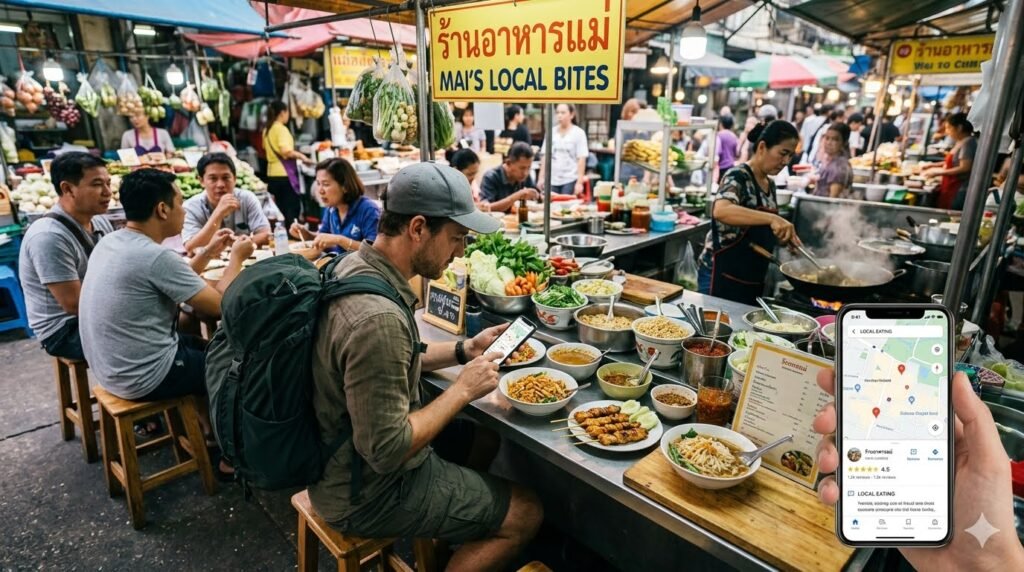
⚠️The Power of Day-One Price Anchoring
The ultimate secret weapon for successfully managing food tour alternatives for local eating travel over an extended trip is establishing a firm price baseline on day one. Within your first few hours on the ground, walk into a non-tourist neighborhood market and buy a simple, everyday item—such as a piece of fresh fruit, a cup of traditional tea, or a single street skewer—and carefully record the exact price paid.
Compare this baseline across multiple vendors. If a high-profile stall charges three times that recorded rate for an identical item, you have immediate, data-backed proof of a tourist-pricing structure. Once you know the exact cost of a bowl of pho in Hanoi’s working-class neighborhoods, your price baseline protects your wallet for the rest of your trip. If you are researching smart, long-term alternatives to Bali for independent travelers, maintaining this strict baseline tracking keeps you safe, as every over-visited travel zone has a real-price economic layer running directly beneath its inflated tourist-price layer.
💳Group Food Tours vs. Standalone DIY Itineraries
Commercial group food tours are highly useful for time-crunched travelers who have less than 48 hours in a city, possess a large travel allowance, and prefer having an English-speaking guide handle all navigation and communication boundaries. For this specific demographic, paying an upfront premium of $80 to $120 for a structured evening walk makes complete logistical sense.
However, a side-by-side comparison reveals that commercial group tours fail slow travelers and budget backpackers because they eat up a massive chunk of your daily allowance, shield you from interacting directly with the local community, and keep you trapped on predictable, algorithm-optimized routes. Shifting to targeted food tour alternatives for local eating travel allows you to eat identical, higher-quality dishes for a fraction of the cost. For instance, by applying this independent framework to a fast-paced Bangkok budget itinerary, your total daily food spend can drop by nearly 70% while opening up genuine, unfiltered community experiences that a loud group tour could never capture.
📊Build Your Own Food Itinerary: The Repeatable DIY System
To safely execute successful food tour alternatives for local eating travel on every upcoming trip, implement this step-by-step framework before your flight touches down :
📄 Step 1: Research Regional Cuisine Clusters
Every major global city features distinct food neighborhoods. Avoid focusing exclusively on the historic “Old Town” core; instead, look for immigrant quarters, industrial workers’ market districts, or old fishing villages that have been absorbed by the expanding city layout. Isolate two or three of these specific coordinates before you depart.
📄 Step 2: Bookmark 5 to 7 Market-Anchored Eating Zones
Utilize the native-script social media hashtag searches and Google Maps review ratio audits detailed above. You do not need to make advanced reservations; you simply need the exact street coordinates and a rough idea of the venue’s daily opening hours.
📄 Step 3: Source 3 Native-Speaker Leads
Secure one specific recommendation from a localized Facebook expat forum, one from a native-language sub reddit thread, and one from an active language-exchange conversation. These three crowd sourced leads will consistently outrank any curated top-ten online listicle.
📄 Step 4: Establish Your Local Price Baseline on Day One
Walk directly into an operational neighborhood market before noon on your first day. Purchase a small, simple street item and record the exact price. Use this number as your core calibration metric to spot tourist inflation for the remainder of your journey.
📄 Step 5: Leave One Meal Per Day Entirely Unplanned
The single best culinary experiences of your life happen when you choose to follow your nose down a narrow alleyway you weren’t originally supposed to explore. Build flexible space directly into your daily travel itinerary.
🏁The Verdict: Matching Your Eating Strategy to Your Destination Cluster
This independent framework is the ultimate anti-bucket-list approach to authentic dining, relying on careful research, flexible execution, and zero tour flags. It delivers incredible results whether you are exploring Latin American hubs, Eurasian paths, or looking for premium luxury travel alternatives to Paris—a city where independent food tracking is exceptionally rewarding given how far the central tourist-facing restaurant scene has drifted from its traditional roots. Use our summary quick-reference optimization matrix below to match your upcoming travel destination to the exact local sourcing strategy required:
📊 Destination Food Tracking Matrix
| Target Destination Style | Primary Digital Tracking Tool | Recommended Market Focus Window | Core Native Sourcing Channel |
|---|---|---|---|
| Mega-Tourist Capitals (Paris, Madrid, Tokyo) | Google Maps review language ratio audits (Isolate 80%+ native scripts) | Early Morning Focus (Target the working-class marketplace twins) | Expat community forums + local neighborhood early-shift hostel workers |
| Street-Food Hubs (Bangkok, Hanoi, Penang) | Native-script social media hashtag scraping + queue tracking | Late Evening Focus (Target active single-item specialized stalls) | Native language-exchange applications + convenience shop owners |
| Slow Travel Regions (Oaxaca, Tbilisi, Chiang Mai) | Regional, native-language food blogs + cuisine cluster mapping | Extended Multi-Day Rotations (Build vendor intelligence over 3+ days) | Local language subreddits + deep market producer interviews |
By pairing a disciplined day-one price baseline with native-script digital searches, you protect both your travel wallet and your digestive system while uncovering the real culinary life of a city. Stop paying high premium markups for loud, crowded group itineraries. Take control of your menu, interact directly with local neighborhood chefs, and build your own highly customized culinary map. Your palate, your travel budget, and your long-term memories will thank you. Using these structured food tour alternatives for local eating travel ensures you experience authentic culinary culture while keeping your vacation expenses disciplined
Mastering these strategic food tour alternatives for local eating travel is the ultimate way to experience true native food cultures on a budget.
To see how these structural culinary principles function on the ground, you can explore our real-time destination assets before booking your next run. Independent travelers can immediately cross-reference local market pricing tiers by checking our active Madrid Guide Matrix or reviewing the street stall scheduling breakdowns inside our Tokyo Guide Matrix. Additionally, you can find low-cost, neighborhood food zone mapping nodes detailed across both our specialized Bangkok Guide Matrix and our comprehensive, slow-travel Paris Guide Matrix data hubs.