
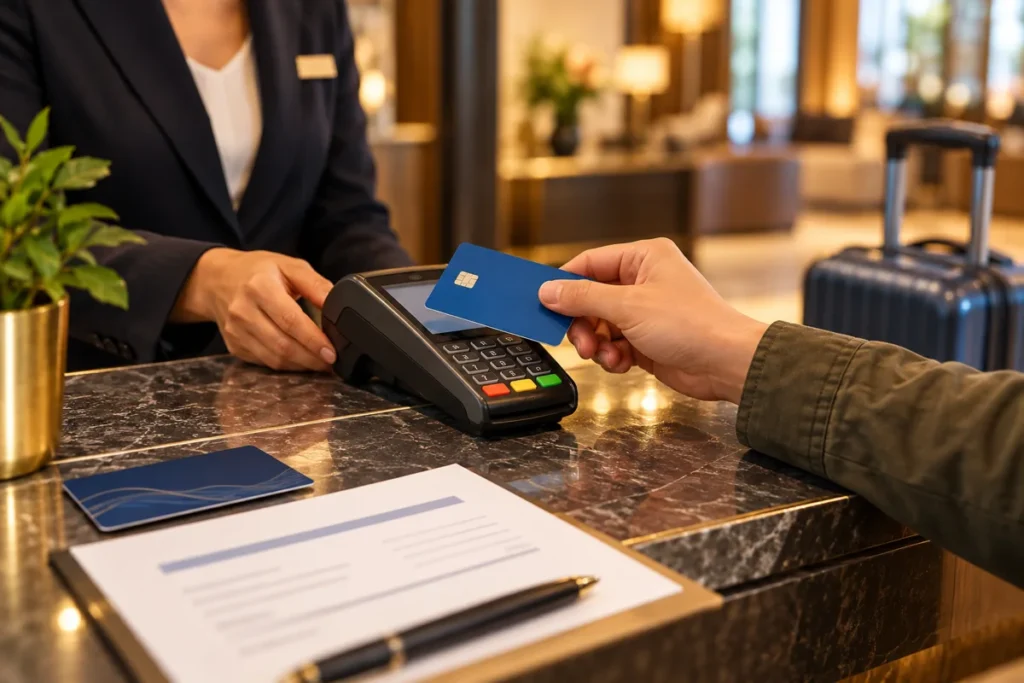
Hotel check-in with a debit card may be possible even when the room is prepaid, but confirm the individual property’s policy before travelling. The card accepted by a booking website does not, by itself, settle which card the hotel requires for incidentals at reception.
Ask the hotel three things: will it accept your particular debit card, how much additional available money is needed, and what happens to that amount after checkout? Getting those answers before a non-refundable booking is more useful than discovering the conditions with your suitcase at the desk.
Quick answer: does a prepaid room remove the deposit?
Not necessarily. Hilton’s official payment FAQs explain that a hotel may authorize a card for incidentals even when the stay has been paid in advance. They also direct guests to the individual hotel for accepted payment methods. Treat that as an example of why a chain-wide booking policy is not a substitute for your property’s check-in terms.
| What you have already done | What still needs checking |
|---|---|
| Paid the room online | Any incidental hold, outstanding tax or mandatory charge |
| Used a debit card to reserve | Whether the same card type is accepted at reception |
| Booked through a third party | What the provider has paid to the hotel and what remains due locally |
| Received a reservation confirmation | Cardholder, identification and arrival requirements |
Hold, deposit and charge: ask which one applies
A temporary authorization reserves an amount against your card; a posted charge is a completed payment. A property may also collect a refundable deposit. These terms are sometimes used loosely in conversation, so ask what will actually appear on your account and what process returns any unused amount.
Chase’s explanation of bank-account holds describes how a merchant’s estimated debit-card authorization can restrict funds even when the eventual spending is lower. For a traveller, the practical issue is available spending money while the hold remains.
Do not label every pending transaction as a duplicate payment. Ask the hotel and issuer to identify whether you are seeing an authorization, final settlement or separate charge. Keep your final bill so the amounts can be compared.
How much available money should you keep?
Get the amount from your hotel, including whether it is calculated per night, per room or per stay. Ask whether a longer stay or additional spending can require a further authorization. There is no reliable universal hotel-deposit amount that fits every property, country and booking.
Hypothetical example: your room is already paid, your available account balance is US$900 and the hotel confirms an additional US$300 authorization. That leaves US$600 available while the hold remains, before other transactions. If you have planned US$650 of remaining travel spending, the plan does not fit that available balance. The US$300 is an invented example, not a standard hotel policy.
Keep spending and temporarily unavailable money in separate columns. If you have several hotels in sequence, ask what happens when the first hold has not cleared before the next check-in. For event trips, add this to the full-stay comparisons in our LA28 accommodation-location guide and Brazil 2027 booking-timing guide.
Questions to ask the hotel before you book
- Do you accept my bank-issued debit card for the incidental authorization at check-in?
- Are foreign-issued debit cards accepted, and must I present the physical card?
- Must the card be in the registered guest’s name, and what identification is required?
- For my dates and room count, what total will be authorized or charged on arrival?
- Which room charges, taxes or fees remain unpaid despite the online prepayment?
- Is the incidental amount a temporary hold or a collected deposit?
- When do you initiate release or refund, and what confirmation can you provide?
- If this card is not accepted, which alternatives can you approve before arrival?
Describe the card type without sending its full number, security code or a photograph. A debit card, prepaid card, virtual card and digital wallet should not be assumed interchangeable for a hotel’s policy. Ask about the form you actually intend to present.
A message you can adapt
Hello, I am considering a stay at your hotel for [dates]. I will use a bank-issued debit card in my name, issued in [country], and the room rate may be prepaid. Please confirm whether this card type is accepted for check-in and incidentals, the total amount required on arrival, whether it is a hold or a charge, and your release or refund process. Please also confirm any identification or physical-card requirements. Thank you.
Use the property’s verified contact channel and save its written reply with your rate conditions. If the answer is unclear, ask the front desk or reservations team to clarify before the cancellation deadline. Our refundable hotel booking guide helps you compare those deadlines.
How long does a hotel hold take to disappear?
Separate the hotel’s action from your issuer making money available again. Hilton says its hold may take longer than 72 hours after checkout to release depending on the card provider. That is not a universal deadline for all hotels or all cards.
As a property-specific example, The Guild Hotel’s official FAQ describes its own authorization amount and a five-to-seven-business-day timeline after settlement. Read your own hotel’s current policy and ask your issuer how it handles that transaction. Do not build a tightly funded itinerary around someone else’s release experience.
If the expected period has passed, contact the hotel with your stay dates, final bill and a masked transaction reference, then ask your issuer what remains pending. Request clarification rather than assuming that another swipe, card change or new payment will automatically remove an old hold.
What if you arrive and the debit card is refused?
Ask which exact requirement is unmet: card type, issuer, guest name, physical-card presentation, available balance or another policy. Show any relevant written confirmation without sharing your PIN or authentication codes. Ask what approved alternative is available and whether your booking provider needs to be involved.
Do not assume a companion’s card, cash or a phone wallet will be accepted. Obtain the hotel’s approval before relying on an alternative. If the room was booked through another provider, keep both the reservation and payment confirmation available so the room payment can be checked separately from the incidental requirement.
Late arrivals add another issue: keeping the room available. Use our hotel check-in after midnight guide to confirm the correct room night and arrival arrangements as well as payment.
A two-hotel example: count overlapping holds
Imagine spending three nights in one city before moving to another. The first hotel releases an unused authorization at checkout, but your issuer has not yet restored the available balance when you reach the next property. If the second hotel requests another hold, the two amounts may affect your usable money at the same time.
Invented figures: a traveller has US$1,000 available before the first hotel places a US$200 hold. At the next check-in, US$200 is still restricted and the second hotel requests US$250. Before any other transactions, the resulting available amount would be US$550 if both holds remain. These are arithmetic inputs, not typical hotel amounts or processing promises.
This is why a room already paid for can still affect the rest of a trip. Ask about both properties’ processes before deciding how much money is available for flights, transport and meals. For Brazil, our World Cup payment guide connects those checks with local spending and backup methods.
What to keep after checkout
Ask for the final itemized bill and confirmation of how any deposit or authorization was handled. Compare the completed charges with the services you used. If a pending amount remains, note the date, currency and masked reference so the hotel and issuer can identify the correct transaction.
Keep the conversation focused on whether an amount is pending, posted or refunded. Do not send a full card image, PIN or authentication code to resolve an ordinary billing query. Use the property’s verified contact route and your issuer’s official support channel.
If the hotel says release has been initiated, ask the issuer what it needs and what timing applies to that transaction. Avoid promising yourself that funds will be usable before another non-refundable purchase. A clear record makes follow-up easier, but it does not create an instant-release guarantee.
Frequently asked questions
Can I check into a hotel using only a debit card?
Some properties allow it, but confirm your exact card type and the incidental requirements directly. Online acceptance is not enough evidence for the reception policy.
Why do I need a card if the room is already paid?
The hotel may need an incidental authorization or payment for amounts outside the prepaid room rate. Ask which amounts remain and how they are handled.
Is an incidental hold money I have spent?
A temporary authorization differs from a posted charge, although it can reduce available funds. Compare your final bill and ask your issuer how the transaction appears.
Can I use a prepaid card or virtual card instead?
Ask the hotel about that specific product before travelling. Do not assume every card carrying a familiar payment-network logo meets its check-in conditions.
Can someone else provide the card?
Only rely on that arrangement after the hotel confirms its requirements and any authorization process. A card used by another person online does not automatically settle what you must present at reception.
Will the hold be released as soon as I check out?
Not necessarily. Ask when the hotel initiates release and how long your issuer may take. A hotel release and an updated available balance can occur at different times.
Can I pay cash to avoid a card hold?
Only if your property explicitly accepts that arrangement. Confirm the deposit, receipt and return process beforehand rather than arriving with cash as an assumed workaround.
What should I check for an international stay?
Confirm foreign-issued card acceptance, the authorization currency, available balance, issuer charges and a practical backup. Our Jamaica cash and card guide applies those payment checks to a destination plan.
Before you leave home
Save the hotel’s written payment answer, check what is prepaid, keep the required available balance separate from planned spending, and bring the approved card and identification. The goal is a clear check-in arrangement, not a surprise payment negotiation after a long journey.

Marsha Rowe is the Founder and Travel Strategist at Parandjah Travels. She uncovers high-intent travel intelligence, specializing in slow travel frameworks and sports event logistics.