
Welcome to The Ultimate Guide to Astro-Tourism 2026, where we explore the world’s most pristine dark sky destinations and the highly anticipated Total Solar Eclipse. As urban light pollution intensifies, a new luxury travel trend has taken over: Astro-tourism. In 2026, travelers are moving away from crowded cities to find “natural darkness.” Whether you are a professional astronomer or a casual stargazer, 2026 is the “Golden Age” of the cosmos, featuring a Total Solar Eclipse and the peak of the Solar Maximum.
Table of Contents
Why Astro-Tourism is Booming in 2026.
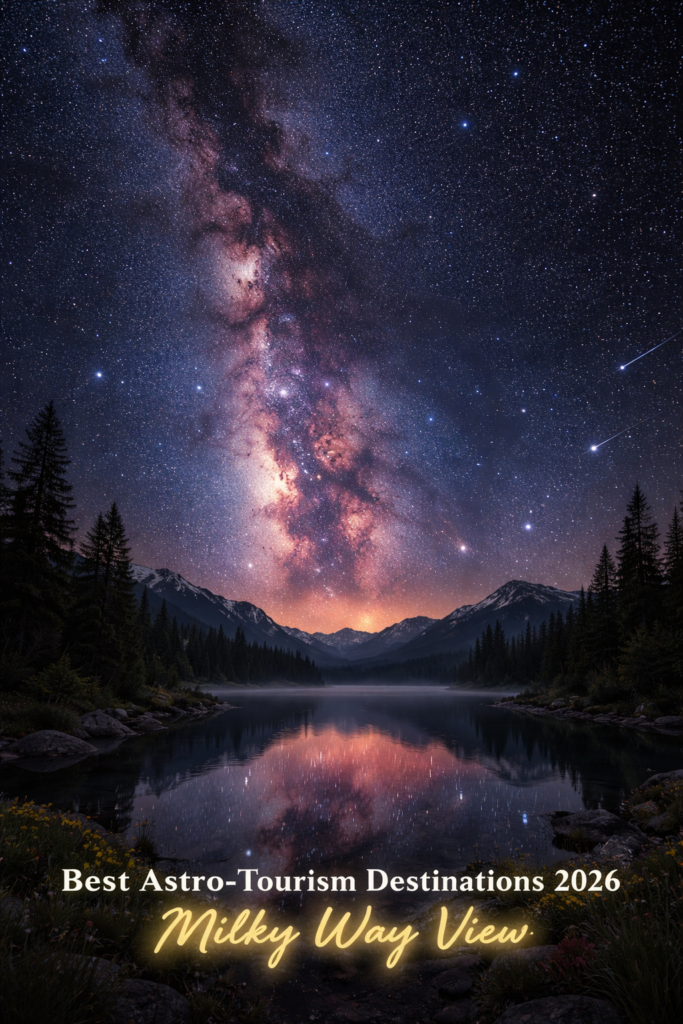
Why Astro-Tourism is Booming in 2026
1. The Solar Maximum Peak
The Sun follows an 11-year cycle, and 2026 marks the Solar Maximum. This means the Northern Lights (Aurora Borealis) will be more frequent, more vibrant, and visible much further south than usual, making it a record year for sightings.
2. The Total Solar Eclipse (August 12, 2026)
This is the most anticipated celestial event of the decade. A total solar eclipse will sweep across Greenland, Iceland, and Northern Spain. The “Path of Totality” is currently the most searched travel route on the web for 2026.
3. Mental Wellness & “Starbathing”
Much like “forest bathing,” starbathing is a recognized wellness practice for 2026. The vastness of the universe helps reduce cortisol levels and provides the “digital detox” that modern travelers crave to escape screen fatigue.
Top 5 Dark Sky Destinations for 2026
- The Atacama Desert, Chile: The world’s clearest window to the stars with 300+ clear nights.
- Teruel and Galicia, Spain: The premier location for the August 2026 Total Eclipse.
- Utah’s Mighty Five, USA: Home to the highest concentration of International Dark Sky Parks.
- Aoraki Mackenzie, New Zealand: The best place on Earth to see the Southern Cross.
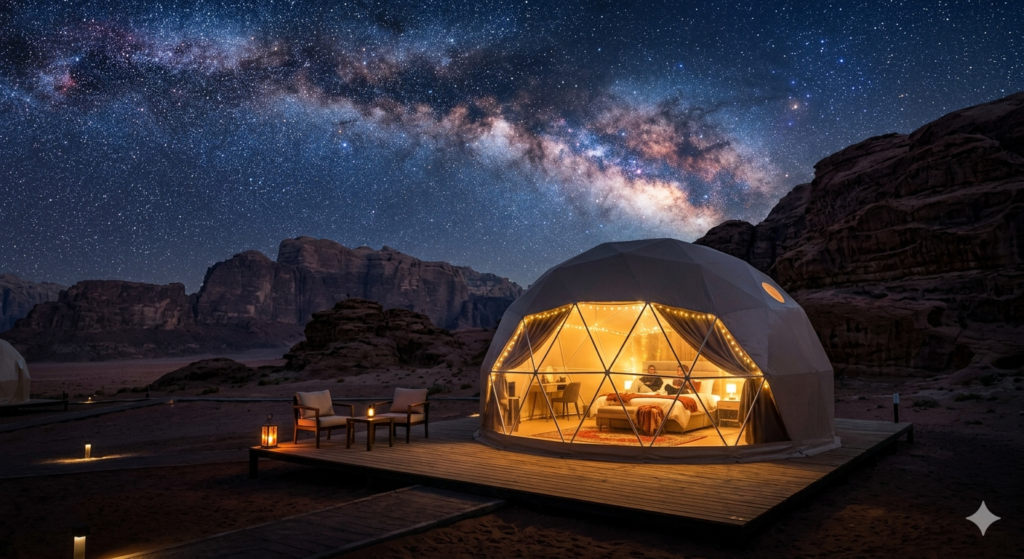
- Wadi Rum, Jordan: Sleep in a “Martian Dome” for an otherworldly celestial experience.
How to Plan Your Perfect Stargazing Trip
To reach the stars, your travel planning must be precise. Here is how to ensure your celestial journey is a success:
1. Check the Lunar Calendar
The “Golden Rule” of astro-tourism: Travel during the New Moon. A full moon acts like a giant streetlamp in the sky, washing out the faint light of distant galaxies. Aim for the window 3 days before or after a New Moon for the darkest skies.
2. Download Essential Astro-Apps
- Stellarium: A mobile planetarium that shows exactly what stars and planets are above you in real-time.
- My Aurora Forecast: Essential for tracking the probability of seeing the Northern Lights during the Solar Maximum.
- PhotoPills: The top choice for photographers wanting to align the Milky Way with specific landscapes or monuments.
3. Pack the “Dark Sky” Essentials
- Red-light Flashlight: Preserves your “night vision.” White light ruins your eyes’ sensitivity to dim stars for up to 20 minutes.
- Binoculars (7×50): Often more effective for beginners than a telescope; perfect for seeing the Moon’s craters and Jupiter’s moons.
- Thermal Gear: Even in the desert or during summer, temperatures plummet at night when you are standing still to observe the heavens.
The Crown Jewel: The Total Solar Eclipse of August 12, 2026
The biggest driver for Astro-tourism 2026 is the total solar eclipse. This will be the first total eclipse visible in Europe in over two decades.
- Top Viewing Spots: Northern Spain (specifically the regions of Galicia, Asturias, and Castile and León) and Iceland (near Reykjavik) will be the primary hubs.
- Booking Hack: Hotels in the “Path of Totality” are already seeing 80% occupancy. Look for boutique rural stays in the Spanish highlands to avoid the coastal crowds.
Dark Sky Parks: Where the Stars Never Fade
Searchers looking for Astro-tourism 2026 want locations with zero light pollution.
Atacama Desert, Chile: Still the global capital for professional and amateur astronomers due to its high altitude and dry air.
Bryce Canyon, Utah: A gold-tier International Dark Sky Park. The “Astronomy Rangers” offer guided telescope tours that are world-renowned.
Aoraki Mackenzie, New Zealand: One of the largest Dark Sky Reserves in the world. In 2026, new luxury “Star-Gazing Pods” are opening with glass ceilings for bed-side viewing.
Essential Gear for Astro-Tourism 2026
You can’t have a guide without a packing list.
- Astrophotography Setup: Mention the importance of a sturdy tripod and “Star-Tracker” mounts for long-exposure shots.
- Smart Telescopes: 2026 is the year of the “unistellar” digital telescope, which automatically identifies constellations via your smartphone.
The Rise of “Hushpitality” in Astro-Tourism 2026
A new term is dominating the luxury travel market: Hushpitality. In the context of Astro-tourism 2026, this means high-end accommodations that prioritize “acoustic and light purity.”
- The Silent Sky Retreats: Resorts in the Namib Desert (Namibia) and the Alqueva region (Portugal) are building “Dark Sky Suites.” These rooms feature retractable roofs and specialized red-light interior systems to ensure your eyes remain adjusted to the dark.
- Sleep Tourism Connection: There is a direct link between the lack of blue light in Dark Sky Parks and the best sleep quality of your life. This makes Astro-tourism 2026 a top choice for those looking for a wellness reset.
The 2026 Celestial Calendar: Don’t Miss These Events
| Date | Event | Best Viewing Location |
|---|---|---|
| August 12, 2026 | Total Solar Eclipse | Northern Spain & Iceland |
| August 12-13, 2026 | Perseids Meteor Shower | Rural Utah & Montana, USA |
| September 2026 | Equinox Aurora Spikes | Lapland, Finland & Norway |
| December 2026 | Geminids Meteor Shower | Canary Islands, Spain |
Northern Lights 2026: The “Solar Maximum” Window
While the Total Solar Eclipse is the headliner, Astro-tourism 2026 is also benefiting from the tail end of the “Solar Maximum.” This is the period of highest solar activity in the sun’s 11-year cycle, resulting in more frequent and intense Aurora Borealis.
The Southern Lights (Aurora Australis): For a truly unique experience, head to Stewart Island, New Zealand. It is one of the few places in the world where you can see the southern version of the lights with virtually no light pollution.
The Nordic Circuit: Destinations like Tromsø, Norway and Abisko, Sweden are seeing record bookings. In 2026, the trend is “Aurora Glamping,” where you stay in heated glass igloos designed for 360-degree views of the lights.
The “Astro-Photography” Toolkit for Beginners
- Long Exposure Basics: Teach them about the “Rule of 500” to avoid star trails.
- The Rise of AI-Editing: Mention how apps like Starry Landscape Stacker are becoming essential for the 2026 traveler.
- Low-Light Gear: Suggest investing in a “Fast Lens” (f/2.8 or wider) to maximize the amount of light hitting the sensor in Dark Sky Parks.
Cultural Astronomy: The Ancient Connection
o provide deep value, connect Astro-tourism 2026 to history.
- Chaco Canyon, New Mexico: This is an “International Dark Sky Park” that was also the center of ancestral Puebloan culture. The buildings are aligned with solar and lunar cycles, making it a perfect spot for “Archaeoastronomy.”
- Stonehenge, UK: While crowded, the summer solstice at Stonehenge remains a bucket-list event for those interested in how our ancestors viewed the heavens.
Indigenous Stargazing: A Cultural Pillar of Astro-Tourism 2026
Beyond the science of the stars, Astro-tourism 2026 is witnessing a massive shift toward “Cultural Astronomy.” Travelers are no longer content with just a telescope; they want to understand the stories and navigation techniques used by ancient cultures for millennia.
The Songlines of Australia
In the Australian Outback, Indigenous guides are leading Astro-tourism 2026 tours that explain the “Emu in the Sky”—a constellation made of the dark dust lanes of the Milky Way. Unlike Western astronomy, which looks at the stars, many Indigenous cultures look at the spaces between them. This provides a profound shift in perspective for modern travelers.
Mayan Alignments in the Yucatán
In Mexico, the 2026 travel season is highlighting the “Zenith Passage” at sites like Chichén Itzá. These experiences allow travelers to witness how ancient architects aligned massive stone pyramids with the sun’s highest point, proving that Astro-tourism 2026 is a continuation of a human obsession that is thousands of years old.
Citizen Science: Contributing to Discovery During Your Trip
One of the most rewarding aspects of Astro-tourism 2026 is the opportunity to contribute to real scientific research. Travelers are becoming “Citizen Scientists,” using their vacations to help professional astronomers map the heavens.
Meteor Spotting: During major events like the Perseids Meteor Shower, tourists are being recruited to record the frequency and brightness of “fireballs,” providing critical data for tracking space debris and near-earth objects.
Light Pollution Monitoring: Using apps like Loss of the Night, travelers in Dark Sky Parks can record local visibility data. This helps global organizations track the spread of light pollution and protect our pristine night skies.
Astro-Tourism 2026 for Families: Inspiring the Next Generation
Families are a major driver of the 2026 travel market. Parents are trading theme parks for “Star Parties,” recognizing that a night under the Milky Way can spark a lifelong interest in STEM (Science, Technology, Engineering, and Math).
Space-Themed Accommodations
From “Martian Dome” stays in the Utah desert to “Astronaut Training Camps” at the Kennedy Space Center, the options for family-centric Astro-tourism 2026 have never been more diverse. These stays often include kid-friendly telescope workshops and “Moon-Walking” VR experiences.
The “Star-Ranger” Programs
US National Parks like Joshua Tree and Great Basin have expanded their Junior Ranger programs to include specialized “Night Sky” badges. These programs teach children about nocturnal wildlife and the importance of preserving natural darkness, making Astro-tourism 2026 an educational and environmental lesson all in one.
The Future of Stargazing Tech: Wearables and Satellites
As we look toward 2027 and beyond, the technology used in Astro-tourism 2026 is becoming “invisible” and more integrated into the travel experience.
- AR Stargazing Glasses: The latest Augmented Reality glasses can now overlay constellation lines and planet names directly onto your field of vision in real-time. This eliminates the need to look down at a phone screen, keeping your eyes “dark-adapted” for the best possible view.
- The Satellite Dilemma: A major topic in Astro-tourism 2026 is the impact of satellite mega-constellations (like Starlink). While they provide the internet needed for remote travel, they also create “streaks” in long-exposure photography. The 2026 traveler is learning to use “Star-Removal” AI software to keep their photos of the cosmos pristine.
Planning Your Astro-Tourism 2026 Budget
To help you plan, here is a breakdown of the typical costs associated with a high-end stargazing escape:
- Luxury Dark Sky Lodge: $450 – $900 per night (Includes guided tours and equipment).
- Professional Photography Workshops: $1,200 – $2,500 (3-5 day intensive courses).
- Guided Telescope Tours: $50 – $150 per person.
- Special Event Access (Eclipse Viewing): $200 – $500 (Premium viewing sites with expert commentary).
The Psychology of the Night Sky: Why Astro-tourism 2026 is Rising
There is a profound psychological reason why Astro-tourism 2026 has become a multi-billion dollar industry. Psychologists refer to the feeling we get under a star-filled sky as “Awe.” This emotion has been scientifically proven to reduce stress, increase feelings of compassion, and help people put their daily problems into perspective.
- The Overview Effect on Earth: You don’t need to go to space to feel what astronauts feel. Standing in a Dark Sky Park during an Astro-tourism 2026 retreat provides a “grounded” version of the Overview Effect—the realization that we are all part of a small, fragile planet in a vast universe.
- Cosmic Humility: In an age of digital noise and ego-driven social media, the silence and scale of the cosmos offer a rare form of “mental hygiene.” This is why many Astro-tourism 2026 packages now include “Silent Stargazing” sessions designed for total sensory deprivation.
Smartphone Astrophotography: Capturing Astro-tourism 2026 for the “Everyday” Traveler
You no longer need a $5,000 DSLR camera to capture the beauty of the cosmos. One of the most searched “how-to” topics for Astro-tourism 2026 is how to take star photos with a modern smartphone.
The “Night Mode” Revolution
Phones like the iPhone 15/16 Pro and the Google Pixel 8/9 have revolutionized Astro-tourism 2026. Their “Night Sight” and “Astro” modes use computational photography to stack multiple long exposures into one sharp image.
The Pro-Raw Advantage: If your phone supports it, shoot in “RAW” mode. This allows you to edit the “Dark Sky” levels later in apps like Lightroom, bringing out the vibrant purples and blues of the Milky Way.
Stability is Everything: Even with the best phone, you cannot hold it by hand for a 30-second exposure. The #1 item for your Astro-tourism 2026 packing list should be a compact smartphone tripod.
Use the Timer: Touching the screen to take a photo causes a tiny vibration. Use a 3-second delay timer so the phone is perfectly still when the shutter opens.
Emerging Hubs: Astro-tourism 2026 in the Middle East
The Middle East is rapidly becoming a global leader in the Astro-tourism 2026 sector, specifically through massive “Giga-projects” in Saudi Arabia.
AlUla, Saudi Arabia: With its ancient rock formations and zero light pollution, AlUla is hosting “Stargazing and Dine” events that combine gourmet local cuisine with high-powered telescope viewing. It is a prime example of how Astro-tourism 2026 is blending luxury with heritage.
The Red Sea Project: This development is aiming to be the world’s largest “Dark Sky Certified” resort. They have implemented strict lighting ordinances across thousands of square kilometers to ensure that Astro-tourism 2026 visitors see the stars exactly as the ancient Bedouin navigators did.